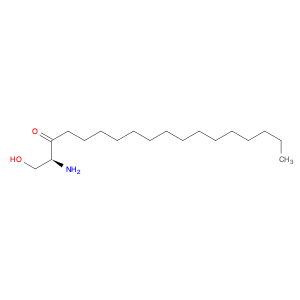
CAS 18944-28-0
:3-CETO-DIHIDROESFINGOSINA HCL
Descripción:
3-Ceto-dihidrosfingosina hidrocloruro, con el número CAS 18944-28-0, es un metabolito de esfingolípidos que juega un papel significativo en la señalización celular y la estructura de la membrana. Este compuesto presenta una cadena larga de alcohol amino, característica de los esfingolípidos, y contiene un grupo ceto en la tercera posición de carbono, lo que lo distingue de otras bases esfingoides. Como sal de hidrocloruro, es típicamente más soluble en agua, facilitando su uso en estudios biológicos y bioquímicos. La sustancia se utiliza a menudo en investigaciones relacionadas con la biología celular, particularmente en estudios que investigan el metabolismo de esfingolípidos, la apoptosis y las respuestas al estrés celular. Sus propiedades estructurales le permiten interactuar con varios componentes celulares, influyendo en las vías de señalización y las funciones celulares. Además, la 3-ceto-dihidrosfingosina puede servir como precursor para la síntesis de esfingolípidos más complejos, destacando su importancia en la bioquímica de lípidos. Se deben observar precauciones de seguridad y manejo, como con todas las sustancias químicas, particularmente en entornos de laboratorio.
Fórmula:C18H37NO2
InChI:InChI=1S/C18H37NO2/c1-2-3-4-5-6-7-8-9-10-11-12-13-14-15-18(21)17(19)16-20/h17,20H,2-16,19H2,1H3/t17-/m0/s1
Clave InChI:KBUNOSOGGAARKZ-KRWDZBQOSA-N
SMILES:CCCCCCCCCCCCCCCC(=O)[C@H](CO)N
Sinónimos:- 3-Keto-Sphinganine Hydrochloride
- 3-Keto-Dihydrosphingosine Hydrochloride
Filtrar por
Porcentaje de pureza
0
100
|
0
|
50
|
90
|
95
|
100
Se han encontrado 8 productos.
- Precio más bajo
- Precio más alto
- Pureza más baja
- Pureza más alta
- Entrega estimada más rápida
(2S)-2-Amino-1-hydroxyoctadecan-3-one
CAS:(2S)-2-Amino-1-hydroxyoctadecan-3-oneFórmula:C18H37NO2Pureza:98%Peso molecular:299.49(2S)-2-Amino-1-hydroxyoctadecan-3-one
CAS:(2S)-2-Amino-1-hydroxyoctadecan-3-one is a key intermediate in the sphingolipid biosynthetic pathway. It is formed by the decarboxylation and condensation of L-serine and palmytyl-CoA, catalyzed by serine palmytyltransferase (SPT), It is commonly used in research on sphingolipid metabolism and related biological mechanisms.Fórmula:C18H37NO2Peso molecular:299.493-Ketodihydrosphingosine
CAS:Producto controladoApplications 3-Ketodihydrosphingosine is derived from N-Boc-L-Serine (B667355), which is an N-Boc-protected form of L-Serine (S270975). L-Serine is a non-essential amino acid that is required for the synthesis of sphinogolipids and phosphatidylserine, compounds that are important for central nervous system neuronal survival. L-Serine is also important in intermediary metabolism in eukaryotic cells.
References de Koning, T., et al.: Biochem. J., 371, 653 (2003); Furuya, S.: Asia Pac. J. Clin. Nutr., 17, 312 (2008); Hirabayashi, Y. & Furuya, S.: Prog. Lipid. Res., 47, 188 (2008)Fórmula:C18H37NO2Forma y color:NeatPeso molecular:299.493-Ketodihydrosphingosine-d13
CAS:Producto controladoFórmula:C18D13H24NO2Forma y color:NeatPeso molecular:312.5723-Keto-dihydrosphingosine
CAS:3-Keto-dihydrosphingosine is a metabolite of sphingolipids, which are long chain fatty acids that are found in cell membranes. It is also an active form of the enzyme serine palmitoyltransferase, which catalyzes the final step of sphingolipid synthesis. 3-Keto-dihydrosphingosine has been shown to have antimicrobial activity against Gram-positive bacteria and fungi. The optimum concentration for this compound is at 10 mM, and it inhibits the growth of bacteria by inhibiting enzyme activities involved in the biosynthesis of lipids and proteins. 3-Keto-dihydrosphingosine may be used as an important substrate for drug development to treat infectious diseases such as tuberculosis or leprosy.Fórmula:C18H37NO2Pureza:Min. 95%Forma y color:PowderPeso molecular:299.5 g/molRef: 3D-TAA94428
Producto descatalogado