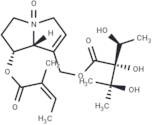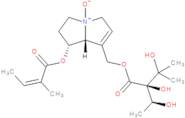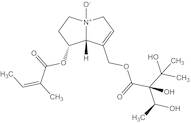
CAS 41093-89-4
:Fórmula:C20H31NO8
InChI:InChI=1S/C20H31NO8/c1-6-12(2)17(23)29-15-8-10-21(27)9-7-14(16(15)21)11-28-18(24)20(26,13(3)22)19(4,5)25/h6-7,13,15-16,22,25-26H,8-11H2,1-5H3/b12-6-/t13-,15+,16+,20-,21?/m0/s1
Clave InChI:KDJGEXAPDZNXSD-KCFAIRMISA-N
SMILES:C/C=C(/C)\C(=O)O[C@@H]1CC[N+]2([C@@H]1C(=CC2)COC(=O)[C@@]([C@H](C)O)(C(C)(C)O)O)[O-]
Filtrar por
Porcentaje de pureza
0
100
|
0
|
50
|
90
|
95
|
100
Se han encontrado 12 productos.
- Precio más bajo
- Precio más alto
- Pureza más baja
- Pureza más alta
- Entrega estimada más rápida
Echimidine N-oxide
CAS:Echimidine N-oxide, a pyrrolizidine alkaloid, exhibits significant inhibitory activity against acetylcholinesterase (AChE) with an IC50 value of 0.347 mM.Fórmula:C20H31NO8Forma y color:SolidPeso molecular:413.462Echimidine N-oxide (Standard)
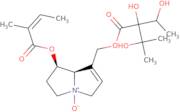
CAS:Echimidine N-oxide (Standard) is a reference standard for research and analysis in studies involving Echimidine N-oxide. Echimidine N-oxide, a pyrrolizidine alkaloid, exhibits significant inhibitory activity against acetylcholinesterase (AChE) with an IC50 value of 0.347 mM.Fórmula:C20H31NO8Peso molecular:413.462Echimidine-N-oxide 100 µg/mL in Water
CAS:Producto controladoFórmula:C20H31NO8Forma y color:Single SolutionPeso molecular:413.46Echimidine N-oxide
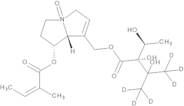
CAS:Natural alkaloidFórmula:C20H31NO8Pureza:≥ 95.0 % (HPLC)Forma y color:PowderPeso molecular:413.46Echimidine N-Oxide-D6
CAS:Producto controladoApplications (+)-Echimidine N-Oxide-D3 is a labelled analogue of (+)-Echimidine N-Oxide (E325585), a hepatotoxic pyrolizidine alkaloid that is present in honey, pollen, and comfrey tea leaves.
References Cao, Y., et al.: J. Food Comp. Anal., 29, 106 (2013); Hirono, I., et al.: J. Nat. Cancer Inst., 63, 469 (1979); Oberlies, N., et al.: Pub. Health Nut., 7, 919 (2004)Fórmula:C20D6H25NO8Forma y color:NeatPeso molecular:416.481Echimidine N-oxide
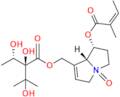
CAS:Echimidine N-oxide is a natural alkaloid derivative, which is isolated from certain plant species in the Boraginaceae family. It acts as a precursor in the biosynthetic pathway of pyrrolizidine alkaloids. The mode of action involves metabolic conversion within the organism, leading to potential bioactive effects. This compound is primarily used in scientific research to explore its pharmacological properties, particularly its role in influencing various biological pathways. Its applications extend to the study of natural product biosynthesis and investigations into its potential therapeutic benefits, as well as toxicological studies due to its structural relationship to other bioactive alkaloids.Fórmula:C20H31NO8Pureza:Min. 95%Forma y color:PowderPeso molecular:413.46 g/mol