CAS 480-81-9
:Senecifilina
Descripción:
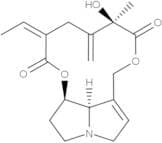
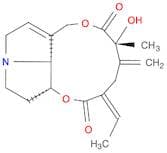
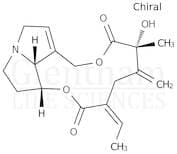
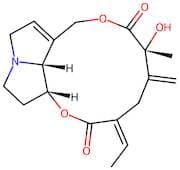
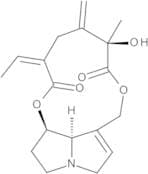
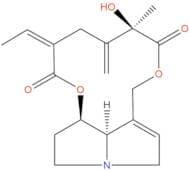
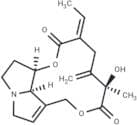
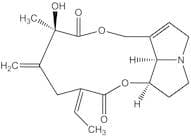
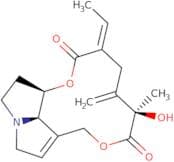
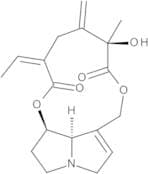
Senecifilina es un alcaloide derivado de plantas del género Senecio, conocido particularmente por su presencia en ciertas especies de la familia Asteraceae. Se caracteriza por su compleja estructura bicíclica, que incluye un anillo de pirrolidina. Senecifilina exhibe propiedades hepatotóxicas, principalmente debido a su capacidad para formar metabolitos reactivos que pueden dañar las células del hígado. Este compuesto ha despertado interés en la investigación farmacológica debido a sus posibles efectos en varios sistemas biológicos, incluyendo su papel en la medicina tradicional. Sin embargo, su toxicidad plantea preocupaciones sobre la seguridad y el uso terapéutico. Senecifilina se estudia típicamente en el contexto de sus efectos en la función hepática y sus posibles implicaciones en toxicología. Al igual que muchos alcaloides derivados de plantas, los procesos de extracción y purificación son críticos para obtener este compuesto en un entorno de laboratorio, y su manipulación requiere precaución debido a su naturaleza tóxica. En general, aunque Senecifilina puede tener actividades biológicas interesantes, su perfil de seguridad requiere una cuidadosa consideración en cualquier aplicación.
Fórmula:C18H23NO5
InChI:InChI=1S/C18H23NO5/c1-4-12-9-11(2)18(3,22)17(21)23-10-13-5-7-19-8-6-14(15(13)19)24-16(12)20/h4-5,14-15,22H,2,6-10H2,1,3H3/b12-4-/t14-,15-,18-/m1/s1
Clave InChI:InChIKey=FCEVNJIUIMLVML-QPSVUOIXSA-N
SMILES:O=C/1O[C@]2([C@@]3(N(CC2)CC=C3COC(=O)[C@](C)(O)C(=C)C\C1=C\C)[H])[H]
Sinónimos:- (1,6)Dioxacyclododecino(2,3,4-gh)pyrrolizine-2,7-dione, 3-ethylidene-3,4,5,6,9,11,13,14,14a,14b-decahydro-6-hydroxy-6-methyl-5-methylene-, (3Z,6R,14aR,14bR)-
- (15Z)-12-hydroxy-13,19-didehydrosenecionan-11,16-dione
- (3Z,6R,14aR,14bR)-3-Ethylidene-3,4,5,6,9,11,13,14,14a,14b-decahydro-6-hydroxy-6-methyl-5-methylene[1,6]dioxacyclododecino[2,3,4-gh]pyrrolizine-2,7-dione
- 13,19-Didehydro-12-hydroxysenecionan-11,16-dione
- Ccris 4336
- Hsdb 5188
- Jacodine
- Nci-C61165
- Nsc 30622
- Senecionan-11,16-dione, 13,19-didehydro-12-hydroxy-
- Seneciophylline
- Seneciphyllin
- Seniciphylline
- [1,6]Dioxacyclododecino[2,3,4-gh]pyrrolizine-2,7-dione, 3-ethylidene-3,4,5,6,9,11,13,14,14a,14b-decahydro-6-hydroxy-6-methyl-5-methylene-, [6R-(3Z,6R*,14aR*,14bR*)]-
- trans-15-Ethylidene-12beta-hydroxy-12alpha-methyl-13-methylenesenec-1-enine
- α-Longilobine
- Ver más sinónimos
Ordenar por
Pureza (%)
0
100
|
0
|
50
|
90
|
95
|
100
Encontrado 13 productos.
Seneciphylline
CAS:Seneciphylline analytical standard provided with chromatographic purity, to be used as reference material for qualitative determination.Fórmula:C18H23NO5Pureza:(GC) ≥90%Forma y color:PowderPeso molecular:333.39(3Z,6R,14aR,14bR)-3-Ethylidene-3,4,5,6,9,11,13,14,14a,14b-decahydro-6-hydroxy-6-methyl-5-methylene[1,6]dioxacyclododecino[2,3,4-gh]pyrrolizine-2,7-dione
CAS:Fórmula:C18H23NO5Pureza:99%Forma y color:SolidPeso molecular:333.3789Seneciphylline
CAS:Seneciphylline, one of the hepatotoxic pyrolizidine alkaloids, has mutagenic activity in Drosophila and their transfer into rat milk.Seneciphylline can significantly increased the activities of epoxide hydrase and glutathione-S-transferase but cause reduction of cytochrome P-450 and related monooxygenase activities.Fórmula:C18H23NO5Pureza:95%~99%Peso molecular:333.384Seneciphylline
CAS:Seneciphylline: hepatotoxic, mutagenic in Drosophila, passes into rat milk, affects key enzymes in rats.Fórmula:C18H23NO5Pureza:99.53% - 99.84%Forma y color:White PowderPeso molecular:333.38Seneciphylline
CAS:Natural alkaloidFórmula:C18H23NO5Pureza:≥ 98.0 % (HPLC)Forma y color:PowderPeso molecular:333.39Seneciphylline
CAS:Seneciphylline is a pyrrolizidine alkaloid, which is a naturally occurring compound derived from plants of the Senecio genus. This compound is primarily found in various species within this genus, which are known for their toxic properties. Seneciphylline exerts its effects through the formation of metabolites that bind to cellular macromolecules, leading to the disruption of normal cell function and cell death. These toxic metabolites are primarily formed in the liver, where they can cause significant damage to liver cells.
Fórmula:C18H23NO5Pureza:Min. 95%Forma y color:PowderPeso molecular:333.38 g/molSeneciphylline 100 µg/mL in Water
CAS:Producto controladoFórmula:C18H23NO5Forma y color:Single SolutionPeso molecular:333.38