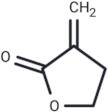
CAS 547-65-9
:Tulipalin A
Descripción:
Tulipalin A, con el número CAS 547-65-9, es un compuesto químico que ocurre de forma natural y se clasifica como un lactona sesquiterpénica. Se deriva principalmente de varias especies del género Tulipa, particularmente de los tulipanes. Este compuesto se caracteriza por su estructura distintiva, que incluye un anillo de lactona y múltiples dobles enlaces, lo que contribuye a su reactividad y actividad biológica. Tulipalin A es conocido por sus potenciales propiedades medicinales, incluyendo efectos antiinflamatorios y antimicrobianos, aunque se necesita más investigación para comprender completamente sus mecanismos y aplicaciones. Además, exhibe un olor característico, que se puede atribuir a su naturaleza volátil. Debido a su actividad biológica, Tulipalin A ha despertado interés en los campos de la farmacología y la química de productos naturales. Sin embargo, es importante señalar que la exposición a Tulipalin A puede causar reacciones alérgicas en algunas personas, particularmente en aquellas sensibles al polen de tulipán o compuestos relacionados. Al igual que muchos productos naturales, el estudio de Tulipalin A continúa evolucionando, revelando su importancia tanto en contextos ecológicos como terapéuticos.
Fórmula:C5H6O2
InChI:InChI=1S/C5H6O2/c1-4-2-3-7-5(4)6/h1-3H2
Clave InChI:InChIKey=GSLDEZOOOSBFGP-UHFFFAOYSA-N
SMILES:C=C1C(=O)OCC1
Sinónimos:- 2(3H)-Furanone, dihydro-3-methylene-
- 2-Methylene-4-butanolide
- 2-Methylene-γ-butyrolactone
- 2-Methylenebutyrolactone
- 3-Methylenedihydro-2(3H)-Furanone
- 3-Methylenedihydrofuran-2(3H)-one
- 3-Methylenedihydrofuran-2-one
- 3-Methylideneoxolan-2-one
- 3-methylidenedihydrofuran-2(3H)-one
- 4,5-Dihydro-3-methylene-2(3H)-furanone
- Butyric acid, 4-hydroxy-2-methylene-, γ-lactone
- Dihydro-3-methylene-2(3H)-furanone
- Lmsv 6
- NSC 205367
- Securolide
- Tetrahydro-3-methylene-2-furanone
- Tulipalin A
- Tulipaline
- Ver más sinónimos
Filtrar por
Porcentaje de pureza
0
100
|
0
|
50
|
90
|
95
|
100
Se han encontrado 9 productos.
- Precio más bajo
- Precio más alto
- Pureza más baja
- Pureza más alta
- Entrega estimada más rápida
alpha-Methylene-gamma-butyrolactone (stabilized with 2,6-Di-tert-butyl-p-cresol)
CAS:Fórmula:C5H6O2Pureza:>95.0%(GC)Forma y color:Colorless to Yellow clear liquidPeso molecular:98.10α-Methylene-γ-butyrolactone
CAS:α-Methylene-γ-butyrolactoneFórmula:C5H6O2Pureza:95% (stabilized with 2% 2,6Ditertbutylpcresol)Forma y color:LiquidPeso molecular:98.099933-Methylenedihydrofuran-2(3H)-one
CAS:Fórmula:C5H6O2Pureza:98%Forma y color:LiquidPeso molecular:98.09993-Methylenedihydrofuran-2(3H)-one
CAS:3-Methylenedihydrofuran-2(3H)-oneFórmula:C5H6O2Pureza:95% (stabilized with 2% 2,6-Di-tert-butyl-p-cresol)Peso molecular:98.1Tulipalin A
CAS:Tulipalin A (α-methylene-γ-butyrolactone) (2-Methylenebutyrolactone) which has some phytotoxicity is a natural compound extracted from Tulipa gesneriana.Fórmula:C5H6O2Pureza:95.9% - 97.78%Forma y color:SolidPeso molecular:98.09992-Methylenebutyrolactone (BHT added as stabilizer)
CAS:Fórmula:C5H6O2Pureza:98%Forma y color:LiquidPeso molecular:98.101α-Methylene-γ-butyrolactone
CAS:Alpha-methylene-gamma-butyrolactone (AMGBL) is a naturally occurring sesquiterpene lactone. It has been shown to have anticancer effects on solid tumours, such as those of the liver and lung. AMGBL is also used in the treatment of tuliposide-induced skin lesions. The biological activity of AMGBL is due to its ability to inhibit matrix metalloproteinase (MMP)-1 and -2 and to enhance the production of epidermal growth factor receptor (EGFR). AMGBL also binds to DNA at the hydroxyl group and can be used as an anti-aging agent.Fórmula:C5H6O2Pureza:Min. 95%Forma y color:Clear LiquidPeso molecular:98.1 g/molRef: 3D-FM29544
Producto descatalogado