CAS 60153-92-6
:Ácido propanoico-d5 (9CI)
Descripción:
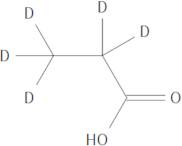
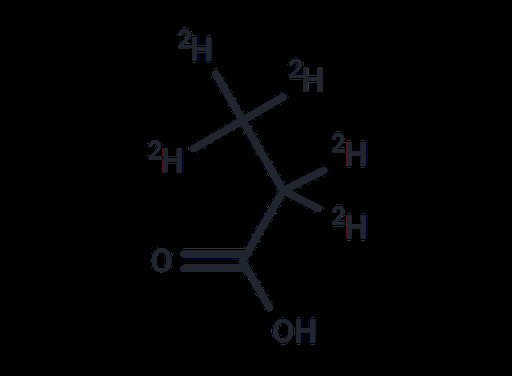
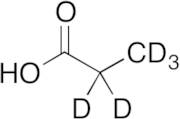
El ácido propanoico-d5, también conocido como ácido 2-propanoico o ácido propiónico-d5, es una forma deuterada del ácido propanoico, donde cinco átomos de hidrógeno son reemplazados por deuterio, un isótopo estable del hidrógeno. Este compuesto tiene la fórmula molecular C3H6O2 y se caracteriza por su grupo funcional ácido carboxílico, que le confiere propiedades ácidas. Típicamente aparece como un líquido incoloro con un olor penetrante y es soluble en agua, alcohol y éter. La presencia de deuterio lo hace útil en diversas aplicaciones, particularmente en espectroscopía de resonancia magnética nuclear (RMN) y otras técnicas analíticas, ya que permite el seguimiento de rutas moleculares y el estudio de mecanismos de reacción. El ácido propanoico-d5 también se utiliza en la síntesis de compuestos deuterados para la investigación y el desarrollo farmacéutico. Sus propiedades físicas y químicas, como el punto de ebullición y la densidad, son similares a las de su contraparte no deuterada, pero la sustitución isotópica puede influir en la cinética de reacción y la termodinámica.
Fórmula:C3HD5O2
Sinónimos:- Propionic-D5 Acid
- Propionic Acid (D5)
Ordenar por
Pureza (%)
0
100
|
0
|
50
|
90
|
95
|
100
Se han encontrado 5 productos.
Propionic-d5 Acid
CAS:Fórmula:CD3CD2COOHPureza:98 atom % DForma y color:Colorless LiquidPeso molecular:79.06816Propionicacid-D5
CAS:Propionicacid-D5 is a deuterated compound of Propionicacid. Propionicacid has a CAS number of 79-09-4. Propionic acid (PA) is widely used as an antifungal agent in food. It is present naturally at low levels in dairy products and occurs ubiquitously, together with other short-chain fatty acids (SCFA), in the gastro-intestinal tract of humans and other mammals as an end-product of the microbial digestion of carbohydrates. It has significant physiological activity in animals. PA is irritant but produces no acute systemic effects and has no demonstrable genotoxic potential.Propionic aciduria is one of the most frequent organic acidurias, a disease that comprise many various disorders. The outcome of patients born with Propionic aciduria (genetic disorder) is poor intellectual development patterns, with 60% having an IQ less than 75 and requiring special education. Successful liver and/or renal transplantations, in a few patients, have resulted in better quality of life but have not necessarily prevented neurological and various visceral complications. These results emphasize the need for permanent metabolic follow-up whatever the therapeutic strategy. Decreased early mortality, less severe symptoms at diagnosis, and more favorable short-term neurodevelopmental outcome were recorded in patients identified through expanded newborn screening.Fórmula:C3D5H1O2Forma y color:SolidPeso molecular:79.11