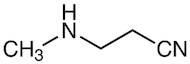
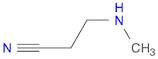
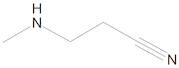
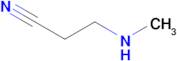
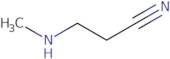
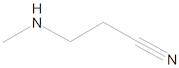
CAS 693-05-0
:3-(Metilamino)propanonitrilo
- (2-Cyanoethyl)methylamine
- 2-cyano-N-methylethanaminium
- 3-(Methyl Amino)-Propionitrile
- 3-(Methylamino)Propanenitrile
- 3-(Methylamino)propionitrile
- 3-(N-Methylamino)propionitrile
- 3-Methylaminopropionitrile
- 3-Methylaminopropiononitrile
- Methyl(2-cyanoethyl)amine
- N-(2-Cyanoethyl)-N-methylamine
- N-(2-Cyanoethyl)methylamine
- N-(β-Cyanoethyl)methylamine
- N-Methyl-2-cyanoethylamine
- N-Methyl-N-(2-cyanoethyl)amine
- N-Methyl-β-alaninenitrile
- N-Methyl-β-aminopropionitrile
- NSC 8399
- Propanenitrile, 3-(methylamino)-
- Propionitrile, 3-(methylamino)-
- Ver más sinónimos
- Precio más bajo
- Precio más alto
- Pureza más baja
- Pureza más alta
- Entrega estimada más rápida
3-(Methylamino)propionitrile
CAS:Fórmula:C4H8N2Pureza:>98.0%(GC)(T)Forma y color:Colorless to Almost colorless clear liquidPeso molecular:84.123-(Methylamino)propanenitrile
CAS:3-(Methylamino)propanenitrileFórmula:C4H8N2Pureza:>98%Forma y color:LiquidPeso molecular:84.12N-Methyl-beta-alaninenitrile
CAS:Formamide is a colorless gas with a pungent, irritating odor. It is used as an antiseptic and an intermediate in the production of other organic compounds. Formamide has been shown to be effective against animal-derived pathogens such as Covid-19 and influenza A/H5N1, and it has been proposed as a potential treatment for pandemic influenza. Formamide reacts with chlorine to produce formate salt (formic acid), which can then be converted into amines or hexamethylphosphoramide. The reaction rate of formamide increases with increasing temperature, but decreases with increasing concentration of hydrogen.
Formamide is also used as a solvent in microscopy to dissolve tissue samples for analysis by electron microscopy techniques.Fórmula:C4H8N2Pureza:Min. 98 Area-%Forma y color:Colorless Clear LiquidPeso molecular:84.12 g/mol3-(Methylamino)propionitrile
CAS:3-(Methylamino)propanenitrileFórmula:C4H8N2Pureza:97%Peso molecular:84.123-(Methylamino)-propanenitrile
CAS:Applications Aminoproponitriles can be used as inhibitors of oxidase enzymes and as a reagent for aminomethylphosphine ligands or the synthesis of aminobenzothiazoles.
References Joyce, L.L. et al.: Chem. Commun., 1, 101 (1999); Wilmarth, K.R. et al: J. Toxicol. Environ. Health., 37, 411 (1992);Fórmula:C4H8N2Forma y color:NeatPeso molecular:84.12