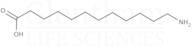
CAS 693-57-2
:Ácido 12-aminododecanoico
- 12-Amindodecanoic acid
- 12-Aminolauric Acid
- Dodecanoic acid, 12-amino-
- λ-Aminolauric acid
- ω-Aminododecanoic acid
- ω-Aminolauric acid
- 12-Aminododecanoic acid
- Precio más bajo
- Precio más alto
- Pureza más baja
- Pureza más alta
- Entrega estimada más rápida
12-Aminolauric Acid
CAS:Fórmula:C12H25NO2Pureza:>98.0%(T)Forma y color:White to Almost white powder to crystalPeso molecular:215.3412-Aminododecanoic Acid
CAS:12-Aminododecanoic AcidFórmula:C12H25NO2Pureza:95%Forma y color:SolidPeso molecular:215.3312-Aminododecanoic acid
CAS:Producto controladoFórmula:C12H25NO2Forma y color:NeatPeso molecular:215.3312-Aminolauric Acid
CAS:Producto controladoApplications 12-Aminolauric Acid is an amino acid used as a reagent in organic synthesis of several compounds including phenylbutazone which is a new long-acting agent which displays improved pharmacokinectics based on human serum albumin as a drug carrier.
References Zhou, J., et al.: Chem. Biol. Drug. Des., pages ahead of print (2016);Fórmula:C12H25NO2Forma y color:NeatPeso molecular:215.3312-Aminododecanic Acid in Acetonitrile(5%Acetic acid)
CAS:Acetonitrile(5%Acetic acid)Fórmula:C12H25NO2Forma y color:Faintly beige powder; [Sigma-Aldrich MSDS]Peso molecular:215.3312-Aminododecanoic acid
CAS:12-Aminododecanoic acid is a fatty acid that is used in the manufacture of magnetic particles. It is synthesized by cationic polymerization of 4-tert-butylbenzoic acid and dodecanedioic acid. The process involves the use of water vapor to remove hydrochloric acid from the solution and form a salt, which then reacts with dodecanedioic acid to produce 12-aminododecanoic acid. This compound has been shown to have transport properties for nitrogen atoms and can be used in exfoliated materials such as nanometals. 12-Aminododecanoic acid has also been shown to exhibit redox activity due to its ability to react with hydrogen peroxide.
Fórmula:C12H25NO2Pureza:Min. 95%Forma y color:White PowderPeso molecular:215.33 g/mol