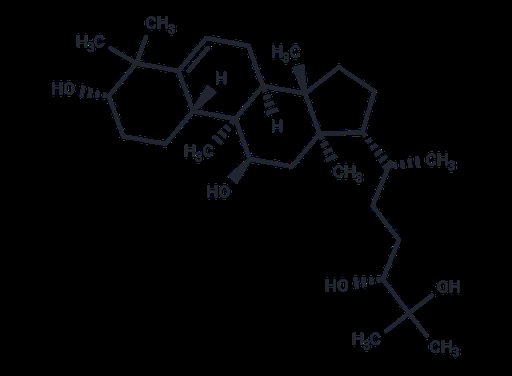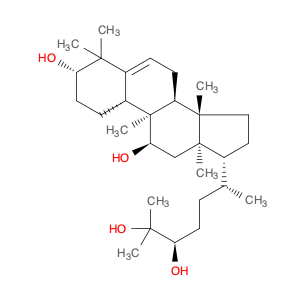
CAS 88930-15-8
:Fórmula:C30H52O4
InChI:InChI=1S/C30H52O4/c1-18(9-13-24(32)27(4,5)34)19-15-16-28(6)22-12-10-20-21(11-14-23(31)26(20,2)3)30(22,8)25(33)17-29(19,28)7/h10,18-19,21-25,31-34H,9,11-17H2,1-8H3/t18-,19-,21-,22+,23+,24-,25-,28+,29-,30+/m1/s1
Clave InChI:JLYBBRAAICDTIS-AYEHCKLZSA-N
SMILES:C[C@H](CC[C@H](C(C)(C)O)O)[C@H]1CC[C@@]2([C@@]1(C[C@H]([C@@]3([C@H]2CC=C4[C@H]3CC[C@@H](C4(C)C)O)C)O)C)C
Filtrar por
Porcentaje de pureza
0
100
|
0
|
50
|
90
|
95
|
100
Se han encontrado 10 productos.
- Precio más bajo
- Precio más alto
- Pureza más baja
- Pureza más alta
- Entrega estimada más rápida
Mogrol (Standard)
CAS:Mogrol (Standard) is a reference standard for research and analysis in studies involving Mogrol. Mogrol, a biometabolite of mogrosides, functions by inhibiting the ERK1/2 and STAT3 pathways, diminishing CREB activation, and activating AMPK signaling.Fórmula:C30H52O4Forma y color:SolidPeso molecular:476.7315Mogrol
CAS:Mogrol has exhibited anti-cancer activities, it suppressed leukemia cell growth via inhibition of the ERK1/2 and STAT3 pathways, in particular, through the suppression of p-ERK1/2 and p-STAT3. Mogrol significantly improved LPS-induced memory impairment in mice. It also suppressed adipogenesis by reducing CREB activation in the initial stage of cell differentiation and by activating AMPK signaling in both the early and late stages of this process.Fórmula:C30H52O4Pureza:95%~99%Peso molecular:476.742(3S,8S,9R,10R,11R,13R,14S,17R)-17-((2R,5R)-5,6-Dihydroxy-6-methylheptan-2-yl)-4,4,9,13,14-pentamethyl-2,3,4,7,8,9,10,11,12,13,14,15,16,17-tetradecahydro-1H-cyclopenta[a]phenanthrene-3,11-diol
CAS:Fórmula:C30H52O4Pureza:99%Forma y color:SolidPeso molecular:476.7315Mogrol
CAS:Mogrol, a biometabolite of mogrosides, functions by inhibiting the ERK1/2 and STAT3 pathways, diminishing CREB activation, and activating AMPK signaling.Fórmula:C30H52O4Pureza:99.85% - 99.95%Forma y color:Yellow SolidPeso molecular:476.7315Mogrol
CAS:Producto controladoMogrol is a protein that is biosynthesized in the fruit of the mogrove tree. It has been shown to inhibit the biosynthesis of glycosides by inhibiting glycosyltransferases and other enzymes involved in this process. Mogrol has also shown anticancer activity, which may be due to its ability to inhibit tumor cell growth and induce apoptosis. Mogrol also exhibits anti-inflammatory effects. These activities are attributed to mogrosides, which are glycoside compounds found in mogrove fruits.
Fórmula:C30H52O4Pureza:Min. 95%Peso molecular:476.73 g/mol