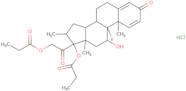
CAS 956901-32-9
:Fórmula:C22H30ClFO5
InChI:InChI=1S/C22H29FO5.ClH/c1-12-8-16-15-5-4-13-9-14(25)6-7-19(13,2)21(15,23)17(26)10-20(16,3)22(12,28)18(27)11-24;/h6-7,9,12,15-17,24,26,28H,4-5,8,10-11H2,1-3H3;1H/t12-,15-,16-,17-,19-,20-,21-,22-;/m0./s1
Clave InChI:OHILSKSRDDTCIR-PWIFQOOMSA-N
SMILES:C[C@H]1C[C@H]2[C@@H]3CCC4=CC(=O)C=C[C@@]4([C@]3([C@H](C[C@@]2([C@]1(C(=O)CO)O)C)O)F)C.Cl
Filtrar por
Porcentaje de pureza
0
100
|
0
|
50
|
90
|
95
|
100
Se han encontrado 1 productos.
- Precio más bajo
- Precio más alto
- Pureza más baja
- Pureza más alta
- Entrega estimada más rápida
Betamethasone hydrochloride
CAS:Betamethasone hydrochloride is an inhibitor analog of the protein kinase that has been shown to have anticancer properties. It has been used in Chinese medicine for centuries as a treatment for various diseases, including cancer. Betamethasone hydrochloride acts by inhibiting the activity of kinases, which are enzymes involved in cell signaling pathways that regulate cell growth and division. This drug induces apoptosis, or programmed cell death, in tumor cells by disrupting their normal function. Additionally, betamethasone hydrochloride has been shown to inhibit the growth of cancer cells and reduce tumor size in animal models. It is also used in the treatment of edema associated with kidney disease and tolvaptan-induced hyponatremia by promoting urine production.Fórmula:C28H38ClFO7Pureza:Min. 95%Peso molecular:541 g/mol