Sustratos fluorogénicos
Se han encontrado 297 productos de "Sustratos fluorogénicos"
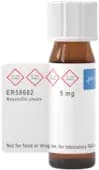
Resorufin oleate
Resorufin oleate is a fluorogenic lipase substrate.Pureza:Min. 95%Forma y color:PowderPeso molecular:477.64 g/molResorufin pentyl ether
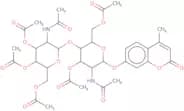
CAS:Resorufin pentyl ether is a drug transporter that can be used as an experimental model for studying the effects of chemical pesticides on humans. Resorufin pentyl ether inhibits energy metabolism and inhibits hepatic p450 activity and polymerase chain reaction in hepatocyte-like cells in vitro. It has been shown to inhibit the enzyme activities of rat liver p450s and human cytochrome P450 3A4 (CYP3A4) at physiological levels. Resorufin pentyl ether has also been shown to be toxic in mice, with toxicity studies showing an LD50 of 4.5 mg/kg after oral administration. This drug is not active against bacteria or fungi, but it is able to inhibit protein synthesis in model systems containing mouse monoclonal antibodies or calf thymus DNA.Pureza:Min. 95%Peso molecular:283.32 g/mol4-Methylumbelliferyl b-D-chitobiose heptaacetate
CAS:4-Methylumbelliferyl b-D-chitobiose heptaacetate is a fluorogenic substrate that is widely used in diagnostic and research applications. It can be used as a substrate for enzymes such as alkaline phosphatase, β-glucuronidase, β-galactosidase, β-glucosidase, α-amylase, α-glucosidase, α-mannosidase, and α-fucosidase. 4MUBH can also be used in the detection of bacterial growth. 4MUBH reacts with NADPH to produce light through chemiluminescence. This product has been shown to have a high purity and quality and should not be stored in UV light or strong acids. CAS No. 55900-34-0Pureza:Min. 95%Peso molecular:792.74 g/mol6-Chloro-4-(trifluoromethyl)umbelliferyl b-D-cellotetraoside
6-Chloro-4-(trifluoromethyl)umbelliferyl b-D-cellotetraoside is a fluorescent substrate that is used to measure the activity of the enzyme beta-glucuronidase. It is a chemiluminescent compound that emits light when hydrolyzed by an enzyme. 6-Chloro-4-(trifluoromethyl)umbelliferyl b-D-cellotetraoside has been shown to be a high quality and environmentally friendly product, as it does not cause any significant change in pH or turbidity in water samples. It has also been shown to be nontoxic and nonmutagenic at concentrations up to 400 ppm. This product can be used for a variety of purposes, including diagnostic tests for bacterial infections or food testing.
Pureza:Min. 95%Peso molecular:913.15 g/mol4-Methylumbelliferyl b-D-gentiotrioside
CAS:4-Methylumbelliferyl beta-D-gentiotrioside is a fluorogenic substrate for beta-glucosidase. After enzymatic cleaveage, free 4-methylumbelliferone (also known as hymecromone) is released, exhibiting blue fluorescence upon excitation with UV light. The strongest fluorescence of 4-methylumbelliferone requires deprotonation of the hydroxyl group (thus requires alkaline pH), with a maximal fluorescence intensity obtained with excitation at 350 to 370 nm and emission at 440 to 470 nm. The use of 4-methylumbelliferyl beta-D-gentiotriosideas a substrate for measuring the beta-glucosidase activity is used for Gaucher disease screening.Fórmula:C28H38O18Pureza:Min. 98 Area-%Forma y color:PowderPeso molecular:662.59 g/molL-Glutamic acid γ-(7-amido-4-methylcoumarin)
CAS:Substrate for aminopeptidase a or the assay of γ-glutamyl transferase yielding a blue fluorescent solution upon cleavage.Fórmula:C15H16N2O5Pureza:Min. 99 Area-%Peso molecular:304.31 g/molRef: 3D-G-3850
1gA consultar50mgA consultar250mgA consultar500mgA consultar2500mgA consultar-Unit-ggA consultar4-Methylumbelliferyl 2-azido-2-deoxy-3-O-(tetra-O-acetyl-b-D-galactopyranosyl)-4,6-O-benzylidene-a-D-galactopyranoside
CAS:4-Methylumbelliferyl 2-azido-2-deoxy-3-O-(tetra-O-acetyl-b-D-galactopyranosyl)-4,6-O-benzylidene a D galactopyranoside is a chemiluminescent substrate for detecting ligands. It has been used to detect the presence of bacteria, fungi, and parasites in food samples and as an indicator for enzymatic activity. This product is an excellent fluorescent substrate for the detection of nucleic acids such as DNA. This product is a conjugate with high purity, which makes it suitable for use in various types of applications.Fórmula:C37H39N3O16Pureza:Min. 95%Peso molecular:781.72 g/mol4-Methylumbelliferyl 2,3,6-tri-O-benzoyl-b-D-galactopyranoside
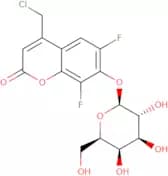
CAS:4-Methylumbelliferyl 2,3,6-tri-O-benzoyl-b-D-galactopyranoside is a fluorogenic substrate that can be used in food testing. This compound is also a chromogenic substrate that can be used for environmental testing. This product is a ligand and chemiluminescent reagent that can be used in diagnostics. It is also an enzyme substrate that has high purity and high quality.Pureza:Min. 95%Peso molecular:650.63 g/mol4-Chloromethyl-6,8-difluoroumbelliferyl b-D-galactopyranoside
CAS:4-Chloromethyl-6,8-difluoroumbelliferyl b-D-galactopyranoside is a compound commonly used in biochemical research as a fluorescent substrate for the detection of sugar hydrolase enzymes. This compound can be cleaved by enzymes such as β-galactosidase, releasing a fluorescent molecule that can be easily detected using fluorescence spectroscopy. The compound is a member of the family of umbelliferyl glycosides, which have been widely used in the study of various biochemical pathways for many years. The advantage of using this particular substrate is that the fluorescent product has a high quantum yield, which means it produces a strong signal for detection. This substrate has been used in a wide variety of applications, including the study of microbial physiology and in the development of diagnostic assays for detecting bacterial and fungal infections.
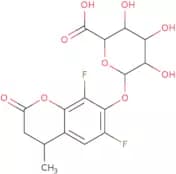
Pureza:Min. 95%Peso molecular:408.74 g/mol6,8-Difluoro-4-methylumbelliferyl b-D-glucuronide
CAS:6,8-Difluoro-4-methylumbelliferyl b-D-glucuronide is a chemiluminescent substrate for the enzyme glucuronidase. The compound has been shown to be stable in the presence of a wide range of pHs and temperatures. It can be used in applications such as diagnostics, culture media and food testing. 6,8-Difluoro-4-methylumbelliferyl b-D-glucuronide has a high purity level and can be used as an indicator for other compounds such as acetaminophen or ibuprofen.Pureza:Min. 95%Forma y color:White To Off-White SolidPeso molecular:388.27 g/molMaltotetraose 2-aminobenzamide
Maltotetraose 2-aminobenzamide is a chemiluminescent substrate that emits light in the presence of certain oxidizing agents. It provides high quality and environmental testing, as well as staining and ligand capability. Maltotetraose 2-aminobenzamide is used in diagnostics to identify bacteria and other microorganisms. Maltotetraose 2-aminobenzamide can be used for the detection of bacterial colonies on agar plates using a fluorogenic substrate, or for the detection of fungi using a chromogenic substrate. Maltotetraose 2-aminobenzamide is also used as an enzyme substrate in food testing or conjugate with enzymes for bioluminescence.
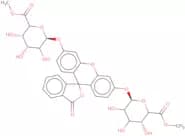
Pureza:Min. 95%Fluorescein di-b-D-glucuronide dimethyl ester
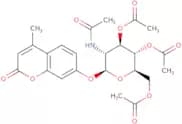
Fluorogenic substrate for beta-glucuronidasePureza:Min. 95%Forma y color:PowderPeso molecular:712.61 g/mol4-Methylumbelliferyl 2-acetamido-3,4,6-tri-O-acetyl-2-deoxy-b-D-glucopyranoside
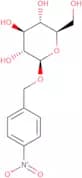
CAS:4-Methylumbelliferyl 2-acetamido-3,4,6-tri-O-acetyl-2-deoxy--bDglucopyranoside is a compound that has been shown to interact with glutamicum and casein kinase. It is also a test compound for corynebacterium glutamicum and interacts with it by functional theory. The compound has been shown to inhibit inflammatory diseases and may be used as a potential treatment for these diseases.Pureza:Min. 95%Peso molecular:505.47 g/mol(4-Nitrophenyl)methyl-b-D-glucopyranoside
CAS:This product is a fluorogenic substrate that is used in the detection of enzymes in biological systems. It is also used as a ligand to study enzyme activity and can be used to quantify enzyme activity. This product is made from high-purity, high-quality reagents and is often used as an enzyme substrate in diagnostic kits for food testing, environmental testing, and detection of bacteria with the help of chemiluminescence. The CAS number for this product is 700368-52-1. This product can be used for fluorescence staining and bioluminescence.Pureza:Min. 95%Peso molecular:315.28 g/molResorufin benzyl ether
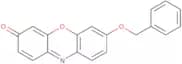
CAS:Resorufin benzyl ether is a chemical compound that can be used as a substrate for cytochrome P450. It has been shown to inhibit the activity of epoxide hydrolase, an enzyme involved in the metabolism of endoperoxides. Resorufin benzyl ether has also been found to inhibit cytochrome P450 enzymes, which are responsible for oxidative metabolism of xenobiotics. This compound has been shown to have a high affinity for mouse monoclonal antibody and is used in immunoassays to detect mouse antibodies. Resorufin benzyl ether is used in biochemical assays and polymerase chain reactions (PCRs) as a fluorescence marker. In addition, this compound is used in model systems to study enzyme activities such as recombinant cytochrome p450 and protein oxidation by reactive oxygen species (ROS).
Pureza:Min. 95%Peso molecular:303.31 g/molN-Succinyl-Ala-Phe-Lys 7-amido-4-methylcumarin acetate (salt)
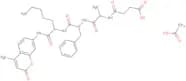
CAS:Producto controladoFluorogenic substrate targeting plasminFórmula:C34H43N5O10Pureza:Min. 95%Peso molecular:681.7 g/mol6-Chloro-4-(trifluoromethyl)umbelliferyl b-D-galactopyranoside
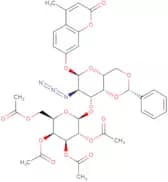
6-Chloro-4-(trifluoromethyl)umbelliferyl b-D-galactopyranoside is a chromogenic substrate for the enzyme β-galactosidase, which hydrolyzes the substrate to produce a fluorescent product. This fluorogenic substrate can be used in chemiluminescent detection of β-galactosidase activity as well as in immunochemical and immunohistochemical analysis of glycoproteins. 6-Chloro-4-(trifluoromethyl)umbelliferyl b-D-galactopyranoside is also used for staining of glycoprotein substrates with periodic acid Schiff reagent or Alcian blue, and it can be used in the diagnosis of glycogen storage diseases.Pureza:Min. 95%Peso molecular:426.73 g/mol4-Methylumbelliferyl 2-azido-2-deoxy-4,6-O-phenylmethylene-a-D-galactopyranoside
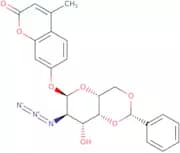
CAS:4-Methylumbelliferyl 2-azido-2-deoxy-4,6-O-phenylmethylene-a-D-galactopyranoside is a fluorogenic substrate that reacts with beta D galactosidase to produce light. This product is useful for diagnostics, conjugate production, and other applications. 4MUF 2 -Gal provides a convenient means of detecting beta D galactosidase activity in cell culture media and can be used as a chromogenic substrate for the detection of enzymes involved in glycosylation reactions. It is also used to detect staining by bioluminescence. The compound can be used in food testing and environmental testing to measure the presence of beta D galactosidase.Fórmula:C23H21N3O7Pureza:Min. 95%Peso molecular:451.43 g/mol4-Methylumbelliferyl N,N',N'',N'''-tetraacetyl-b-D-chitotetraoside
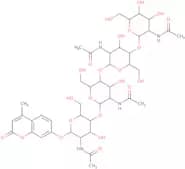
CAS:4-Methylumbelliferyl N,N',N'',N'''-tetraacetyl-beta-D-chitotetraoside is a fluorogenic substrate for chitinase. After enzymatic cleaveage, free 4-methylumbelliferone (also known as hymecromone) is released, exhibiting blue fluorescence upon excitation with UV light. The strongest fluorescence of 4-methylumbelliferone requires deprotonation of the hydroxyl group (thus requires alkaline pH), with a maximal fluorescence intensity obtained with excitation at 350 to 370 nm and emission at 440 to 470 nm. The use of 4-methylumbelliferyl N,N',N'',N'''-tetraacetyl-beta-D-chitotetraosideas a substrate for measuring the chitinase activity is used for fungal infection detection and Gaucher disease screening.Fórmula:C42H60N4O23Pureza:Min. 95%Forma y color:PowderPeso molecular:988.94 g/mol4-Methylumbelliferyl-a-D-mannopyranoside-6-phosphoethanolamine
4-Methylumbelliferyl-a-D-mannopyranoside-6-phosphoethanolamine is a synthetic fluorogenic substrate that can be used in the detection of phosphatases. This substrate is a chromogenic and fluorogenic substrate that reacts when it is cleaved by enzymes. It has been shown to work with a number of different enzyme types, including esterases, phosphatases, and proteases. 4-Methylumbelliferyl-a-D-mannopyranoside-6-phosphoethanolamine has demonstrated high quality for use in bioluminescence, food testing, and environmental testing.4Methylumbelliferyl - a - D - mannopyranoside - 6 - phosphoethanolamine has been assigned CAS No. 81771-07-2.Pureza:Min. 95%