Tintes, colorantes y tinciones
Los colorantes, tintes y tinturas son herramientas esenciales en biología molecular, cruciales para visualizar y estudiar el ADN, los cromosomas y los núcleos celulares. Estos compuestos permiten a los investigadores resaltar componentes celulares específicos, facilitando la observación y el análisis detallados bajo el microscopio. En esta categoría, encontrará una amplia gama de colorantes y tintes de alta calidad utilizados en diversas técnicas de tinción, incluyendo colorantes fluorescentes para análisis de ADN y cromosomas, tintes histológicos para muestras de tejido y tintes específicos para estructuras celulares. Estas herramientas son indispensables en la investigación genética, citología, histología y diagnósticos, proporcionando claridad y contraste en las muestras biológicas. En CymitQuimica, ofrecemos una selección completa de colorantes, tintes y tinturas para apoyar su investigación en biología molecular y asegurar resultados precisos y fiables en sus estudios.
Subcategorías de "Tintes, colorantes y tinciones"
- Tintes ácidos(49 productos)
- Azobencenos(270 productos)
- Tintes azoicos(7 productos)
- Tintes básicos(27 productos)
- Tintes de cumarina(71 productos)
- Tintes de cianina, tintes de escuarilio(53 productos)
- Tintes DCM(4 productos)
- Diariolethenes(12 productos)
- Tintes de dipirrometeno(26 productos)
- Tintes Directos(17 productos)
- Tintes dispersos(2 productos)
- Sensibilizadores de colorantes(12 productos)
- Tintes(416 productos)
- Tinturas y colorantes(911 productos)
- Generating Insoluble Dyes(14 productos)
- Generating Soluble Dyes(11 productos)
- Hexaarilbiimidazol(4 productos)
- Indicadores(575 productos)
- Tintes mordantes(10 productos)
- Tintes de infrarrojo cercano (NIR)(28 productos)
- Tintes de aceite(15 productos)
- Otras tinciones y tintes(2 productos)
- Tintes de perileno(17 productos)
- Tintes fotocromáticos(40 productos)
- Tintes de ftalocianina, tintes de porfirina(101 productos)
- Tintes de quinacridona(8 productos)
- Espiropiranos(16 productos)
- Tinciones y tintes(243 productos)
- Tinciones y tintes para microscopía(5 productos)
- Tintes de tina(5 productos)
- Tintes de xanteno(65 productos)
Mostrar 23 subcategorías más
Se han encontrado 755 productos de "Tintes, colorantes y tinciones"
Ordenar por
Pureza (%)
0
100
|
0
|
50
|
90
|
95
|
100
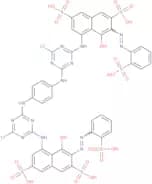
C.I.Reactive Red 120
CAS:<p>C.I.Reactive Red 120 is a reactive dye that has been shown to adsorb onto the crystal structure of formic acid and react at a temperature of 50°C. C.I.Reactive Red 120 is also catalytic, with an efficiency of up to 80%. The antibacterial activity of this dye has been shown to be comparable to that of other dyes, such as Reactive Yellow 3 and Reactive Blue 15. This dye is used in the detection, identification, and quantification of bacteria by liquid chromatography (LC) with UV-visible spectroscopy or LC-MS/MS analysis. It can be used for bacterial identification in the presence of escherichia coli and bovine serum albumin (BSA) proteins as well as other interfering substances in biological samples.</p>Fórmula:C44H30O20N14S6Cl2Pureza:Min. 95%Forma y color:PowderPeso molecular:1,338.09 g/molSomatostatin-14 (reduced)
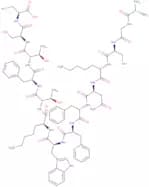
CAS:<p>Somatostatin-14 (reduced) H-Ala-Gly-Cys-Lys-Asn-Phe-Phe-Trp-Lys-Thr-Phe-Thr-Ser-Cys is a synthetic peptide that is an adjuvant for vaccines. It induces a biphasic response by increasing the humoral immune response and decreasing the cellular immune response. Somatostatin has been shown to decrease the severity of symptoms in patients with psychiatric disorders and can be used as a long term treatment for these conditions. Somatostatin also has effects on the pancreas, such as inhibiting insulin release, leading to decreased blood glucose levels. Its disulfide bond in its structure may be important for its activity and stability.</p>Fórmula:C76H106N18O19S2Pureza:Min. 95%Peso molecular:1,639.9 g/molTetrabromophenol blue
CAS:<p>Tetrabromophenol blue is a model system for the study of the mechanism of action of protein-inhibiting drugs. It has been shown to inhibit cancer cells and human pathogens by binding to basic proteins in the cell membrane, thereby preventing their activity. Tetrabromophenol blue inhibits polymerase chain reaction (PCR) by acting as a competitive inhibitor with respect to DNA, and also inhibits fluorescein angiography by reducing the rate at which dye is taken up by cells. Tetrabromophenol blue binds to wild-type strains of bacteria and halts protein synthesis, but does not bind to mutant strains or human serum. This drug has been shown to be effective against hl-60 cells when used at physiological levels.</p>Fórmula:C19H6Br8O5SPureza:Min. 95%Forma y color:Brown PowderPeso molecular:985.55 g/molVictoria blue B
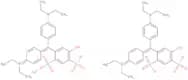
CAS:<p>Victoria Blue B is a compound that contains potassium dichromate and sodium citrate. It has been shown to have high resistance against many types of bacteria, including human serum and cell nuclei. Victoria Blue B has been shown to adsorb nitrite ions from wastewater, which can be useful for the treatment of sewage or as an antimicrobial agent in biological samples. The mechanism by which Victoria Blue B does this is not yet fully understood.</p>Fórmula:C33H32N3ClPureza:Min. 70 Area-%Forma y color:PowderPeso molecular:506.08 g/molFast Yellow
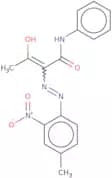
CAS:<p>Fast Yellow is a liquid crystal composition that is used in the production of devices and liquid crystal compositions. It has a high molecular weight, low surface tension, and excellent solvency and dispersing properties. Fast Yellow is also a disinfectant with good water absorption, which makes it suitable for use as an additive in polymer films. Fast Yellow consists of arylalkyl groups that are hydrophobic, making this product highly suitable for use in devices with hydrophobic surfaces.</p>Fórmula:C17H16N4O4Pureza:Min. 95%Forma y color:PowderPeso molecular:340.33 g/mol([15N]Gly)-Glutathione (reduced)
CAS:<p>Please enquire for more information about ([15N]Gly)-Glutathione (reduced) including the price, delivery time and more detailed product information at the technical inquiry form on this page</p>Pureza:Min. 95%Patent blue V Calcium salt
CAS:<p>Patent Blue V calcium salt is a calcium salt of Patent Blue V, which is a light-sensitive dye with an absorption peak at 450 nm. It has been used in analytical chemistry to measure the fatty acid content of oils and fats. Patent Blue V calcium salt has also been used as a reagent in kinetic studies to measure the rate of reactions involving detergent compositions, cationic surfactants, and hydroxyl groups. The lymphatic vessels react to this dye by showing an increase in permeability. The activation energies for these reactions have been determined using kinetic data.</p>Fórmula:C27H31N2O7S2·5CaPureza:Min. 85.0 Area-%Forma y color:PowderPeso molecular:582.7 g/mol(Z-Asp-Glu-Val-Asp)2-Rhodamine 110
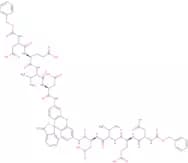
CAS:<p>Fluorogenic dye targeting caspase 3</p>Fórmula:C72H78N10O27Pureza:Min. 95%Peso molecular:1,515.44 g/molReactive Blue 4
CAS:<p>Reactive Blue 4 is a reactive dye that is used in the treatment of wastewater. It has been shown to be effective against microbial and fungal infections. Reactive Blue 4 binds to the cell membrane, preventing the transport of ions and other essential components into the cell, leading to its death. The binding mechanism is thought to involve steric interactions and hydrogen bonding. This dye also inhibits enzymes such as benzalkonium chloride and sodium carbonate, which are involved in bacterial processes such as photosynthesis or respiration.</p>Fórmula:C23H14Cl2N6O8S2Pureza:Min. 95%Forma y color:PowderPeso molecular:637.43 g/molVat Blue 6 - Technical grade
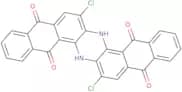
CAS:<p>Vat Blue 6 is a reactive dye that can be used in the production of textiles and paper. The name Vat Blue 6 comes from the vat dyeing process, which is a type of textile dyeing. It reacts with sulfonic acids and light exposure to form a hydroxyl group. This reactive dye also has a glycol ester in its molecule, which makes it soluble and more reactive than other types of dyes. Vat Blue 6 is anhydrous and has a diameter between 0.1-0.3 microns, making it small enough to be used as a cross-linking agent or as a particle for surface treatment. Vat Blue 6 has been shown to have high reactivity in the presence of monocarboxylic acids and fatty acids, which are both found in natural fibers such as wool or silk.</p>Fórmula:C28H12Cl2N2O4Pureza:Min. 95%Forma y color:Blue PowderPeso molecular:511.31 g/molC.I.Direct Red 83:1
CAS:<p>C.I.Direct Red 83:1 is a dye that has been used in wastewater treatment to remove color. It is a polymerized dye that has been shown to be more efficient than the decolouration process, which is the traditional method of removing color from wastewater. The light source for this process must be within the range of 350-500 nm and at least 100 mW/cm2 intensity. This dye has also been shown to be an effective photolysis agent for organic compounds such as phenols, amines, and sulfides.</p>Pureza:Min. 95%Tetrabromophenol blue sodium salt
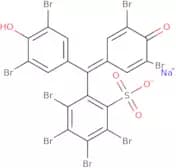
CAS:<p>Tetrabromophenol blue sodium salt is a dye that is used as an additive in the production of vinyl alcohol polymer films. Tetrabromophenol blue sodium salt can be used to measure albumin concentration and postexposure by adding phenyl groups to the molecule. The color of tetrabromophenol blue sodium salt changes upon exposure to radiation, which makes it useful for diagnostic purposes. It also has a hydrocarbon group that transforms into an insoluble form when exposed to evaporation, making it useful for titration methods. Tetrabromophenol blue sodium salt is relatively stable and labile in nature, making it susceptible to techniques such as pyrolysis, oxidation, or reduction.</p>Fórmula:C19H5Br8NaO5SPureza:Min. 95%Peso molecular:1,007.53 g/molPigment Red 112
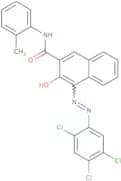
CAS:<p>Pigment Red 112 is a hydroxylated derivative of the low molecular weight glycol ester, polyethylene glycol. It is used as a control agent in the manufacture of paints and plastics. Pigment Red 112 is soluble in organic solvents such as acetone, which makes it useful for coating metal surfaces. It is also water-soluble and can be used to produce transparent coatings. Pigment Red 112 has been shown to inhibit lipid biosynthesis by binding to fatty acids and particle formation due to its chemical crosslinking properties. Pigment Red 112 may cause allergic reactions in some people who are sensitive or have skin conditions such as eczema.</p>Fórmula:C24H16O2N3Cl3Forma y color:Red Clear LiquidPeso molecular:484.76 g/molC.I.Reactive Black 5
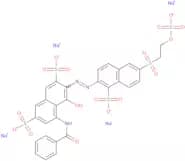
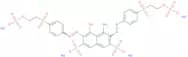
CAS:<p>C.I.Reactive Black 5 is a reactive dye that can be used to detect bacterial growth in the presence of sodium carbonate, which is added to the reaction solution at a concentration of 0.1M. The dye has been shown to inhibit enzyme activities, such as nitrogen atoms and anhydrous sodium, and disrupt bacterial growth by binding to cell surfaces. This dye is also able to photobind with bacterial cells in nutrient solutions and kinetic experiments, leading to inhibition of cell division through the disruption of DNA replication.</p>Fórmula:C26H21N5O19S6Na4Pureza:Min. 95%Forma y color:Brown PowderPeso molecular:991.82 g/molC.I.Vat green 2
CAS:<p>C.I. Vat green 2 is a synthetic dye that has been shown to have genotoxic potential and is therefore considered carcinogenic. It is soluble in water, but not in organic solvents such as acetone or chloroform. C.I. Vat green 2 can be used in the textile industry as a colorant for nylon fibers, polyester yarns, rayon fabrics, and acrylic fibers, among others. The stability of this dye depends on temperature and pH; it decomposes at temperatures above 120 °C and pH above 10. This compound is commonly used to produce an emerald green color when dissolved in water or alcohol with the help of an acidifier or base catalyst such as sodium hydroxide, ammonium hydroxide, or hydrogen peroxide.</p>Fórmula:C36H18Br2O4Pureza:Min. 95%Peso molecular:674.33 g/molAcid red 26
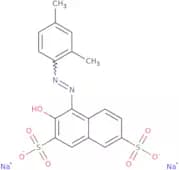
CAS:<p>Acid Red 26 is a water-soluble dye that can be used in the textile industry and as an indicator for wastewater treatment. It has been shown to have significant up-regulation in biological samples, such as human serum and human immunoglobulin. Acid Red 26 has been tested for its toxicity in a number of studies, with little evidence of carcinogenic potential. The rate constant is not available for this compound.</p>Fórmula:C18H14N2Na2O7S2Pureza:Min. 95%Peso molecular:480.42 g/molPigment orange 34
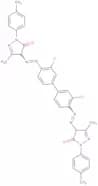
CAS:<p>Pigment orange 34 is a cross-linking agent that can be used as a hydroxyl radical scavenger. It has also been shown to have an inhibitory effect on the reaction of formaldehyde with protein, and is a molecule that contains both a hydroxyl group and a carboxylic acid group. Pigment orange 34 reacts with various substances such as glycol esters, fatty acids, or phenols to produce reaction products. This product is synergistic with other control agents such as magnetic particles or radiation. Pigment orange 34 is in its bound form when it is synthesized, but becomes reactive when it is mixed with other agents during surface methodology.</p>Fórmula:C34H28Cl2N8O2Forma y color:PowderPeso molecular:651.54 g/mol4,4'-(4,5,6,7-Tetrabromo-1,1-dioxido-3H-2,1-benzoxathiol-3-ylidene)bis[2-iodo-6-nitrophenol]
CAS:<p>Dye for detection of human serum albumin in urine</p>Fórmula:C19H6Br4I2N2O9SPureza:Min. 95 Area-%Forma y color:PowderPeso molecular:1,011.75 g/molAcid blue 182
CAS:<p>Acid blue 182 is an alkali metal salt of a polycarboxylic acid. It is used as a detergent builder, where it regulates the pH and viscosity of hard water. Acid Blue 182 is bactericidal and has been shown to have good detergency properties at low concentrations. This compound also has surfactant properties, which make it effective in removing oils, fats, greases and other organic substances from surfaces. Acid Blue 182 is often used in laundry detergent compositions because it does not cause color fading or bleeding.</p>Fórmula:C23H17N3O9S2·2NaPureza:Min. 95%Forma y color:Blue PowderPeso molecular:589.51 g/molC.I.Reactive Red 180
CAS:<p>C.I.Reactive Red 180 is a reactive dye with a red color that is used in experiments to monitor the electrochemical oxidation of metal ions, such as copper and iron. The dye is also used in the textile industry for coloring fabrics and paper. Reactive Red 180 has a density of 1.00 g/cm3 and an optimum pH of 4.0-5.5 depending on the environment it is exposed to. It has been shown to have an efficiency of around 80% when used as an electrode in electrolysis reactions and can be electrochemically oxidized at an optimum voltage of 0.2 V. The color produced by this dye ranges from yellow-red to deep red depending on the concentration of the solution or amount of exposure time to light or heat.</p>Fórmula:C29H23N3O17S5·4NaPureza:Min. 95%Forma y color:Red PowderPeso molecular:937.79 g/mol



![([15N]Gly)-Glutathione (reduced)](/_next/image/?url=https%3A%2Fstatic.cymitquimica.com%2Fproducts%2F3D%2Fthumb-webp%2FFG109306.webp&w=3840&q=75)

![4,4'-(4,5,6,7-Tetrabromo-1,1-dioxido-3H-2,1-benzoxathiol-3-ylidene)bis[2-iodo-6-nitrophenol]](/_next/image/?url=https%3A%2Fstatic.cymitquimica.com%2Fproducts%2F3D%2Fthumb-webp%2FFT76467.webp&w=3840&q=75)