


Compuestos policíclicos
Los compuestos policíclicos son moléculas orgánicas que contienen múltiples anillos interconectados. Estos compuestos incluyen hidrocarburos aromáticos policíclicos y otros sistemas de anillos complejos. Son significativos en la ciencia de materiales, productos farmacéuticos y electrónica orgánica. En CymitQuimica, ofrecemos compuestos policíclicos de alta calidad para apoyar sus investigaciones y aplicaciones industriales, asegurando resultados confiables y efectivos en sus proyectos.
Subcategorías de "Compuestos policíclicos"
- Acridinas(97 productos)
- Antraquinonas(533 productos)
- Ácidos antraquinonesulfónicos(16 productos)
- Azobencenos(270 productos)
- Azonaftalenos(98 productos)
- Azoxibencenos(12 productos)
- Azulenos(11 productos)
- Benzimidazoles(1.475 productos)
- Benzodioxanos(27 productos)
- Benzofuranos(924 productos)
- Benzotiofenos(700 productos)
- Benzotriazoles(438 productos)
- Binaftilos(133 productos)
- Carbazoles(462 productos)
- Cromanos, Cromatos(480 productos)
- Cumarinas(1.122 productos)
- Ciclofanos(11 productos)
- Fluorenos y fluorenonas(381 productos)
- Imidazopiridinas(10 productos)
- Indans(118 productos)
- Indazoles(2.037 productos)
- Indenes(22 productos)
- Indoles(3.988 productos)
- Indolines(119 productos)
- Isatinos(234 productos)
- Isobenzofuranos(17 productos)
- Ftalimidas N-sustituidas(153 productos)
- Naftalenos(2.436 productos)
- Naftiridinas(17 productos)
- Naftoquinona(2 productos)
- Perilenos(36 productos)
- Fenazinas(25 productos)
- Ftalazinas(33 productos)
- Ftalimida(153 productos)
- Hidrocarburos aromáticos policíclicos (HAP)(270 productos)
- Polifenol(261 productos)
- Pteridinas(52 productos)
- Pirenos(87 productos)
- Quinuclidina(1 productos)
- Tetracenos(7 productos)
Mostrar 32 subcategorías más
Se han encontrado 4574 productos de "Compuestos policíclicos"
Ordenar por
Pureza (%)
0
100
|
0
|
50
|
90
|
95
|
100
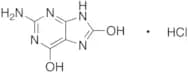
2-Amino-6,8-dihydroxypurine Hydrochloride (~90%)
CAS:Producto controlado<p>Applications 2-Amino-6,8-dihydroxypurine is an 8-oxo-guanine repair pathway coordinated by MUTYH glycosylase and DNA polymerase λ.<br>References Avkin, S., et al.: Mutat. Res., 510, 81 (2002), Niimi, N., et al.: Biochem., 48, 4239 (2009), Muftuoglu, M., et al.: J. Biol. Chem., 284, 9270 (2009),<br></p>Fórmula:C5H6ClN5O2Pureza:~90%Forma y color:Off White SolidPeso molecular:203.595-Methoxypsoralen
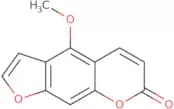
CAS:<p>5-Methoxypsoralen is a light-activated compound, which is a naturally derived organic substance found in certain plants, particularly from the Apiaceae family. This compound functions as a furocoumarin that interacts with DNA through photoactivation, forming cross-links upon exposure to ultraviolet A (UVA) light. These cross-links disrupt DNA replication, ultimately inhibiting cell proliferation.</p>Fórmula:C12H8O4Pureza:Min. 98 Area-%Forma y color:White PowderPeso molecular:216.19 g/molDL-Indole-3-lactic acid
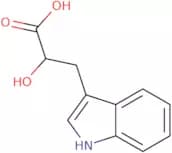
CAS:<p>Indole-3-lactic acid is a plant hormone that is produced in the leaves of the plant when they are under stress. It has been shown to have activity against bowel diseases and metabolic disorders. Indole-3-lactic acid has been isolated from plants like Caproicum album, which is used in vitro to measure its effect on caproic acid production. This compound has also been detected in human serum and wastewater treatment. Indole-3-lactic acid inhibits tryptophan degradation by competing with indolecarboxylase for substrate. The effect of indole-3-lactic acid on dextran sulfate and glomerular filtration rate was studied using a rat model, where it was found that it had no significant effects.</p>Fórmula:C11H11NO3Pureza:Min. 95%Forma y color:PowderPeso molecular:205.21 g/mol6-Bromo-1H-indole-3-carboxylic acid
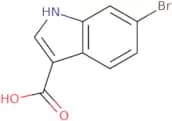
CAS:<p>6-Bromo-1H-indole-3-carboxylic acid is a natural product that is isolated from the marine sponge Smenospongia purpurea. It was first reported in 1979 and has been used for the synthesis of other compounds. 6-Bromoindole, a precursor to 6-bromo-1H-indole-3-carboxylic acid, is biosynthesized from methyl ester and NMR spectra indicate that it has a dihedral angle of 173°. This compound has been shown to have antibacterial activity against staphylococcus.</p>Fórmula:C9H6BrNO2Pureza:Min. 95%Forma y color:PowderPeso molecular:240.05 g/molRef: 3D-FB56690
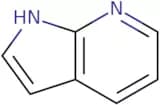
Producto descatalogado7-Azaindole
CAS:<p>7-Azaindole is a reactive chemical that has been shown to be effective in the treatment of skin cancer, as well as hepatic steatosis. The compound can promote the transfer of hydrogen atoms and form a dimer with protonated nitrogen. 7-Azaindole reacts rapidly with nucleophiles such as amines, alcohols, and thiols to form covalent bonds. The reaction mechanism is characterized by an initial protonation step followed by nucleophilic attack or hydrogen transfer from the nucleophile to 7-azaindole. Kinetic studies have demonstrated that the rate of this reaction depends on the concentration of both reactants.</p>Fórmula:C7H6N2Forma y color:PowderPeso molecular:118.14 g/molScopolin
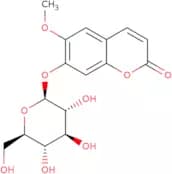
CAS:<p>Scopolin is a coumarin glucoside, which is derived from the plant secondary metabolism. It originates predominantly from species within the Solanaceae family, including tobacco and potato plants. Its biosynthesis involves the conversion of scopoline, a precursor molecule, through glucosylation. This process is catalyzed by glucosyltransferases, which facilitate the attachment of a glucose moiety.</p>Fórmula:C16H18O9Pureza:Min. 98 Area-%Forma y color:White PowderPeso molecular:354.31 g/molQuinoline 2,4-dicarboxylic acid
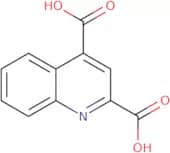
CAS:<p>Quinoline 2,4-dicarboxylic acid (QDA) is a novel cytotoxic agent that targets cervical cancer cells. It inhibits the uptake of glucose and other nutrients by cervical cancer cells, leading to cell death through apoptosis. QDA also inhibits the expression of genes involved in cross-linking reactions, which are important for the structural integrity of proteins. This agent has been shown to inhibit the growth of aniline-induced breast cancer cells and glutamate-stimulated PC12 cells. QDA binds to DNA and forms covalent bonds with nucleotide bases, inhibiting DNA synthesis, as well as interfering with protein synthesis and cell division. The QDA mechanism is similar to that of benzoquinolines and estrone sulfate.</p>Fórmula:C11H7NO4Pureza:Min. 95%Forma y color:White PowderPeso molecular:217.18 g/mol2-Butyl-1,3-diazaspiro[4.4]non-1-en-4-one Hydrochloride
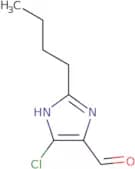
CAS:Fórmula:C11H18N2O·HClPureza:>98.0%(T)(HPLC)Forma y color:White to Almost white powder to crystalPeso molecular:230.742-Butyl-4-chloro-1H-imidazole-5-carboxaldehyde
CAS:<p>Glyoxal is a chemical compound that has shown to have bactericidal activity against human pathogens such as Mycobacterium tuberculosis, Helicobacter pylori, and Staphylococcus aureus. It is used in the synthesis of heterocyclic amines and can be found as an impurity in imidazole derivatives. Glyoxal is a broad-spectrum antimicrobial that has been shown to inhibit the growth of fungi and bacteria by reacting with functional groups on the microorganisms' cell walls. It reacts with bacterial cell walls by forming an intermediate molecule, which reacts with other molecules present in the microorganism's environment to form carbon dioxide, water, and glyoxal. The reaction time for glyoxal depends on temperature; higher temperatures will result in faster reactions. Techniques used to synthesize glyoxal include dehydration of oximes or by reaction with phosphorus oxychloride.</p>Fórmula:C8H11ClN2OPureza:Min. 95%Forma y color:PowderPeso molecular:186.64 g/molRef: 3D-FB19493
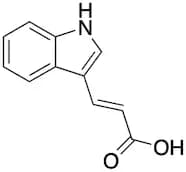
Producto descatalogado3-Indoleacrylic Acid
CAS:Producto controlado<p>Applications 3-Indoleacrylic Acid (cas# 1204-06-4) is a useful research chemical.<br></p>Fórmula:C11H9NO2Forma y color:NeatPeso molecular:187.194-Amino-2,2'-bipyridine
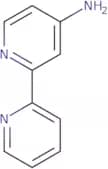
CAS:<p>Please enquire for more information about 4-Amino-2,2'-bipyridine including the price, delivery time and more detailed product information at the technical inquiry form on this page</p>Fórmula:C10H9N3Pureza:Min. 95%Forma y color:PowderPeso molecular:171.2 g/mol3-Quinuclidinol HCl
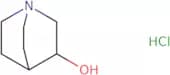
CAS:Producto controlado<p>3-Quinuclidinol HCl is a cholinergic drug that inhibits the enzyme acetylcholinesterase. This action prevents the breakdown of the neurotransmitter acetylcholine, which causes an increase in its concentration in the synaptic cleft. 3-Quinuclidinol HCl has been shown to have a dose-dependent effect on increasing acetylcholine levels, which is believed to be due to its ability to inhibit butyrylcholinesterase. In addition, this drug has been shown to have pharmacokinetic properties that are consistent with those of other cholinergic drugs. 3-Quinuclidinol HCl also interacts with other substances and can block nicotinic receptors at high doses.</p>Fórmula:C7H13NO·HClPureza:Min. 95%Peso molecular:163.64 g/mol4-Aminoquinoline-2-one
CAS:<p>4-Aminoquinoline-2-one is a nonsteroidal anti-inflammatory drug that has tuberculostatic activity. It binds to the nitrogen atoms of the enzyme dihydropteroate synthase, which is involved in the synthesis of folic acid and DNA. This leads to an increase in reactive oxygen species and inflammation, which causes disease activity. 4-Aminoquinoline-2-one has been shown to be synergistic with monoclonal antibodies when used as a treatment for inflammatory diseases. In order for 4-aminoquinoline-2-one to be taken up by cells, it must bind to cellular uptake proteins through hydrogen bonds or disulfide bonds.</p>Fórmula:C9H8N2OPureza:Min. 95%Peso molecular:160.17 g/molRef: 3D-FA43448
Producto descatalogado4,7,13,16,21-Pentaoxa-1,10-diazabicyclo[8.8.5]tricosane
CAS:<p>4,7,13,16,21-Pentaoxa-1,10-diazabicyclo[8.8.5]tricosane (POD) is a nitrogen containing heterocycle that is used as a fungicide and insecticide. POD has significant antifungal activity against various species of fungi such as Trichophyton mentagrophytes and Candida albicans. It also inhibits the growth of some Gram-positive bacteria such as Clostridium botulinum. The compound may be used to treat conditions associated with elevated blood pressure by inhibiting the conversion of tyrosine to dihydroxyphenylalanine (DOPA). POD forms stable complexes with metal hydroxides in the presence of water and hydrochloric acid, which are important intermediates for chemical reactions. The frequency shift of positron emission in POD is due to the electron capture during positron annihilation.</p>Fórmula:C16H32N2O5Pureza:Min. 95%Peso molecular:332.44 g/molRef: 3D-FP168636
Producto descatalogado


![2-Butyl-1,3-diazaspiro[4.4]non-1-en-4-one Hydrochloride](/_next/image/?url=https%3A%2Fstatic.cymitquimica.com%2Fproducts%2F3B%2Fthumb-webp%2FB3291.webp&w=3840&q=75)


![4,7,13,16,21-Pentaoxa-1,10-diazabicyclo[8.8.5]tricosane](/_next/image/?url=https%3A%2Fstatic.cymitquimica.com%2Fproducts%2F3D%2Fthumb-webp%2FFP168636.webp&w=3840&q=75)