Compuestos deuterados
Los compuestos deuterados son moléculas orgánicas en las que uno o más átomos de hidrógeno son reemplazados por deuterio, un isótopo estable del hidrógeno. Estos compuestos son esenciales en varios campos científicos, incluyendo la espectroscopía de RMN, la espectrometría de masas y los estudios cinéticos de isótopos. Los compuestos deuterados mejoran la claridad y precisión de las señales en los análisis al reducir el ruido de fondo y proporcionar información única sobre los mecanismos de reacción y las estructuras moleculares. En CymitQuimica, encontrarás una amplia gama de compuestos deuterados diseñados específicamente para apoyar tu investigación en química analítica y estudios moleculares.
Se han encontrado 4233 productos de "Compuestos deuterados"
Ordenar por
Pureza (%)
0
100
|
0
|
50
|
90
|
95
|
100
1,3-Distearoyl-2-chloropropanediol-d5
CAS:Please enquire for more information about 1,3-Distearoyl-2-chloropropanediol-d5 including the price, delivery time and more detailed product information at the technical inquiry form on this pageFórmula:C39H70D5CIO4Pureza:Min. 95%Peso molecular:751.95 g/molAMOZ-d5
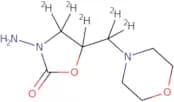
CAS:Producto controladoAMOZ-d5 is a new analytical method for the determination of drug metabolites in animal muscle tissue. The sample preparation process involves hydrolysis with aqueous acid and subsequent extraction into methanol. AMOZ-d5 has been validated using a range of different samples, such as drugs, food supplements, and animals. This method is an improvement over other techniques due to its speed and sensitivity.Fórmula:C8H10D5N3O3Pureza:Min. 95%Peso molecular:206.25 g/mol4-Aminobiphenyl-D9
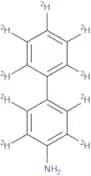
CAS:Producto controlado<p>4-Aminobiphenyl is a chemical compound that belongs to the group of aromatic amines. It is a human carcinogen and has been shown to cause cancer in animals. 4-Aminobiphenyl has been detected in the environment as an environmental pollutant and can be found in small quantities at low levels in food, air, and water. 4-Aminobiphenyl can be hydrolyzed by acid or alkaline hydrolysis to form its hydrolysate, which contains nitroarenes that are not present in the original compound. The DNA modification caused by 4-aminophenol may be due to its ability to modify DNA bases through reactive metabolites such as nitroarenes.</p>Fórmula:C12H2D9NPureza:Min. 95%Peso molecular:178.27 g/mol([13C6]Leu15)-pTH (1-34) (human) trifluoroacetate salt
Please enquire for more information about ([13C6]Leu15)-pTH (1-34) (human) trifluoroacetate salt including the price, delivery time and more detailed product information at the technical inquiry form on this pagePureza:Min. 95%Fmoc-[ring-D5]Phe-OH
CAS:Producto controladoPlease enquire for more information about Fmoc-[ring-D5]Phe-OH including the price, delivery time and more detailed product information at the technical inquiry form on this pageFórmula:C24H16D5NO4Pureza:Min. 95%Peso molecular:392.46 g/mol([ring-D5]Phe6)-Somatostatin-14
Please enquire for more information about ([ring-D5]Phe6)-Somatostatin-14 including the price, delivery time and more detailed product information at the technical inquiry form on this pageFórmula:C76H99D5N18O19S2Pureza:Min. 95%Peso molecular:1,642.91 g/molProtein Kinase P34 (cd2) Substrate trifluoroacetate salt
CAS:H-ADAQHATPPKKKRKVEDPKDF-OH peptide, which can act as a substrate of Protein Kinase P34 (cd2). The peptide is supplied as a trifluoroacetate salt.Fórmula:C106H172N32O32Pureza:Min. 95%Peso molecular:2,406.7 g/molCD36 (93-110)-Cys
CAS:<p>Please enquire for more information about CD36 (93-110)-Cys including the price, delivery time and more detailed product information at the technical inquiry form on this page</p>Fórmula:C96H151N29O33SPureza:Min. 95%Peso molecular:2,271.47 g/mol([D2]Gly4)-Cholecystokinin Octapeptide (sulfated) ammonium salt
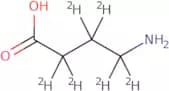
Please enquire for more information about ([D2]Gly4)-Cholecystokinin Octapeptide (sulfated) ammonium salt including the price, delivery time and more detailed product information at the technical inquiry form on this pageFórmula:C49H60D2N10O16S3Pureza:Min. 95%Peso molecular:1,145.28 g/mol4-Aminobutyric-2,2,3,3,4,4-D6
CAS:Producto controlado4-Aminobutyric-2,2,3,3,4,4-D6 is a metabolic precursor to glutamate that can be used as a marker for neuronal activity. It has been found that 4-aminobutyric acid is present in the cerebrospinal fluid of mice and humans. 4-Aminobutyric acid is synthesized from l-glutamic acid by the enzyme glutamic acid decarboxylase and can be used as an indicator of neurotransmitter activity. The measurement of 4-aminobutyric acid levels can be used for biochemical studies on tissues or cells and also for the diagnosis of diseases related to neurotransmission such as epilepsy.Fórmula:C4H3D6NO2Pureza:Min. 95%Forma y color:PowderPeso molecular:109.15 g/molCys-CD36 (139-155) trifluoroacetate salt
CAS:Please enquire for more information about Cys-CD36 (139-155) trifluoroacetate salt including the price, delivery time and more detailed product information at the technical inquiry form on this pageFórmula:C87H133N25O26SPureza:Min. 95%Peso molecular:1,977.21 g/mol([15N]Gly)-Glutathione (reduced)
CAS:Please enquire for more information about ([15N]Gly)-Glutathione (reduced) including the price, delivery time and more detailed product information at the technical inquiry form on this pagePureza:Min. 95%Fmoc-[15N]Leu-OH
CAS:Fmoc-[15N]Leu-OH is a research chemical that has various applications in the field of biosynthesis and antibody production. It is commonly used in peptide synthesis and as a building block for the preparation of peptides and proteins. Fmoc-[15N]Leu-OH is known for its high purity and quality, making it an ideal choice for researchers and scientists working in the field of molecular biology. This compound can be easily dissolved in ethanol or other organic solvents, allowing for convenient use in laboratory experiments. With its unique characteristics and wide range of applications, Fmoc-[15N]Leu-OH is a valuable tool for those involved in biochemical research.Fórmula:C21H23NO4Pureza:Min. 95%Peso molecular:354.41 g/molH-[15N]Tyr-OH
CAS:<p>H-[15N]Tyr-OH is a metabolite of tyrosine. It is the conjugate acid of propionic acid, and the conjugate base of 4-hydroxybenzyl. H-[15N]Tyr-OH is a phenylalanine and aromatic amino acid that has an aromatic ring with a phenyl substituent. This metabolite is hydroxy, which means it has one hydroxyl group on the phenyl ring. H-[15N]Tyr-OH binds to daphnia in vivo, causing death. The cause for this may be due to its ability to react with oxygen, forming reactive oxygen species (ROS).</p>Pureza:Min. 95%(Des-Gly10,D-Leu6,[13C6]Leu7,Pro-NHEt 9)-LHRH trifluoroacetate salt
Please enquire for more information about (Des-Gly10,D-Leu6,[13C6]Leu7,Pro-NHEt 9)-LHRH trifluoroacetate salt including the price, delivery time and more detailed product information at the technical inquiry form on this pagePureza:Min. 95%([ring-D5]Phe8)-Angiotensin II acetate salt
CAS:<p>Please enquire for more information about ([ring-D5]Phe8)-Angiotensin II acetate salt including the price, delivery time and more detailed product information at the technical inquiry form on this page</p>Fórmula:C50H66D5N13O12Pureza:Min. 95%Peso molecular:1,051.21 g/molBenzoic- d5- acid
CAS:Producto controladoBenzoic acid is a carboxylic acid that is found naturally in many plants, fruits and vegetables. It has been shown to be an effective inhibitor of bacterial growth by binding to the glycan moiety of peptidoglycans. Benzoic acid can be used as a calibrant for mass spectrometry. The molecular weight of benzoic acid is 100.06 g/mol and its melting point is 152 °C (309 °F). Benzoic acid has two structural isomers: ortho-benzoic acid and meta-benzoic acid. Ortho-benzoic acid has a molecular weight of 102.09 g/mol and a melting point of 145 °C (293 °F). Meta-benzoic acid has a molecular weight of 104.10 g/mol and a melting point of 155 °C (311 °F). Benzoate may also be produced from the reaction between benzoyl chloride with sodium benzoFórmula:C7HD5O2Pureza:Min. 95%Peso molecular:127.15 g/mol17β-Estradiol-d2
CAS:Producto controlado<p>17-Estradiol-3,17-diol (17-E2) is the most potent estrogen found in humans. It has been shown to be able to stimulate the growth of breast cancer cells and is a known carcinogen in animals. 17-E2 is metabolized by cytochrome P450 enzymes into catechol estrogens, which are reactive and can bind to DNA. These metabolites can cause mutations that lead to cancer. Analysis of human breast tissue has revealed that 17-E2 is synthesized from estradiol by aromatase and then converted into catechol estrogens by 17β-hydroxysteroid dehydrogenase type 1. 17-E2 also binds to estrogen receptors, which may be linked with the development of certain cancers. The presence of 17-E2 in the environment has been linked with an increased risk for cancer in humans, as it can enter the body through water or food contaminated with waste products.</p>Fórmula:C18H22D2O2Pureza:Min. 95%Forma y color:PowderPeso molecular:274.39 g/mol([13C6]Leu5)-Ghrelin (human) trifluoroacetate salt
CAS:Please enquire for more information about ([13C6]Leu5)-Ghrelin (human) trifluoroacetate salt including the price, delivery time and more detailed product information at the technical inquiry form on this pagePureza:Min. 95%Formaldehyde-13C solution
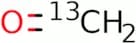
CAS:20% by weight in water. 98 atom % 13CFórmula:H13CHOPureza:Min. 95%Peso molecular:42.12 g/mol


![([13C6]Leu15)-pTH (1-34) (human) trifluoroacetate salt](/_next/image/?url=https%3A%2Fstatic.cymitquimica.com%2Fproducts%2F3D%2Fthumb-webp%2FFL110012.webp&w=3840&q=75)
![Fmoc-[ring-D5]Phe-OH](/_next/image/?url=https%3A%2Fstatic.cymitquimica.com%2Fproducts%2F3D%2Fthumb-webp%2FFF111391.webp&w=3840&q=75)
![([ring-D5]Phe6)-Somatostatin-14](/_next/image/?url=https%3A%2Fstatic.cymitquimica.com%2Fproducts%2F3D%2Fthumb-webp%2FFR110019.webp&w=3840&q=75)

![([D2]Gly4)-Cholecystokinin Octapeptide (sulfated) ammonium salt](/_next/image/?url=https%3A%2Fstatic.cymitquimica.com%2Fproducts%2F3D%2Fthumb-webp%2FFG110020.webp&w=3840&q=75)
![([15N]Gly)-Glutathione (reduced)](/_next/image/?url=https%3A%2Fstatic.cymitquimica.com%2Fproducts%2F3D%2Fthumb-webp%2FFG109306.webp&w=3840&q=75)
![Fmoc-[15N]Leu-OH](/_next/image/?url=https%3A%2Fstatic.cymitquimica.com%2Fproducts%2F3D%2Fthumb-webp%2FFF111321.webp&w=3840&q=75)
![H-[15N]Tyr-OH](/_next/image/?url=https%3A%2Fstatic.cymitquimica.com%2Fproducts%2F3D%2Fthumb-webp%2FFT107850.webp&w=3840&q=75)
![(Des-Gly10,D-Leu6,[13C6]Leu7,Pro-NHEt 9)-LHRH trifluoroacetate salt](/_next/image/?url=https%3A%2Fstatic.cymitquimica.com%2Fproducts%2F3D%2Fthumb-webp%2FFD109775.webp&w=3840&q=75)
![([ring-D5]Phe8)-Angiotensin II acetate salt](/_next/image/?url=https%3A%2Fstatic.cymitquimica.com%2Fproducts%2F3D%2Fthumb-webp%2FFR110025.webp&w=3840&q=75)


![([13C6]Leu5)-Ghrelin (human) trifluoroacetate salt](/_next/image/?url=https%3A%2Fstatic.cymitquimica.com%2Fproducts%2F3D%2Fthumb-webp%2FFL110022.webp&w=3840&q=75)