Antibióticos
Los antibióticos son compuestos diseñados para destruir o inhibir el crecimiento de diversos microorganismos, desempeñando un papel crucial en el tratamiento de infecciones y en la prevención de la propagación de enfermedades. Esta categoría ofrece una gama diversa de ingredientes activos específicamente para la investigación en el campo bioquímico. Estos compuestos son herramientas esenciales en el estudio de los mecanismos bacterianos, los patrones de resistencia y el desarrollo de nuevos agentes terapéuticos. Los investigadores pueden explorar una amplia variedad de antibióticos para comprender sus efectos, optimizar su uso y desarrollar nuevos tratamientos para combatir amenazas microbianas emergentes. La disponibilidad de un espectro tan amplio de antibióticos apoya la investigación avanzada y la innovación en microbiología y ciencias farmacéuticas.
Subcategorías de "Antibióticos"
- Antibióticos macrólidos(26 productos)
- Antibióticos esteroides(31 productos)
- Antibióticos de tetraciclina(20 productos)
- Antibióticos β-lactámicos(11 productos)
Se han encontrado 4102 productos de "Antibióticos"
Ordenar por
Pureza (%)
0
100
|
0
|
50
|
90
|
95
|
100
Narasin
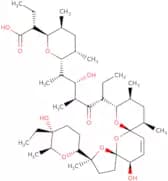
CAS:<p>Narasin is an ionophore antibiotic, which is a fermentation product derived from certain strains of the bacterium *Streptomyces aureofaciens*. It functions by disrupting the ion gradients across cell membranes, specifically facilitating the transport of sodium and potassium ions. This action interferes with the energy metabolism of certain pathogenic microorganisms, rendering them unable to proliferate effectively.</p>Fórmula:C43H72O11Pureza:Min. 95%Peso molecular:765.03 g/molN-Biotinyl-12-aminododecanoyltobramycin amide
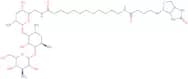
CAS:<p>N-Biotinyl-12-aminododecanoyltobramycin amide is a synthetic bioconjugate, which is derived from the aminoglycoside antibiotic tobramycin. This compound is chemically modified by the addition of a biotin moiety linked through a 12-aminododecanoyl spacer. The source of this product is rooted in the conjugation of biotin to tobramycin, allowing for targeted delivery and potential hybrid applications in both therapeutic and diagnostic fields.</p>Fórmula:C40H74N8O12SPureza:Min. 95%Peso molecular:891.13 g/molTigemonam
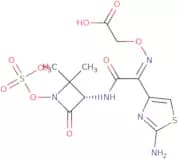
CAS:<p>Tigemonam is a synthetic beta-lactam antibiotic, which is derived from chemical synthesis processes. This compound operates by inhibiting bacterial cell wall synthesis, specifically targeting the penicillin-binding proteins (PBPs). The disruption of the cell wall synthesis ultimately leads to cell lysis and death of the bacteria, making it effective primarily against gram-negative bacterial infections.</p>Fórmula:C12H15N5O9S2Pureza:Min. 95%Peso molecular:437.41 g/molClarithromycin - EP
CAS:<p>A macrolide, broad-spectrum antibiotic that targets cytochrome P4503A4 (CYP3A4). Clarithromycin has been used to potentiate the pharmacological effects of some drugs that are metabolised by the cytochrome P450.</p>Fórmula:C38H69NO13Pureza:Min. 95%Peso molecular:747.95 g/molCeftarolin fosamil
CAS:Ceftaroline fosamil is an advanced antibiotic, which is a cephalosporin derived from synthetic sources with a broad spectrum of activity. It is a prodrug that, once metabolized, becomes active in the body, binding to penicillin-binding proteins (PBPs) of bacteria. This binding inhibits the proteins responsible for cell wall synthesis, leading to bacterial cell lysis and death.Fórmula:C22H21N8O8PS4Pureza:Min. 95%Peso molecular:684.69 g/mol7-Descarbamoyl 17-amino geldanamycin
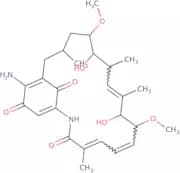
CAS:7-Descarbamoyl 17-amino geldanamycin is a semi-synthetic derivative of the benzoquinone ansamycin antibiotic geldanamycin, which is naturally produced by the bacterium *Streptomyces hygroscopicus*. As an inhibitor of the Heat Shock Protein 90 (Hsp90), it targets this molecular chaperone crucial for the stability and function of numerous oncoproteins. By inhibiting Hsp90, 7-Descarbamoyl 17-amino geldanamycin disrupts protein folding processes, leading to the degradation of client proteins and subsequent disruption of cell signaling pathways involved in tumor growth and survival.Fórmula:C27H38N2O7Pureza:Min. 95%Peso molecular:502.6 g/molPC 190723
CAS:<p>PC 190723 is a synthetic chemical compound, which is derived through targeted chemical synthesis processes involving precise organic reactions. Its mode of action involves disrupting cellular division by inhibiting specific protein functions essential for the mitotic process. This molecular interaction results in potent effects on cell division, making it a valuable tool for studying cellular mechanics and developing therapeutic strategies.</p>Fórmula:C14H8ClF2N3O2SPureza:Min. 95%Peso molecular:355.75 g/mol(10E)-3-O-De(a-L-cladinose)-10-dehydro-11-dehydroxy-6-O-methyl-erythromycin
CAS:Erythromycin derivativeFórmula:C30H53NO9Pureza:Min. 95%Peso molecular:571.74 g/molTropodithietic acid
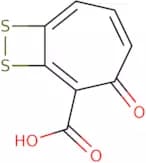
CAS:<p>Tropodithietic acid is a bioactive compound, which is a potent antibacterial agent derived from certain marine bacteria, including the genus Phaeobacter. This antibiotic is characterized by its ability to disrupt quorum sensing, a mechanism that bacteria use for communication and coordination of group behaviors, including virulence. By interfering with this process, tropodithietic acid impedes bacterial colonization and biofilm formation, effectively inhibiting pathogenic activity.</p>Pureza:Min. 95%Tridehydro pirlimycin
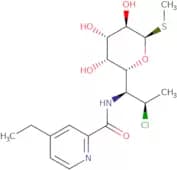
CAS:<p>Tridehydro pirlimycin is an antibiotic compound, which is a synthetic derivative with origins in the lincosamide family. It is characterized by its ability to inhibit bacterial protein synthesis by binding to the 50S ribosomal subunit, leading to a bacteriostatic effect. The compound is primarily developed for its use in veterinary medicine, particularly in the treatment and management of bacterial infections in animals.</p>Fórmula:C17H25ClN2O5SPureza:Min. 95%Peso molecular:404.91 g/molThiamphenicol
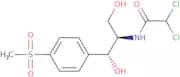
CAS:<p>Thiamphenicol is a semisynthetic derivative of chloramphenicol with action on bacterial protein synthesis inhibition and is used for treating bacterial infections, particularly in veterinary medicine.</p>Fórmula:C12H15Cl2NO5SPureza:Min. 98 Area-%Forma y color:PowderPeso molecular:356.22 g/molCephamycin C
CAS:<p>Cephamycin C is a cephalosporin antibiotic, which is a type of β-lactam antibiotic. It is derived from the fermentation process of certain Streptomyces species and other actinomycetes. Its mode of action involves inhibiting bacterial cell wall synthesis by binding to penicillin-binding proteins (PBPs). This inhibition disrupts the structural integrity of the bacterial cell wall, leading to cell lysis and death.</p>Fórmula:C16H22N4O9SPureza:Min. 95%Forma y color:PowderPeso molecular:446.4 g/molPazufloxacin
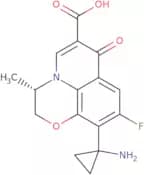
CAS:<p>Pazufloxacin is an antibacterial agent, which is a synthetic derivative originating from the fluoroquinolone class of compounds. This source categorizes it alongside a group of broad-spectrum antibiotics known for their efficacy against a wide variety of bacterial pathogens. The mode of action of pazufloxacin involves the inhibition of bacterial DNA gyrase and topoisomerase IV. These are essential enzymes for bacterial DNA replication, transcription, repair, and recombination processes. By inhibiting these enzymes, pazufloxacin disrupts the bacterial DNA processes, ultimately leading to cell death.</p>Fórmula:C16H15FN2O4Pureza:Min. 95%Peso molecular:318.3 g/mol11-Deoxyfusidic acid
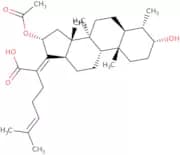
CAS:11-Deoxyfusidic acid is a steroidal antibiotic, which is derived from the fermentation broth of certain strains of fungi, specifically within the Fusidium genus. Its mode of action involves inhibiting bacterial protein synthesis by interacting with elongation factor G (EF-G) on the ribosome, thus disrupting essential processes and impeding bacterial growth.Fórmula:C31H48O5Pureza:Min. 95%Peso molecular:500.71 g/molVancomycin aglycon
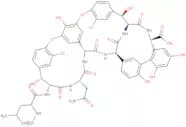
CAS:<p>Vancomycin aglycon is a glycopeptide antibiotic, which is a derivative of vancomycin. It is sourced from the fermentation products of certain Amycolatopsis species, a genus of actinobacteria. The mode of action of vancomycin aglycon involves the inhibition of bacterial cell wall synthesis. It specifically binds to the D-Ala-D-Ala terminus of nascent peptidoglycan chains, thereby preventing the cross-linking that is crucial for maintaining cell wall integrity.</p>Fórmula:C53H52Cl2N8O17Pureza:Min. 95%Peso molecular:1,143.93 g/molLoracarbef monohydrate
CAS:<p>Loracarbef monohydrate is a synthetic antibiotic, which is derived from carbacephem compounds with a mode of action that involves inhibiting bacterial cell wall synthesis. This is achieved by binding to penicillin-binding proteins, thereby blocking the cross-linking of peptidoglycan chains which are crucial for bacterial cell wall structural integrity.</p>Fórmula:C16H16ClN3O4·H2OPureza:Min. 95%Peso molecular:367.78 g/molSulfadiazine
CAS:Sulfadiazine is a sulfonamide antibiotic with action on bacterial folate synthesis inhibition and is used for treating toxoplasmosis and urinary tract infections.Fórmula:C10H10N4O2SPureza:Min. 95%Forma y color:PowderPeso molecular:250.28 g/molCycloheximide, Antibiotic for Culture Media Use Only
CAS:Cycloheximide, Antibiotic for Culture Media Use Only, is an antifungal agent derived from the Streptomyces griseus bacterium. Its primary mode of action involves the inhibition of eukaryotic protein synthesis by interfering with the translocation step on the 80S ribosome. This leads to rapid arrest of protein assembly, effectively limiting fungal and certain yeast growth in culture.Fórmula:C15H23NO4Peso molecular:281.35 g/molRef: 3D-C-9217
10gA consultar25gA consultar50gA consultar100gA consultar250gA consultar-Unit-ggA consultar7-Deazaadenosine, Antibiotic for Culture Media Use Only
CAS:7-Deazaadenosine is a chemical compound used as an antibiotic for culture media, which is a synthetic nucleoside analog derived from adenosine. Its structure is modified by replacing a nitrogen atom in the purine ring with a carbon atom, thus altering its biological interactions. The primary mode of action of 7-Deazaadenosine involves its incorporation into nucleic acids, where it acts as an inhibitor of nucleic acid-processing enzymes. This interference can effectively impede processes like DNA and RNA synthesis.Fórmula:C11H14N4O4Pureza:Min. 97.0 Area-%Peso molecular:266.25 g/molRef: 3D-W-203540
1gA consultar100mgA consultar250mgA consultar500mgA consultar2500mgA consultar-Unit-ggA consultarThienamycin
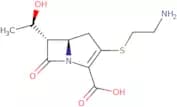
CAS:<p>Thienamycin is a β-lactam antibiotic, which originates from the fermentation of the bacterium *Streptomyces cattleya*. Its mode of action involves inhibiting the synthesis of bacterial cell walls. Thienamycin accomplishes this by binding to penicillin-binding proteins (PBPs) critical for peptidoglycan construction, thereby disrupting cell wall integrity and leading to bacterial lysis.</p>Fórmula:C11H16N2O4SPureza:80%MinForma y color:PowderPeso molecular:272.32 g/mol