


Building Blocks
Esta sección contiene productos fundamentales para la síntesis de compuestos orgánicos y biológicos. Building blocks son los materiales de partida esenciales utilizados para construir moléculas complejas a través de diversas reacciones químicas. Desempeñan un papel crítico en el descubrimiento de fármacos, la ciencia de materiales y la investigación química. En CymitQuimica, ofrecemos una gama diversa de building blocks de alta calidad para apoyar sus investigaciones innovadoras y proyectos industriales, asegurando que tenga los componentes esenciales para una síntesis exitosa.
Subcategorías de "Building Blocks"
- Ácidos borónicos y derivados del ácido borónico(5.781 productos)
- Building Blocks quirales(1.242 productos)
- Building Blocks de hidrocarburos(6.101 productos)
- Building Blocks orgánicos(61.033 productos)
Se han encontrado 205320 productos de "Building Blocks"
Ordenar por
Pureza (%)
0
100
|
0
|
50
|
90
|
95
|
100
3-(4-Amino-2-chlorophenoxymethyl)benzonitrile
CAS:Versatile small molecule scaffoldFórmula:C14H11ClN2OPureza:Min. 95%Peso molecular:258.7 g/mol5-(Methylsulfanyl)pyridine-2-carbonitrile
CAS:Versatile small molecule scaffoldFórmula:C7H6N2SPureza:Min. 95%Peso molecular:150.2 g/mol4-{[(2,2,2-Trifluoroethyl)amino]methyl}benzene-1-sulfonamide
CAS:Versatile small molecule scaffoldFórmula:C9H11F3N2O2SPureza:Min. 95%Peso molecular:268.26 g/mol2-{2-Amino-5,7-dimethyl-[1,2,4]triazolo[1,5-a]pyrimidin-6-yl}acetic acid
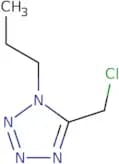
CAS:Versatile small molecule scaffoldFórmula:C9H11N5O2Pureza:Min. 95%Peso molecular:221.22 g/mol5-(Chloromethyl)-1-propyl-1H-1,2,3,4-tetrazole
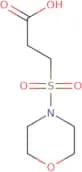
CAS:Versatile small molecule scaffoldFórmula:C5H9ClN4Pureza:Min. 95%Peso molecular:160.6 g/mol3-(Morpholine-4-sulfonyl)propanoic acid
CAS:Versatile small molecule scaffoldFórmula:C7H13NO5SPureza:Min. 95%Peso molecular:223.25 g/mol2-[(1,1-Dioxo-1,2-benzothiazol-3-yl)sulfanyl]propanoic acid
CAS:Versatile small molecule scaffoldFórmula:C10H9NO4S2Pureza:Min. 95%Peso molecular:271.3 g/mol5-Methyl-2-[3-(trifluoromethyl)phenyl]-1,3-oxazole-4-carboxylic acid
CAS:Versatile small molecule scaffoldFórmula:C12H8F3NO3Pureza:Min. 95%Peso molecular:271.19 g/mol3-Cyclopropyl-3-hydroxyazetidine hydrochloride
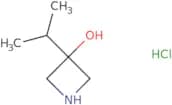
CAS:Versatile small molecule scaffoldFórmula:C6H11NO·HClPureza:Min. 95%Peso molecular:149.61 g/mol3-(Propan-2-yl)azetidin-3-ol hydrochloride
CAS:3-(Propan-2-yl)azetidin-3-ol hydrochloride is a compound that belongs to the group of pyrrolizidine alkaloids. It acts as an inhibitor, particularly against selenite, by forming electrostatic interactions. This compound has been shown to modulate dopamine release and uptake in the brain, making it a potential candidate for research in neurological disorders. Additionally, 3-(Propan-2-yl)azetidin-3-ol hydrochloride can be used as a research chemical for electrode modification due to its ability to form stable complexes with 1,2,4-oxadiazole benzoic acid and benzoate derivatives. Furthermore, this compound exhibits emission properties when activated by collagen or alkaloid compounds. Its unique characteristics make it a versatile compound for various research applications.Fórmula:C6H14ClNOPureza:Min. 95%Peso molecular:151.63 g/mol3-Hydroxy-3-(trifluoromethyl)azetidine hydrochloride
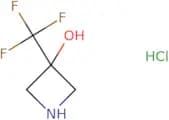
CAS:Versatile small molecule scaffoldFórmula:C4H6F3NO·HClPureza:Min. 95%Peso molecular:177.55 g/mol4-[6-(Bromomethyl)-5H,6H-[1,2,4]triazolo[3,4-b][1,3]thiazol-3-yl]pyridine
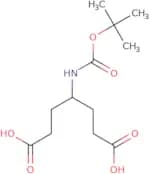
CAS:Versatile small molecule scaffoldFórmula:C10H9BrN4SPureza:Min. 95%Peso molecular:297.18 g/mol4-(N-Boc-amino)-1,6-heptanedioic acid
CAS:Versatile small molecule scaffoldFórmula:C12H21NO6Pureza:Min. 95%Peso molecular:275.3 g/mol(1,1-dioxothiolan-2-yl)methanamine
CAS:Versatile small molecule scaffold
Fórmula:C5H11NO2SPureza:Min. 95%Peso molecular:149.21 g/molEthyl 4H-thieno[3,2-b]pyrrole-2-carboxylate
CAS:Versatile small molecule scaffoldFórmula:C9H9NO2SPureza:Min. 95%Peso molecular:195.24 g/mol2-Chloro-4-methylthiophen-3-amine hydrochloride
CAS:Versatile small molecule scaffold
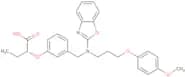
Fórmula:C5H7Cl2NSPureza:Min. 95%Peso molecular:184.09 g/molPemafibrate
CAS:Pemafibrate is a research chemical that has shown potential in various applications. It is derived from d-tagatose and has been studied for its emissions-reducing properties. Pemafibrate also exhibits properties similar to dianhydrogalactitol, an aluminum-based compound used in certain industrial processes. Additionally, it has been explored as a nitrification inhibitor, which can help reduce the release of metallic compounds into the environment.
Fórmula:C28H30N2O6Pureza:Min. 95%Peso molecular:490.55 g/mol3-[Methoxy(methyl)sulfamoyl]benzoic acid
CAS:3-[Methoxy(methyl)sulfamoyl]benzoic acid is a research tool used to study the activation of receptors, ion channels, and other proteins. It is a ligand that binds to the receptor and acts as an inhibitor. 3-[Methoxy(methyl)sulfamoyl]benzoic acid is also used as a reagent for cell biology, antibody production, protein interactions, pharmacology, peptides and other life science applications.Fórmula:C9H11NO5SPureza:Min. 95%Peso molecular:245.25 g/mol3-[(Carbamoylmethyl)sulfamoyl]benzoic acid
CAS:Versatile small molecule scaffoldFórmula:C9H10N2O5SPureza:Min. 95%Peso molecular:258.25 g/molEthyl 2-{3-[(6-nitro-2,4-dihydro-1,3-benzodioxin-8-yl)methyl]-4-oxo-1,3-thiazolidin-2-ylidene}acetate
CAS:Versatile small molecule scaffoldFórmula:C16H16N2O7SPureza:Min. 95%Peso molecular:380.4 g/mol


![4-{[(2,2,2-Trifluoroethyl)amino]methyl}benzene-1-sulfonamide](/_next/image/?url=https%3A%2Fstatic.cymitquimica.com%2Fproducts%2F3D%2Fthumb-webp%2FYIB17844.webp&w=3840&q=75)
![2-{2-Amino-5,7-dimethyl-[1,2,4]triazolo[1,5-a]pyrimidin-6-yl}acetic acid](/_next/image/?url=https%3A%2Fstatic.cymitquimica.com%2Fproducts%2F3D%2Fthumb-webp%2FYIB17846.webp&w=3840&q=75)
![2-[(1,1-Dioxo-1,2-benzothiazol-3-yl)sulfanyl]propanoic acid](/_next/image/?url=https%3A%2Fstatic.cymitquimica.com%2Fproducts%2F3D%2Fthumb-webp%2FYIB17909.webp&w=3840&q=75)
![5-Methyl-2-[3-(trifluoromethyl)phenyl]-1,3-oxazole-4-carboxylic acid](/_next/image/?url=https%3A%2Fstatic.cymitquimica.com%2Fproducts%2F3D%2Fthumb-webp%2FYIB18839.webp&w=3840&q=75)
![4-[6-(Bromomethyl)-5H,6H-[1,2,4]triazolo[3,4-b][1,3]thiazol-3-yl]pyridine](/_next/image/?url=https%3A%2Fstatic.cymitquimica.com%2Fproducts%2F3D%2Fthumb-webp%2FYIB20744.webp&w=3840&q=75)
![Ethyl 4H-thieno[3,2-b]pyrrole-2-carboxylate](/_next/image/?url=https%3A%2Fstatic.cymitquimica.com%2Fproducts%2F3D%2Fthumb-webp%2FYIB24385.webp&w=3840&q=75)
![3-[Methoxy(methyl)sulfamoyl]benzoic acid](/_next/image/?url=https%3A%2Fstatic.cymitquimica.com%2Fproducts%2F3D%2Fthumb-webp%2FYIB29016.webp&w=3840&q=75)
![3-[(Carbamoylmethyl)sulfamoyl]benzoic acid](/_next/image/?url=https%3A%2Fstatic.cymitquimica.com%2Fproducts%2F3D%2Fthumb-webp%2FYIB29020.webp&w=3840&q=75)
![Ethyl 2-{3-[(6-nitro-2,4-dihydro-1,3-benzodioxin-8-yl)methyl]-4-oxo-1,3-thiazolidin-2-ylidene}acet…](/_next/image/?url=https%3A%2Fstatic.cymitquimica.com%2Fproducts%2F3D%2Fthumb-webp%2FYIB29903.webp&w=3840&q=75)