Ácidos carboxílicos
Se han encontrado 12454 productos de "Ácidos carboxílicos"
Alpha-Helical CRF (12-41) trifluoroacetate salt
CAS:Please enquire for more information about Alpha-Helical CRF (12-41) trifluoroacetate salt including the price, delivery time and more detailed product information at the technical inquiry form on this pageFórmula:C152H251N43O47S2Pureza:Min. 95%Peso molecular:3,497.01 g/mol1-(Mercaptomethyl)cyclopropaneacetic acid
CAS:1-(Mercaptomethyl)cyclopropaneacetic acid is a reaction product of hydrolysis, transfer, and industrialization. It is used in the synthesis of organic compounds such as quinolinediols and thioureas. 1-(Mercaptomethyl)cyclopropaneacetic acid is typically prepared by the reaction of an alkylsulfonyl chloride with an inorganic base such as lithium or sodium carbonate in an organic solvent such as acetonitrile. The compound is also used to produce other organosulfur compounds, including imino sulfides and disulfides.Fórmula:C6H10O2SPureza:Min. 95%Forma y color:PowderPeso molecular:146.21 g/molAngiotensin II trifluoroacetate salt
CAS:Angiotensin II is a peptide hormone that may act as a neurotransmitter or neuromodulator. It is one of the most important vasoconstrictor and aldosterone-secreting hormones produced by the renin-angiotensin system in mammals. Angiotensin II has been shown to stimulate cardiac contractility, increase vascular resistance, and regulate blood pressure. The effect of Angiotensin II on cardiac contractility is mediated through its binding to a response element in the promoter region of genes encoding for Ca2+ channels. This binding leads to increased Ca2+ influx into cardiac cells and increased myofibrillar Ca2+ sensitivity. Angiotensin II also activates reactive oxygen species (ROS) production, which causes injury to the renal tubular epithelium and induces tubulointerstitial injury in rats with diabetes. It also stimulates squamous cell carcinoma growth by inducing reactive oxygen species (ROS) production and activating signal trans
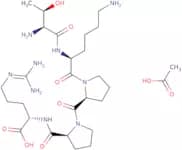
Fórmula:C50H71N13O12·xC2HF3O2Pureza:Min. 95%Peso molecular:1,046.18 g/molH-Thr-Lys-Pro-Pro-Arg-OH acetate salt
CAS:Producto controladoPlease enquire for more information about H-Thr-Lys-Pro-Pro-Arg-OH acetate salt including the price, delivery time and more detailed product information at the technical inquiry form on this pageFórmula:C26H47N9O7Pureza:Min. 95%Peso molecular:597.71 g/molCGRP (chicken) trifluoroacetate salt
CAS:Trifluoroacetate saltFórmula:C165H262N52O50S2Pureza:Min. 95%Peso molecular:3,838.3 g/molNeuropeptide Y (free acid) (human, rat) trifluoroacetate salt
CAS:Please enquire for more information about Neuropeptide Y (free acid) (human, rat) trifluoroacetate salt including the price, delivery time and more detailed product information at the technical inquiry form on this pageFórmula:C189H284N54O58SPureza:Min. 95%Peso molecular:4,272.67 g/molAlloferon 2 trifluoroacetate salt
CAS:Please enquire for more information about Alloferon 2 trifluoroacetate salt including the price, delivery time and more detailed product information at the technical inquiry form on this pageFórmula:C46H69N19O15Pureza:Min. 95%Peso molecular:1,128.16 g/molH-Val-Ile-His-Thr-EDANS acetate salt
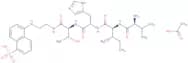
CAS:Producto controladoPlease enquire for more information about H-Val-Ile-His-Thr-EDANS acetate salt including the price, delivery time and more detailed product information at the technical inquiry form on this pageFórmula:C33H48N8O8SPureza:Min. 95%Peso molecular:716.85 g/molDocosahexaenoic acid ethyl ester
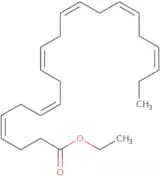
CAS:Docosahexaenoic acid ethyl ester (DHAEE) is a biologically active form of docosahexaenoic acid (DHA), which is an omega-3 polyunsaturated fatty acid. DHAEE is synthesized from DHA through the process of acylation with ethanol. It has been shown to have antioxidant and anti-inflammatory properties in animal studies, as well as improved brain functions. When given to rats, it prevents neuronal death and has been shown to reduce the risk of congestive heart failure.Fórmula:C24H36O2Pureza:Min. 95%Forma y color:Colorless Yellow Clear LiquidPeso molecular:356.54 g/molH-Pro-Pro-Asp-NH2 trifluoroacetate salt
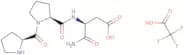
CAS:Please enquire for more information about H-Pro-Pro-Asp-NH2 trifluoroacetate salt including the price, delivery time and more detailed product information at the technical inquiry form on this pageFórmula:C14H22N4O5·C2HF3O2Pureza:Min. 95%Forma y color:SolidPeso molecular:440.37 g/molMca-Amyloid beta/A4 Protein Precursor770 (667-676)-Lys(Dnp)-Arg-Arg amide trifluoroacetate salt
CAS:Please enquire for more information about Mca-Amyloid beta/A4 Protein Precursor770 (667-676)-Lys(Dnp)-Arg-Arg amide trifluoroacetate salt including the price, delivery time and more detailed product information at the technical inquiry form on this pageFórmula:C87H129N27O28SPureza:Min. 95%Peso molecular:2,033.19 g/molN-Methyliminodiacetic Acid
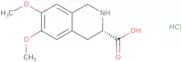
CAS:N-Methyliminodiacetic acid is a monosodium salt that is produced by the reaction of methylamine and malonic acid. It has been shown to have an inhibitory effect on enzymes and metabolic rates in the human body. The structure of N-methyliminodiacetic acid contains a hydroxyl group, which can form hydrogen bonding interactions with nitrogen atoms in proteins, forming a chelate ligand. This type of binding is thought to be responsible for its ability to inhibit enzyme activities and metabolic rate.Fórmula:C5H9NO4Pureza:Min. 95%Peso molecular:147.13 g/mol(S)-(-)-6,7-Dimethoxy-1,2,3,4-tetrahydroisoquinoline-3-carboxylic acid hydrochloride
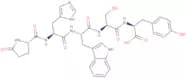
CAS:(S)-(-)-6,7-Dimethoxy-1,2,3,4-tetrahydroisoquinoline-3-carboxylic acid hydrochloride is a synthetic chiral compound that is used to study the role of glyoxylate in biochemical reactions. This drug is an enolate and alkylating agent that can react with nucleophiles such as amines and thiols. It has been shown to be effective against perchlorates by hydrolyzing them into chlorine and oxygen gas. This drug has also been shown to inhibit the growth of Rhodobacter sphaeroides by inhibiting glyoxylate metabolism.Fórmula:C12H15NO4·HClPureza:Min. 95%Forma y color:White PowderPeso molecular:273.71 g/molLHRH (1-5) (free acid) trifluoroacetate salt
CAS:LHRH (1-5) (free acid) trifluoroacetate salt is a synthetic hormone that is used in the treatment of prostate cancer. It inhibits the release of luteinizing hormone and follicle-stimulating hormone from the anterior pituitary gland, which suppresses testosterone production by the testes. LHRH (1-5) (free acid) trifluoroacetate salt is synthesized industrially using a liquid phase synthesis. The product may be recycled by returning it to the manufacturing process or using it as an additive for plastics or other industrial products. LHRH (1-5) (free acid) trifluoroacetate salt was shown to be active against tumor cells in culture and inhibited cell growth in culture. This drug has been shown to inhibit the production of nitric oxide, which may contribute to its anti-tumor activity. LHRH (1-5) (free acid)Fórmula:C34H38N8O9Pureza:Min. 95%Forma y color:PowderPeso molecular:702.71 g/mol4-[2-[[(1S)-1-(2-Aminophenyl)-3-methylbutyl]amino]-2-oxoethyl]-2-ethoxybenzoic acid
CAS:Bosentan is a potent inhibitor of the uptake of organic anions. It is used in the treatment of pulmonary arterial hypertension and has been shown to be effective against pravastatin-resistant HIV protease inhibitors, such as saquinavir, quinidine, and rosuvastatin. Bosentan inhibits uptake by binding to the transporter protein at a site that does not overlap with the binding site for organic anion substrates. This leads to a change in kinetic parameters for substrates, such as pravastatin and saquinavir. The binding site on bosentan may also be elucidated through monolayer experiments with efflux transporters.
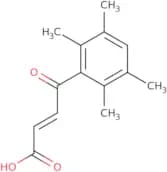
Fórmula:C22H28N2O4Pureza:Min. 95%Peso molecular:384.47 g/mol3-(2,3,5,6-Tetramethylbenzoyl)-acrylic acid
CAS:3-(2,3,5,6-Tetramethylbenzoyl)-acrylic acid is a versatile building block for the synthesis of complex compounds. It is used as a reagent to make other chemicals and has been used in the synthesis of research chemicals. 3-(2,3,5,6-Tetramethylbenzoyl)-acrylic acid is also useful as an intermediate or scaffold compound in organic chemistry. This product has high purity and quality.Fórmula:C14H16O3Pureza:Min. 95%Peso molecular:232.28 g/mol2-Bromopropionic acid benzyl ester
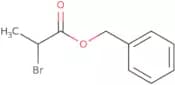
CAS:2-Bromopropionic acid benzyl ester is a synthetic compound with a molecular weight of 220.24 g/mol. It is soluble in organic solvents and has a hydroxyl group at its alpha position. 2-Bromopropionic acid benzyl ester is used in the synthesis of beta-cyclodextrin, which is an important biomaterial for drug delivery as well as other applications. 2-Bromopropionic acid benzyl ester also has antioxidant properties and can be used to treat leukemia cells by inhibiting the production of reactive oxygen species (ROS).
Fórmula:C10H11BrO2Pureza:Min. 95%Peso molecular:243.1 g/molIsopropyl 2-amino-4-hydroxy-5,8-dihydropyrido[3,4-d]pyrimidine-7(6H)-carboxylate
CAS:Please enquire for more information about Isopropyl 2-amino-4-hydroxy-5,8-dihydropyrido[3,4-d]pyrimidine-7(6H)-carboxylate including the price, delivery time and more detailed product information at the technical inquiry form on this page
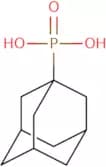
Fórmula:C11H16N4O3Pureza:Min. 95%Peso molecular:252.27 g/mol1-Adamantylphosphonic acid
CAS:1-Adamantylphosphonic acid (1APA) is a trifluoroacetic acid derivative that is used as an organic solvent. It is also a catalyst in organic chemistry. 1APA can be used to catalyze the carbonylation of olefins with phosphines, which are ligands that bind to metal compounds and facilitate chemical reactions. Ferrocene, adamantyl, and metallocene are all examples of ligands. 1APA is also used as a reagent in the synthesis of phosphine ligands, which are used in catalytic reactions.Fórmula:C10H17O3PPureza:Min. 95%Peso molecular:216.21 g/mol2-(2-Naphthyloxy)propanoic acid
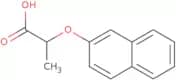
CAS:2-(2-Naphthyloxy)propanoic acid is a naphthalene derivative that is found in the plant species Carthamus tinctorius. It has been shown to have potent antagonist activity against the NMDA receptor, as well as antinociceptive and analgesic properties in vivo. 2-(2-Naphthyloxy)propanoic acid also shows potent anti-inflammatory and cardioprotective effects in vitro and in vivo. 2-(2-Naphthyloxy)propanoic acid can be used for the treatment of bone cancer, congestive heart failure, diabetic neuropathy, or other disorders of the peripheral nervous system.
Fórmula:C13H12O3Pureza:Min. 95%Peso molecular:216.23 g/mol






![4-[2-[[(1S)-1-(2-Aminophenyl)-3-methylbutyl]amino]-2-oxoethyl]-2-ethoxybenzoic acid](/_next/image/?url=https%3A%2Fstatic.cymitquimica.com%2Fproducts%2F3D%2Fthumb-webp%2FFD21379.webp&w=3840&q=75)
![Isopropyl 2-amino-4-hydroxy-5,8-dihydropyrido[3,4-d]pyrimidine-7(6H)-carboxylate](/_next/image/?url=https%3A%2Fstatic.cymitquimica.com%2Fproducts%2F3D%2Fthumb-webp%2FFI135088.webp&w=3840&q=75)