Glycoscience
Subcategorías de "Glycoscience"
- Aminoazúcares(108 productos)
- Anticuerpos relacionados con azúcares(284 productos)
- Glicolípidos(46 productos)
- Glicosaminoglicanos (GAGs)(55 productos)
- Glucósidos(419 productos)
- Monosacáridos(6.622 productos)
- Oligosacáridos(3.699 productos)
- Polisacáridos(506 productos)
Se han encontrado 11035 productos de "Glycoscience"
L-[UL-13C6]Rhamnose monohydrate
CAS:L-[UL-13C6]Rhamnose monohydrate is a high purity, custom synthesis sugar. It has been modified with fluorination, glycosylation and methylation to synthesize a complex carbohydrate. This compound has been shown to be useful in the synthesis of oligosaccharides and monosaccharides. L-[UL-13C6]Rhamnose monohydrate is also used in click chemistry, which is a new method that uses the copper-catalyzed azide-alkyne cycloaddition reaction to form stable covalent bonds between molecules. The CAS number for this compound is 10030-85-0 (unlabelled).Fórmula:C6H12O5·H2OPureza:Min. 95%1,2,3,4-Tetra-O-benzoyl-6-O-trityl-b-D-glucopyranose
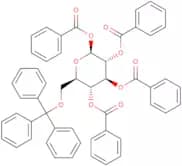
CAS:1,2,3,4-Tetra-O-benzoyl-6-O-trityl-b-D-glucopyranose is a custom synthesis that can be used for methylation and Click modification. This compound is an oligosaccharide consisting of sugar molecules linked by glycosidic bonds. It is a polysaccharide with a saccharide repeating unit composed of monosaccharides. The carbohydrate chain contains 1,2,3,4 tetra O benzoyl groups and 6 O trityl groups. This product has a high purity and can be used in the synthesis of other compounds. 1,2,3,4 Tetra O benzoyl 6 O trityl b D glucopyranose (1) was synthesized from 4-(2'-hydroxyethyl)benzaldehyde (2), 4-(2'-hydroxyethyl)benzoic acid (3),Fórmula:C53H42O10Pureza:Min. 95%Peso molecular:838.89 g/molD-Cellobiose
CAS:Cellobiose is a reducing disaccharide consisting of two β(1-4)-linked glucopyranose units. It is produced by the hydrolysis of cellulose, a homopolysaccharide of glucose with β(1-4)-linkages. Cellobiose constitutes the polar part of cellobiose lipids (CLs) that are secreted by yeasts and mycelia fungi. Their various biological activities have led to a range of applications in the food industry, pharmaceutical industry and in medicine. Cellobiose itself has been used as an indicator carbohydrate for Crohns disease and malabsorption syndrome. In biotechnology, cellobiose is one of the sugars explored for the synthesis of biotensides.Fórmula:C12H22O11Pureza:Min. 98.0 Area-%Peso molecular:342.30 g/molMycothione
Please enquire for more information about Mycothione including the price, delivery time and more detailed product information at the technical inquiry form on this pageFórmula:C34H58N4O24S2Pureza:Min. 95%Peso molecular:970.97 g/molDecyl b-D-glucopyranoside
CAS:Decyl b-D-glucopyranoside is a cationic surfactant, which inhibits bacterial growth by disrupting the lipid bilayer of the cell membrane. It has been used as an antimicrobial agent in the treatment of autoimmune diseases and as a preservative in cosmetics. Decyl b-D-glucopyranoside has also been shown to be effective against citric acid and sodium citrate, two common components of biofilm formation. Decyl b-D-glucopyranoside has chemical stability in both acidic and alkaline environments and is not affected by pH levels. It is also a fatty acid with a hydroxyl group and an ethylene diamine side chain.Fórmula:C16H32O6Pureza:Min. 90 Area-%Forma y color:White PowderPeso molecular:320.42 g/mol2,4,6-Tri-O-acetyl-3-O-benzyl-b-D-glucopyranosylamine
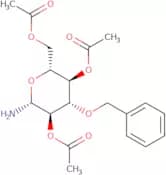
CAS:Building block for 3-O-modified glucosylamide-linked glyconconjugatesFórmula:C19H25NO8Pureza:Min. 95%Forma y color:PowderPeso molecular:395.4 g/mol4-Deoxy-4-fluoro-D-glucose
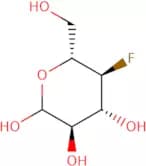
CAS:4-Deoxy-4-fluoro-D-glucose is a biochemical compound that is used to bind to the carbon source in target tissues. It has a fluorine atom and two hydroxy groups, which are responsible for its biological properties. 4-Deoxy-4-fluoro-D-glucose binds to the 6 phosphate in bacterial enzymes and inhibits their activity, leading to cell death. It also binds to the hydroxyl group of proteins and alters their function. 4-Deoxy-4-fluoro-D-glucose is an inhibitor of bacterial enzymes, but has no effect on eukaryotic cells due to its inability to bind with these types of enzymes.Fórmula:C6H11FO5Pureza:Min. 95%Forma y color:PowderPeso molecular:182.15 g/mol1,2,3,4,6-Penta-O-galloyl-a-D-glucopyranose
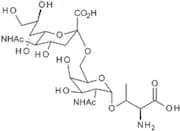
CAS:1,2,3,4,6-Penta-O-galloyl-a-D-glucopyranose is a natural compound that inhibits the Cox-2 enzyme and has anti-cancer properties. It induces cell death by increasing oxidative injury and suppressing autophagy. 1,2,3,4,6-Penta-O-galloyl-a-D-glucopyranose has been shown to reduce xenograft tumor growth in mice while causing no observable toxic effects on normal tissues. This compound also inhibits the proapoptotic protein Bax and promotes the expression of Bcl2 in 3T3L1 preadipocytes. The mechanism of action may be related to its ability to inhibit basic fibroblast proliferation and induce apoptosis in k562 cells.Fórmula:C41H32O26Pureza:Min. 95%Forma y color:Off-White PowderPeso molecular:940.68 g/mol2-Acetamido-6-O-(a-2-N-acetylneuraminyl)-2-deoxy-a-D-galactopyranosyl threonine
2-Acetamido-6-O-(a-2-N-acetylneuraminyl)-2-deoxy-a-D-galactopyranosyl threonine is a carbohydrate antigen that is expressed on the surface of cancer cells. The antigen has been shown to be an efficient target for antibody conjugates and electrochemical impedance spectroscopy. 2A6T is a synthetic derivative of the natural sugar N-acetylgalactosamine and it can be synthesized by modifying the natural pathway in order to produce more of this antigen. This compound has been shown to be an excellent candidate for targeting prostate carcinoma, which is one of the most common cancers in men.Fórmula:C23H39N3O16Pureza:Min. 95%Peso molecular:613.57 g/mol1,2-O-Isopropylidene-3-deoxy-3-fluoro-a-D-xylofuranose
CAS:1,2-O-Isopropylidene-3-deoxy-3-fluoro-a-D-xylofuranose is a synthetic compound that has been modified by methylation, saccharide and glycosylation. It is a fluorinated sugar that can be used for Click modification, such as for oligosaccharide synthesis or other modifications. 1,2-O-Isopropylidene-3-deoxy-3-fluoro-a-D-xylofuranose is a high purity compound that can be custom synthesized to your specifications. It has CAS No. 1853084 2 and is listed under the Glycosylation section in the Carbohydrate database.Fórmula:C8H13FO4Pureza:Min. 95%Peso molecular:192.18 g/mol2,6-di-O-n-pentyl-3-O-trifluroacetyl-γ-cyclodextrin
This gamma-cyclodextrin (γ-CD) derivative is a modified cyclic oligosaccharide composed of eight glucose units, featuring a larger cavity size than α- and β-cyclodextrins. This structural characteristic allows γ-CDs to form inclusion complexes with a wider range of guest molecules, making it particularly versatile in various industries. In the food sector, it is used as a carrier and stabilizer for flavors, fat-soluble vitamins, and polyunsaturated fatty acids, protecting volatile compounds from evaporation. In pharmaceuticals, it enhances the solubility and bioavailability of poorly water-soluble drugs and, thanks to its larger ring size, allows for the encapsulation of larger molecules or even entire drug molecules. γ-CDs and derivatives are also used for environmental remediation and, in analytical chemistry, for the extraction and concentration of target substances.Fórmula:C144H232F24O48Pureza:Min. 95%Peso molecular:3,187.32 g/mol3, 5- O-Isopropylidene - D- lyxonic acid γ-lactone
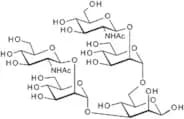
3,5-O-Isopropylidene-D-lyxonic acid gamma-lactone is a sugar that belongs to the group of carbohydrates. It is synthesized by the chemical modification of D-lyxonic acid and has been shown to inhibit the growth of bacteria. 3,5-O-Isopropylidene - D-lyxonic acid gamma-lactone inhibits bacterial growth by binding to the enzyme beta - galactosidase, which is involved in glycosylation and glycosyltransferase activity. This compound also inhibits protein synthesis in bacteria and has been shown to have antiinflammatory properties. 3,5-O-Isopropylidene - D-lyxonic acid gamma-lactone may be used as an alternative sweetener or food additive.Pureza:Min. 95%Bianntennary N-linked core pentasaccharide
The bianntennary N-linked core pentasaccharide is an oligosaccharide that contains a biantennary glycan and a high purity. This product can be custom synthesized with custom modifications. The bianntennary N-linked core pentasaccharide is an excellent substrate for Click modification, fluorination, and glycosylation reactions. It has been shown to have antiviral activity against herpes simplex virus type 1 (HSV-1) in the guinea pig erythrocyte assay. This product has been methylated at the 6 position of the sugar moiety to yield a modified form.Fórmula:C34H58N2O26Pureza:Min. 95 Area-%Forma y color:White PowderPeso molecular:910.82 g/mol2,6-di-O-n-pentyl-3-O-n-butyryl-γ-cyclodextrin
This gamma-cyclodextrin (γ-CD) derivative is a modified cyclic oligosaccharide composed of eight glucose units, featuring a larger cavity size than α- and β-cyclodextrins. This structural characteristic allows γ-CDs to form inclusion complexes with a wider range of guest molecules, making it particularly versatile in various industries. In the food sector, it is used as a carrier and stabilizer for flavors, fat-soluble vitamins, and polyunsaturated fatty acids, protecting volatile compounds from evaporation. In pharmaceuticals, it enhances the solubility and bioavailability of poorly water-soluble drugs and, thanks to its larger ring size, allows for the encapsulation of larger molecules or even entire drug molecules. γ-CDs and derivatives are also used for environmental remediation and, in analytical chemistry, for the extraction and concentration of target substances.Fórmula:C160H288O48Pureza:Min. 95%Peso molecular:2,979.97 g/molD-Arabinose
CAS:D-Arabinose is a dinucleotide phosphate that is an important metabolic intermediate in the pentose phosphate pathway. It has been shown to have pharmacological effects, such as enzyme inhibition and binding to DNA. D-Arabinose has been used in biochemical studies of energy metabolism and related areas. D-Arabinose is converted to ribitol by ribitol dehydrogenase, which can be oxidized to ribulose 5-phosphate by ribulose 5-phosphate dehydrogenase. The conversion of D-arabinose to ribitol requires NAD(P)H, which provides the reducing power for this reaction. The conversion of ribitol to ribulose 5-phosphate also requires NAD(P)H, but does not produce any reducing power. A redox potential measurement was used to determine the relative reduction potentials of the two reactions and found that they are equal at -0.5 volts (V).
Fórmula:C5H10O5Peso molecular:150.13 g/molRef: 3D-A-8200
1kgA consultar5kgA consultar10kgA consultar25kgA consultar2500gA consultar-Unit-kgkgA consultarBlood Group A pentasaccharide type I
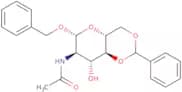
A antigen pentasaccharide Type I, possible use in antiviral developmentFórmula:C34H58N2O25Pureza:Min. 85%Forma y color:PowderPeso molecular:894.82 g/molBenzyl 2-acetamido-4,6-O-benzylidene-2-deoxy-β-D-glucopyranoside
CAS:This product is a computational, experimental, and acoustic expansion of benzyl 2-acetamido-4,6-O-benzylidene-2-deoxy-b-D-glucopyranoside. It is used as an additive to motorcycle fuel, with the purpose of preventing engine knock. The experiment was conducted by measuring the pressure levels in a cylinder at different temperatures. The results showed that the highest pressure level was obtained when the temperature was increased to 220 degrees Celsius and the pressure level decreased when it was lowered to 200 degrees Celsius.Fórmula:C22H25NO6Pureza:Min. 95%Forma y color:White to off-white solid.Peso molecular:399.44 g/mol1-O-Benzyl-2,3:4,6-di-O-isopropylidene-a-L-sorbofuranoside
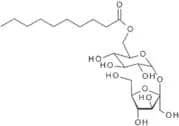
1-O-Benzyl-2,3:4,6-di-O-isopropylidene-a-L-sorbofuranoside is an oligosaccharide that is used for the synthesis of saccharides and polysaccharides. It has a molecular weight of 296.1 g/mol and a CAS number of 257874-01-8. The product can be synthesized from 1,2,3,4,6,-O-isopropylidene sorbitol and benzaldehyde via methylation and click modification. This product is also used in the fluorination of complex carbohydrates. 1,2,3,4,6,-O-isopropylidene sorbitol can be modified by various methods to produce different products with different properties. It has a purity level of ≥98% (HPLC) and is made up of one monosaccharide sugar unit with a single reactiveFórmula:C19H26O6Pureza:Min. 95%Peso molecular:350.41 g/molSucrose monocaprate
CAS:Non-ionic detergentFórmula:C22H40O12Pureza:Min. 97 Area-%Forma y color:White PowderPeso molecular:496.55 g/molMethyl 2,3:4,5:6,7-Tri-O-isopropylidene-D-glycero-D-talo-heptonate
CAS:Methyl 2,3:4,5:6,7-Tri-O-isopropylidene-D-glycero-D-talo-heptonate is a methyl glycoside that can be used for the modification of saccharides and oligosaccharides. This product is also useful as an intermediate in the synthesis of complex carbohydrates.Fórmula:C17H28O8Pureza:Min. 95%Peso molecular:360.4 g/mol
![L-[UL-13C6]Rhamnose monohydrate](/_next/image/?url=https%3A%2Fstatic.cymitquimica.com%2Fproducts%2F3D%2Fthumb-webp%2FMR182508.webp&w=3840&q=75)