Glycoscience
Subcategorías de "Glycoscience"
- Aminoazúcares(108 productos)
- Anticuerpos relacionados con azúcares(282 productos)
- Glicolípidos(46 productos)
- Glicosaminoglicanos (GAGs)(55 productos)
- Glucósidos(419 productos)
- Monosacáridos(6.624 productos)
- Oligosacáridos(3.682 productos)
- Polisacáridos(504 productos)
Se han encontrado 11047 productos de "Glycoscience"
Ethyl 2-deoxy-2-[(trichloroacetyl)amino]-b-D-thioglucopyranoside
CAS:Ethyl 2-deoxy-2-[(trichloroacetyl)amino]-b-D-thioglucopyranoside is a custom synthesis of an oligosaccharide. It is a complex carbohydrate that can be modified to the desired specification. The desired modification can be fluorination, methylation, or click chemistry. Ethyl 2-deoxy-2-[(trichloroacetyl)amino]-b-D-thioglucopyranoside is a monosaccharide with a CAS number of 635684-80-9.Fórmula:C10H16Cl3NO5SPureza:Min. 95%Peso molecular:368.66 g/molGlobo H pentenyl glycoside
CAS:GloboH-pentanyl backbone for incorporation onto peptide or conjugated to proteinPureza:Min. 95%D-Glucose 6-phosphate, disodium salt
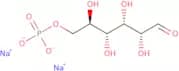
CAS:D-Glucose 6-phosphate, disodium salt is an antibiotic that is used to treat gram-negative bacterial infections. It binds to the bacterial ribosome and inhibits protein synthesis, which leads to cell death by inhibiting the production of proteins vital for cell division. This drug has been shown to be active against a wide range of bacteria, including resistant strains such as Escherichia coli and Salmonella typhimurium. D-Glucose 6-phosphate, disodium salt also has anti-inflammatory properties and can be used as an anti-bacterial agent in the treatment of typhoid fever.
Fórmula:C6H11O9Na2PPeso molecular:304.10 g/molRef: 3D-G-3320
5gA consultar25gA consultar50gA consultar100gA consultar250gA consultar-Unit-ggA consultar1,2,4,6-Tetra-O-acetyl-3-azido-3-deoxy-D-glucopyranose
1,2,4,6-Tetra-O-acetyl-3-azido-3-deoxy-D-glucopyranose is a custom synthesis that has been fluorinated and modified with methyl groups. It is used to synthesize complex carbohydrates and it can be used as a raw material for the production of oligosaccharides. 1,2,4,6-Tetra-O-acetyl-3-azido-3-deoxy--D--glucopyranose is soluble in water and ethanol and has a CAS number.Fórmula:C14H19N3O9Pureza:Min. 95%Peso molecular:373.32 g/molMethyl 3,6-di-O-benzyl-2-deoxy-2-phthalimido-b-D-glucopyranoside
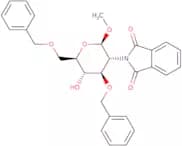
CAS:Methyl 3,6-di-O-benzyl-2-deoxy-2-phthalimido-b-D-glucopyranoside is a custom synthesis product that is used to modify saccharides. This compound is an oligosaccharide and polysaccharide that can be fluorinated to form a complex carbohydrate. Methyl 3,6-di-O-benzyl-2-deoxy-2-phthalimido-b-D--glucopyranoside has been shown to react with monosaccharides and sugars in the presence of base to form a modified sugar.Fórmula:C29H29NO7Pureza:Min. 95%Peso molecular:503.54 g/mol1,2,3-Tri-O-benzoyl-4,6-O-(4-methoxybenzylidene)-a-D-mannopyranose
1,2,3-Tri-O-benzoyl-4,6-O-(4-methoxybenzylidene)-a-D-mannopyranose is a carbonyl compound that is an intermediate in the synthesis of saccharides. The chemical modification of this compound can be used to synthesize complex carbohydrates. This compound has been fluorinated and methylated to produce a variety of derivatives with different properties. It also has been glycosylated and click modified for use in research and development.Fórmula:C35H30O10Pureza:Min. 95%Peso molecular:610.61 g/molMethyl 2-deoxy-D-threo-pentofuranoside
CAS:Methyl 2-deoxy-D-threo-pentofuranoside is a synthetic monosaccharide that has been modified by fluorination. It can be used for the synthesis of oligosaccharides and complex carbohydrates. Methyl 2-deoxy-D-threo-pentofuranoside can also be used for glycosylation, methylation, or click modification reactions. This product is available in high purity and will not contain any impurities.Pureza:Min. 95%Valproic acid b-D-glucuronide
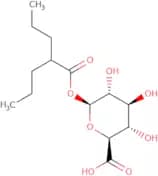
CAS:Producto controladoValproic acid b-D-glucuronide is a drug that belongs to the group of anticonvulsants. Valproic acid b-D-glucuronide inhibits the activity of glutamate, which is an excitatory neurotransmitter in the brain. It also causes irreversible inhibition of GluCl channels and increases diastolic pressure. Valproic acid b-D-glucuronide has been shown to have anti-inflammatory properties, as it reduces the production of prostaglandins and cytokines. The drug has been used in animal models to study pain perception and chronic pain syndromes such as bone cancer or metabolic disorders. Valproic acid b-D-glucuronide also blocks GABA receptors, causing increased levels of gamma aminobutyric acid (GABA) and dopamine. The drug has been shown to induce a state of deep sleep in rats that are deprived from REM sleep for three weeks.
Fórmula:C14H24O8Pureza:Min. 95%Forma y color:PowderPeso molecular:320.34 g/mol6'-Sulpho Lewisa-BSA
6'-Sulpho Lewisa-BSA is a carbohydrate that has been modified with sulphur and fluorine. It is used as a fluorescence probe for the detection of carbohydrates in solutions, such as glycoproteins, glycopeptides, and glycolipids. 6'-Sulpho Lewisa-BSA is a complex carbohydrate that can be synthesized from the reaction of d-glucose and D-alanine. It can also be custom synthesized to suit the needs of the customer. This product is high purity and can be methylated or glycosylated. 6'-Sulpho Lewisa-BSA also has been modified by click chemistry to incorporate fluorescent groups at specific sites on the sugar chain.Pureza:Min. 95%CMP-Neu5Gc sodium salt
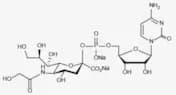
CAS:Please enquire for more information about CMP-Neu5Gc sodium salt including the price, delivery time and more detailed product information at the technical inquiry form on this pageFórmula:C20H29N4Na2O17PPeso molecular:674.41 g/mol1,6-Anhydro-2-O-p-toluenesulfonyl-b-D-glucopyranose
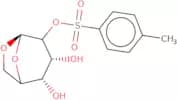
CAS:1,6-Anhydro-2-O-p-toluenesulfonyl-b-D-glucopyranose is a synthetic sugar that is used in glycosylation reactions. It has high purity and is available for custom synthesis. The compound is primarily used as a substrate for Click chemistry modifications to the anomeric carbon. It has been shown to effectively inhibit the growth of bacteria by binding to DNA gyrase, preventing the formation of covalent bonds that are required for bacterial cell division.Fórmula:C13H16O7SPureza:Min. 95%Peso molecular:316.33 g/mol3'-Sialyl-3-fucosyllactose-BSA
3'-Sialyl-3-fucosyllactose-BSA is a glycosylation that has been modified with fluorination and methylation. This product can be custom synthesized to order, in any quantity, using high purity reagents. 3'-Sialyl-3-fucosyllactose-BSA is a complex carbohydrate that is found on the surface of many human cells, including erythrocytes and B cells. It is also an important component of the oligosaccharide chains of glycoproteins and glycolipids. The modification of 3'-sialyl-3-fucosyllactose with fluorine or other halogens can be used as a fluorescent probe for carbohydrate binding proteins.Pureza:Min. 95%Quercetin 7-O-b-D-glucuronide
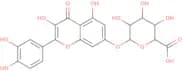
CAS:Quercetin 7-O-b-D-glucuronide is a methylated glycoside of quercetin. Quercetin 7-O-b-D-glucuronide has been shown to inhibit the activity of Saccharomyces cerevisiae alpha amylase, alpha and beta amylases, and alpha glucosidase, which are enzymes that hydrolyze starch. This product also inhibits the growth of Candida albicans and Saccharomyces cerevisiae. Quercetin 7-O-b-D-glucuronide is available for custom synthesis in order to meet customers' specific needs.Fórmula:C21H18O13Pureza:Min. 95%Peso molecular:478.36 g/mol2,5-Dideoxy-2,5-imino-D-mannitol HCl
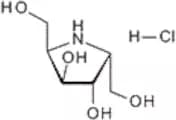
CAS:Methylation is a chemical reaction that adds a methyl group to the substrate. The Methylation of saccharide is achieved by the addition of an alkyl group to the oxygen atom adjacent to the carbonyl group in the saccharide. The saccharide becomes a methylated saccharide. Click chemistry is a form of chemoselective reactions, which are reactions that involve only one reactant and produce one product. The most common example of click chemistry is a reaction between an azide and an alkynyl, which will give rise to 1,3-dipolar cycloaddition products. Carbohydrate modification includes modifications such as glycosylation, fluorination, and complex carbohydrate synthesis. Glycosylation refers to the process by which sugars are attached to other molecules, such as proteins or lipids. Fluorination refers to adding fluorine atoms (F) onto molecules using various methods. Complex carbohydrates can be synthesized from simple sugars with carbonFórmula:C6H13NO4·HClPureza:Min. 95%Peso molecular:199.63 g/mol1,2,6-Tri-O-galloylglucose
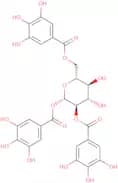
CAS:1,2,6-Tri-O-galloylglucose is a natural compound that has been shown to have inhibitory effects on the human immunodeficiency virus (HIV) enzyme serine protease. This inhibits the viral replication process by preventing the protease from cleaving viral polyproteins. The compound also inhibits complement activation and has antioxidant properties. 1,2,6-Tri-O-galloylglucose is active against leukemia cells and has been shown to be more effective at lower pH levels. It also has an inhibitory effect on ellagitannins and anticomplement activity.Fórmula:C27H24O18Pureza:Min. 95%Peso molecular:636.47 g/molLasofoxifene b-D-glucuronide
CAS:Lasofoxifene b-D-glucuronide is a synthetic, nonsteroidal estrogen that was developed to avoid the side effects of other estrogens. It is a prodrug that is hydrolyzed in vivo to lasofoxifene and then undergoes methylation and glucuronidation. Lasofoxifene b-D-glucuronide has been shown to inhibit tumor growth in animals by reducing the number of cancer cells and blocking their spread. This drug also prevents bone loss by inhibiting the production of osteoclasts, which are cells that break down bone tissue.Fórmula:C34H39NO8Pureza:Min. 95%Peso molecular:589.68 g/mola-D-Xylopyranosyl azide
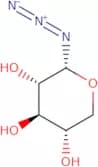
CAS:a-D-Xylopyranosyl azide is a sugar that can be synthesized from the reaction of 1,2-dichloroethane with 2,3,4,6-tetra-O-acetyl-a-D-xylopyranose. This compound has a high purity and can be custom synthesized to order. It is used in glycosylation reactions to modify saccharides and oligosaccharides. It has been shown to be useful for click modification and fluorination reactions.
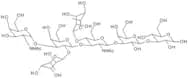
Pureza:Min. 95%a-Heptasaccharide
CAS:a-Heptasaccharide is a complex carbohydrate that is synthesized from glycerol and seven monosaccharides. It is used in the synthesis of other carbohydrates and as a fluorination reagent.Fórmula:C46H78N2O34Pureza:Min. 95 Area-%Forma y color:PowderPeso molecular:1,203.13 g/molTri-b-GalNAc-C12-amido-C3-azide
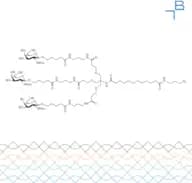
Tri-b-GalNAc-C12-amido-C3-azide is a unique bifunctional ligand for ASGPR-targeted applications. The three terminal GalNAc sugars can bind to ASGPR receptors that permit hepatocyte uptake, the C12-amide linker offers a stable spacer and the C3-azide moiety enables tailored bioconjugation via CuAAC click chemistry. This design has the potential for targeted delivery of therapeutic cargo (drugs, siRNA, nanoparticles) to hepatocytes, development of LYTACs for selective protein degradation, and creation of in vivo ASGPR imaging probes.Fórmula:C76H136N14O29Pureza:Min. 95%Peso molecular:1,709.97 g/molTri-b-GalNAc-triazolyl-C5-amine
CAS:Tri-b-GalNAc-triazolyl-C5-amine is used for ASGPR-targeted delivery research. This molecule features three ASGPR-binding groups connected by a five-carbon alkyl (C5-alkyl) linker and a reactive amine group for attaching other molecules. When tri-b-GalNAc-triazolyl-C5-amine binds to ASGPR on cells, the entire complex is efficiently taken up into the cell and allows easy conjugation to various cargos such as RNA or Cas9 complexes, specifically to liver cells (hepatocytes). Additionally, tri-GalNAc-C5-amine can be used to create targeted chimeric molecules (LYTACs) or be attached to dyes for cellular imaging.Fórmula:C67H118N14O31Pureza:Min. 95%Peso molecular:1,615.73 g/mol
![Ethyl 2-deoxy-2-[(trichloroacetyl)amino]-b-D-thioglucopyranoside](/_next/image/?url=https%3A%2Fstatic.cymitquimica.com%2Fproducts%2F3D%2Fthumb-webp%2FME45369.webp&w=3840&q=75)