Glycoscience
Subcategorías de "Glycoscience"
- Aminoazúcares(108 productos)
- Anticuerpos relacionados con azúcares(282 productos)
- Glicolípidos(46 productos)
- Glicosaminoglicanos (GAGs)(55 productos)
- Glucósidos(419 productos)
- Monosacáridos(6.624 productos)
- Oligosacáridos(3.682 productos)
- Polisacáridos(504 productos)
Se han encontrado 11047 productos de "Glycoscience"
Benzyl 2,3,4-tri-O-acetyl-4-nitromethyl-b-D-arabinopyranose
CAS:Benzyl 2,3,4-tri-O-acetyl-4-nitromethyl-b-D-arabinopyranose is a water soluble, white solid that is a glycosylation product of Benzyl 2,3,4-tri-O-acetyl b D arabinopyranose and 4 nitrobenzaldehyde. It can be used for the modification of polysaccharides and as an intermediate in the synthesis of oligosaccharides. This compound has been shown to be effective in inhibiting the growth of Mycobacterium tuberculosis and Mycobacterium avium complex.Fórmula:C19H23NO10Pureza:Min. 95%Peso molecular:425.39 g/molPenta-O-acetyl-a-L-idopyranose
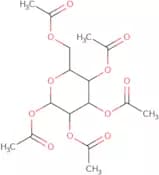
CAS:Penta-O-acetyl-a-L-idopyranose is a monosaccharide that is synthesized from D-glucose and acetic anhydride. It has been modified with methylation, fluorination, and saccharide modification. Penta-O-acetyl-a-L-idopyranose is soluble in water, methanol, ethanol, and acetone. This compound has been shown to be useful for glycosylation reactions as well as click chemistry. CAS No. 16299-15-3.
Fórmula:C16H22O11Pureza:Min. 95%Forma y color:PowderPeso molecular:390.34 g/mol10-Beta-D-glucopyranosyl-1,8-dihydroxy-3-(hydroxymethyl)-anthrone heptaacetate
CAS:10-Beta-D-glucopyranosyl-1,8-dihydroxy-3-(hydroxymethyl)-anthrone heptaacetate is a synthetic saccharide that can be used as a fluorescent probe. It is synthesized by reacting methyl anthrone with 10-beta-D-glucopyranosyl chloride and sodium hydroxide under basic conditions. The fluorination of the compound leads to its fluorescent properties. This product has been custom synthesized for use in click chemistry reactions.
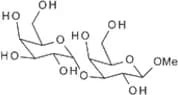
Fórmula:C35H36O16Pureza:Min. 95%Peso molecular:712.60 g/molMethyl 3-O-(a-D-galactopyranosyl)-b-D-galactopyranoside
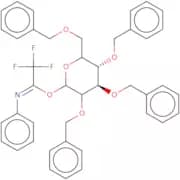
Methyl 3-O-(a-D-galactopyranosyl)-b-D-galactopyranoside is a fluorinated methylated carbohydrate. It is an oligosaccharide with a sugar backbone. The sugar in the molecule is a monosaccharide, which is attached to other sugars through glycosylation. Methyl 3-O-(a-D-galactopyranosyl)-b-D-galactopyranoside has been synthesized and can be custom synthesized for specific requirements. It has high purity and can be obtained with a variety of modifications, such as fluorination to increase its stability. This compound can be used in a variety of applications, including the treatment of tuberculosis infections and cancer.Fórmula:C13H24O11Pureza:Min. 95%Forma y color:White to off-white solid.Peso molecular:356.32 g/mol2,3,4,6-Tetra-O-benzyl-D-galactopyranosyl N-phenyl trifluoroacetimidate
This product is a type of modification and has many uses in the industry. It is an oligosaccharide that is a carbohydrate and can be used as a complex carbohydrate. This product can also be synthesized, which is done by custom synthesis. The CAS Number for this product is 908-92-1, which means it has high purity. This product is also an oligosaccharide that is a carbohydrate and can be used as a complex carbohydrate. This product can also be synthesized, which is done by custom synthesis. The CAS Number for this product is 908-92-1, which means it has high purity.Fórmula:C42H40F3NO6Pureza:Min. 95%Peso molecular:711.77 g/mol7-Hydroxycoumarin D5-D-glucuronide sodium salt
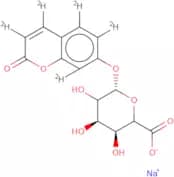
Producto controlado7-Hydroxycoumarin D5-D-glucuronide sodium salt is a synthetic, fluorinated, monosaccharide that is used in glycosylation reactions. It has been shown to be useful for the synthesis of complex carbohydrates and polysaccharides as well as click modification of proteins. 7-Hydroxycoumarin D5-D-glucuronide sodium salt can be used in the synthesis of glycosylations and polysaccharides or as a sugar donor in Click chemistry. This compound can also be methylated or modified by other methods. 7-Hydroxycoumarin D5-D-glucuronide sodium salt is available at high purity and CAS No.Fórmula:C15H8D5O9·NaPureza:Min. 95%Forma y color:White to off-white solid.Peso molecular:365.28 g/molPseudoginsenoside Rh2
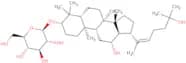
CAS:Pseudoginsenoside Rh2 is a bioactive compound, which is a derivative of ginsenosides found in Panax ginseng. It is specifically extracted from the plant's root, known for its rich saponin content. Pseudoginsenoside Rh2 functions by interacting with various cellular pathways, influencing apoptosis, and cell cycle regulation. The mechanism of action involves modulation of signaling pathways, including PI3K/Akt and MAPK, which are crucial in controlling cell growth and survival.Fórmula:C36H62O8Pureza:Min. 95%Peso molecular:622.87 g/mol1,3-o-Dibenzyl-N-acetyl-β-D-glucosamine 4,6-diacetate
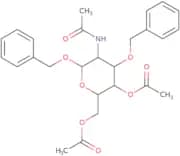
CAS:Please enquire for more information about 1,3-o-Dibenzyl-N-acetyl-β-D-glucosamine 4,6-diacetate including the price, delivery time and more detailed product information at the technical inquiry form on this page
Fórmula:C26H31NO8Pureza:Min. 95%Peso molecular:485.5 g/molMethyl 3-O-(2-acetamido-2-deoxy-b-D-galactopyranosyl)-b-D-galactopyranoside
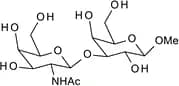
CAS:Methyl 3-O-(2-acetamido-2-deoxy-b-D-galactopyranosyl)-b-D-galactopyranoside is a modified sugar that can be used for synthesis of saccharides, oligosaccharides, and polysaccharides. This product has been custom synthesized to be a high purity compound with CAS No. 130234-66-1. It has been fluorinated and is available in the glycosylation form.Fórmula:C15H27NO11Pureza:Min. 95%Peso molecular:397.36 g/molGala1-3Galb1-4(6-deoxyGlcNAc)-HSA
Gala1-3Galb1-4(6-deoxyGlcNAc)-HSA is a custom synthesis of a complex carbohydrate. It is an oligosaccharide with CAS No. and Polysaccharide that has been modified by Methylation, Glycosylation, and Click modification. Carbohydrate is one of the most important macronutrients for human health, as it provides energy and cell building blocks. Sugar (e.g., glucose) is the simplest form of carbohydrate, while saccharide refers to chains of sugar molecules. Gala1-3Galb1-4(6-deoxyGlcNAc)-HSA has been fluorinated and synthesized with high purity in order to be used as a drug delivery system. This drug can be used to treat various diseases such as diabetes mellitus type I or II, cancer, or HIV/AIDS.
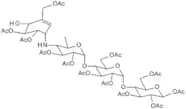
Pureza:Min. 95%Acarbose tridecaacetate
CAS:Acarbose tridecaacetate is a bacterial extract that has been shown to inhibit the growth of various strains of bacteria. This extract was extracted from the fields and contains aluminum oxide impurities. Acarbose tridecaacetate has shown efficacy in seed culture and actinomyces, which are two types of bacteria. The sequence of this extract has been determined using aluminum oxide. Acarbose tridecaacetate is soluble in a variety of solvents, including organic solvents and solvents. It can be purified by chromatography to remove any bulk drug or organic solvent that may be present.
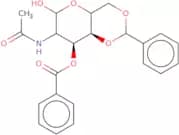
Fórmula:C51H69NO31Pureza:Min. 95%Forma y color:White PowderPeso molecular:1,192.08 g/mol2-Acetamido-3-O-benzoyl-4,6-O-benzylidene-2-deoxy-D-glucopyranose
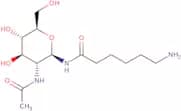
CAS:This is a custom synthesized oligosaccharide that is a complex carbohydrate. This is an Oligosaccharide, Polysaccharide, and CAS No. 1486465-81-9. It has been modified by methylation, glycosylation, and carbamylation. This product has high purity and has been fluorinated. It is a saccharide and a sugar with Click modification.Fórmula:C22H23NO7Pureza:Min. 95%Peso molecular:413.42 g/mol2-Acetamido-N-(e-aminocaproyl)-2-deoxy-b-D-glucopyranosyl amine
CAS:2-Acetamido-N-(e-aminocaproyl)-2-deoxy-b-D-glucopyranosyl amine (Km) is a compound that has been shown to have hexosaminidase activity. It is a human liver enzyme that catalyzes the cleavage of the terminal alpha-1,4 linkage between N-acetylglucosamine and D-glucose residues from the nonreducing end of the beta 1,4 linked N-acetylglucosamine molecule. The KM value for this enzyme is 3.2 mM. This compound also has affinity chromatography properties, which allows it to be used in affinity chromatography experiments as a ligand for concanavalin A. 2KA can be used in gel electrophoresis to separate polypeptides by their size or charge. The corresponding KM value for this process is 22.5 mM. Denaturing conditions are required toFórmula:C14H27N3O6Pureza:Min. 95%Peso molecular:333.38 g/mol1-Amino-1-deoxy-D-glucitol hydrochloride
CAS:1-Amino-1-deoxy-D-glucitol hydrochloride (AMDG) is a compound that has been synthesized to inhibit the enzyme chondroitin sulfate. Chondroitin sulfate is an important component of cartilage and plays a role in the inflammatory response. It also inhibits the production of gamma-aminobutyric acid, which is an inhibitory neurotransmitter. AMDG can be used as a treatment for pain by inhibiting the transmission of pain signals through the nervous system. AMDG also has anti-inflammatory effects, which may be due to its ability to suppress prostaglandin synthesis.Pureza:Min. 95%Colitose
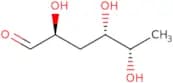
CAS:Colitose is a sugar that has antimicrobial properties. It is a monosaccharide, which means it contains six carbon molecules. Colitose has been shown to inhibit bacterial growth and to prevent the development of resistant mutants in human serum. Colitose has also been shown to have therapeutic potential for infectious diseases such as bowel disease and other inflammatory bowel diseases. The structural analysis of colitose revealed that it contains terminal residues at the end of each chain, which are composed of glucose, galactose, and mannose. The glycan chains are linked together by alpha-1,6-glycosidic bonds. These terminal residues serve as a receptor for Toll-like receptors (TLRs), which are found on cells in the bowel wall and help regulate inflammation.
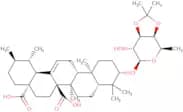
Fórmula:C6H12O4Pureza:Min. 95%Forma y color:PowderPeso molecular:148.16 g/molQuinovic acid 3-O-(3',4'-O-isopropylidene)-b-D-fucopyranoside
CAS:Quinovic acid 3-O-(3',4'-O-isopropylidene)-b-D-fucopyranoside is a monocyclic aromatic hydrocarbon that belongs to the class of phthalic acids. It is a white or light yellow crystalline solid that has been used as an absorber for rubber, polyester, and other organic solvents. This compound has been shown to be carcinogenic in animal studies with leukemia cells in mice and rats. Quinovic acid 3-O-(3',4'-O-isopropylidene)-b-D-fucopyranoside also induces bone resorption in animals.Pureza:Min. 95%O-(2-Acetamido-2-deoxy-3,4,6-tri-O-acetyl-D-glucopyranosylidene)amino N-(4-nitrophenyl)carbamate
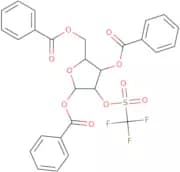
CAS:O-(2-Acetamido-2-deoxy-3,4,6-tri-O-acetyl-D-glucopyranosylidene)amino N-(4-nitrophenyl)carbamate is a synthetic compound that has been modified with fluorine. The compound is an example of a glycosylation reaction, which is the process of joining two sugars to form a complex carbohydrate. It has been modified with Methylation and Click modification. O-(2-Acetamido-2-deoxy-3,4,6-tri-O-acetyl)-D glucopyranosylidene)amino N-(4 nitrophenyl)carbamate also has a saccharide component and is classified as Polysaccharide. This compound can be custom synthesized for customers who need high purity or oligosaccharides.Fórmula:C21H24N4O12Pureza:Min. 95%Peso molecular:524.44 g/mol1,3,5-Tri-O-benzoyl-2-O-(trifluoromethanesulfonyl)-a-D-ribofuranose
CAS:1,3,5-Tri-O-benzoyl-2-O-(trifluoromethanesulfonyl)-a-D-ribofuranose is a nucleoside that is phosphorylated by the enzyme deoxycytidine kinase to form 1,3,5-tri-O-benzoyl-2'-O-(trifluoromethanesulfonyl)-a-[D]ribofuranosyl phosphate. This compound has been shown to activate immune cells in vitro and in vivo. The activation of immune cells may be due to its ability to inhibit the expression of enzymes that are required for DNA synthesis. 1,3,5-Tri-O-benzoyl-2'-O-(trifluoromethanesulfonyl)-a-[D]ribofuranosyl phosphate also inhibits the expression of enzymes involved in DNA replication and cell proliferation.Fórmula:C27H21F3O10SPureza:Min. 95%Forma y color:PowderPeso molecular:594.51 g/molMethyl 2,3-di-O-acetyl-4,6-O-benzylidene-α-D-glucopyranoside
CAS:Methyl 2,3-di-O-acetyl-4,6-O-benzylidene-a-D-glucopyranoside is a glycosylation agent that is used to attach sugars to proteins, polysaccharides, and other biological molecules. This compound can be synthesized in custom quantities with high purity. It is often used for the modification of saccharides and oligosaccharides. Methyl 2,3-di-O-acetyl-4,6-O-benzylidene-a -D glucopyranoside has been shown to react with a variety of functional groups including amines, alcohols, carboxylic acids, thiols and sulfhydryls.Fórmula:C18H22O8Pureza:Min. 95%Peso molecular:366.37 g/molBenzyl N-acetyl-4,6-O-benzylidene-a-isomuramic acid
CAS:Benzyl N-acetyl-4,6-O-benzylidene-a-isomuramic acid is a high purity custom synthesis. It is a sugar that has been modified by click chemistry, fluorination, glycosylation, and methylation. The modification of this compound includes the addition of an acetamide group to the hydroxyl group on carbon 2 and a benzylidene acetal at carbon 4. This compound has been synthesized to be used as a monosaccharide or an oligosaccharide in complex carbohydrates.Fórmula:C25H29NO8Pureza:Min. 95%Peso molecular:471.5 g/mol