Compuestos relacionados con enzimas, péptidos y proteínas
Los compuestos relacionados con enzimas, péptidos y proteínas son críticos para estudiar y manipular las vías bioquímicas. Estos compuestos incluyen enzimas que catalizan reacciones bioquímicas, péptidos que actúan como hormonas y moléculas de señalización, y proteínas que desempeñan una amplia gama de funciones dentro de los organismos. Esta categoría abarca inhibidores, activadores, sustratos y otros reactivos esenciales para la enzimología, la proteómica y la investigación de péptidos. En CymitQuimica, ofrecemos una diversa selección de compuestos de alta calidad para facilitar su investigación en cinética enzimática, función de proteínas y síntesis de péptidos, asegurando resultados precisos y fiables.
Subcategorías de "Compuestos relacionados con enzimas, péptidos y proteínas"
- Aminoácidos (AA)(40.542 productos)
- Enzimas(3.561 productos)
- Péptidos(30.714 productos)
- Proteínas(15.021 productos)
Se han encontrado 1312 productos de "Compuestos relacionados con enzimas, péptidos y proteínas"
Ordenar por
Pureza (%)
0
100
|
0
|
50
|
90
|
95
|
100
Methixene hydrochloride hydrate
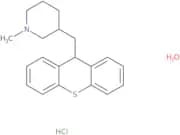
CAS:Producto controlado<p>Methixene hydrochloride hydrate is a drug that is used to treat inflammatory bowel disease. It works by inhibiting the activity of enzymes involved in the production of epidermal growth factor, which is a protein that stimulates the growth of cells in the lining of the intestine. Methixene hydrochloride hydrate may also be used for other purposes not listed here. Methixene hydrochloride hydrate can cause liver damage and bone cancer and should not be taken by people with infectious diseases or those who are pregnant. This medication has an effect on dopamine levels and may help with Parkinson's disease. Although methixene hydrochloride hydrate is used to treat many different illnesses, it cannot cure them all.</p>Fórmula:C20H26ClNOSPureza:Min. 95%Forma y color:PowderPeso molecular:363.95 g/molPotassium chlorate
CAS:Producto controlado<p>Potassium chlorate is a strong oxidizing agent and a salt of potassium and chlorate. Potassium chlorate is used as an oxidizer in fireworks, propellants, and for the treatment of wastewater. It can also be used to generate chlorine dioxide, which is used as a disinfectant. Potassium chlorate has been shown to have genotoxic effects on rat liver cells, which may be due to its ability to induce transcriptional regulation by altering DNA methylation status. Chronic exposure to high concentrations of potassium chlorate can cause apical necrosis in rats. This type of necrosis is caused by the accumulation of potassium ions that lead to a disruption in membrane integrity. Chlorates are also known to cause chronic renal toxicity via oxidative stress mechanisms.</p>Fórmula:ClKO3Pureza:Min. 95%Forma y color:White SolidPeso molecular:122.55 g/molLithium thiocyanate hydrate
CAS:<p>Lithium thiocyanate hydrate is a crystalline compound that consists of lithium, sulfur, and oxygen. It has been shown to have antihypertensive activity, which may be due to the inhibition of the enzyme angiotensin-converting enzyme (ACE). Lithium thiocyanate hydrate is used in pharmaceutical preparations as a coagulant and solvent. Crystals of this compound are formed by reacting lithium chloride with hexafluoroisopropanol in an aqueous solution containing metal ions. The crystals are macrocyclic structures consisting of alternating layers of lithium thiocyanate and sulfoxide groups. These groups form hydrogen bonds between adjacent layers, leading to the formation of the crystals' crystalline structure.</p>Fórmula:LiSCN·xH2OPureza:(%) Min. 99.9%Forma y color:White PowderCopper(II) acetate monohydrate
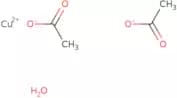
CAS:<p>Copper acetate is a chemical compound that is composed of copper and acetic acid. Copper acetate monohydrate, the form used in this product, is an ionic salt that has the chemical formula Cu(CHCO)2. The copper atom has a coordination geometry of 4.5 and is surrounded by six oxygen atoms and two hydrogen atoms. The reaction mechanism for this compound involves methyl ethyl malonic acid as shown below: The first step in the reaction mechanism is the formation of a carbanion intermediate with the loss of a proton from one of the methyl groups on malonic acid. This carbanion attacks the copper atom to form an intermediate with two positive charges on it, which then breaks down into two molecules of malonic acid and one molecule of water. The other methyl group then reacts with another molecule of malonic acid to form methyl ethyl dicarboxylate and release another proton. This proton can be accepted by water or react with</p>Fórmula:C4H6CuO4·H2OPureza:Min. 95%Forma y color:Blue Clear LiquidPeso molecular:199.65 g/molTriethyl Orthovalerate
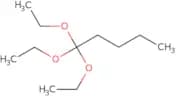
CAS:<p>Triethyl orthovalerate is an amide with a cyclic structure. It is used as a model protein for the study of the effects of structural modifications on protein stability and function. Triethyl orthovalerate has been shown to be an inhibitor of prostaglandin synthesis in human cells, which may be due to its ability to inhibit the enzyme amidase.</p>Fórmula:C11H24O3Pureza:Min. 95%Peso molecular:204.31 g/mol5-Ethylcyclohexane-1,3-dione, hydrate
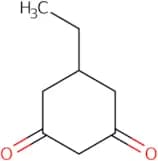
CAS:<p>5-Ethylcyclohexane-1,3-dione is a hydrate of 5-ethylcyclohexane-1,3-dione. It has been shown to be an allosteric modulator of the metabotropic glutamate receptor and has been used in the synthesis of juglone. The modification of 5-ethylcyclohexane-1,3-dione has been studied using a number of methodologies, which have led to its optimization and the development of novel derivatives that may have applications in the treatment of dyskinesia. 5-Ethylcyclohexane-1,3-dione is also a key intermediate for the synthesis of dimethyldioxirane (DMDO), a reagent that can be used for Diels–Alder reactions.</p>Fórmula:C8H12O2•(H2O)xPureza:Min. 95%Forma y color:PowderPeso molecular:140.18 g/molReinecke salt monohydrate
CAS:<p>Reinecke salt monohydrate is a potentiometric titrant for use in automated titration. It consists of a mixture of choline chloride and polyvinyl chloride and is used in the analysis of polyvinyl chloride. Reinecke salt monohydrate has been optimized for injection analysis and has a response time of less than one minute.</p>Fórmula:NH4•Cr•(SCN)4•(NH3)2•H2OPureza:Min. 95%Peso molecular:354.44 g/molTriisopropanolamine Borate
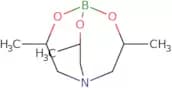
CAS:<p>Triisopropanolamine borate is an organic compound with the formula (CH3)3N(CH2)3OH. It is a colorless liquid with a sweet, amine-like odor. Triisopropanolamine borate is widely used as a cross-linking agent in coatings, and as a reactive functional group in polycarboxylic acid synthesis and cationic polymerization. It also has been used as a blood pressure lowering agent and to treat high calcium levels in the blood. The chemical structure of triisopropanolamine borate can be seen below: Triisopropanolamine Borate, Chemical Structure The chemical formula for triisopropanolamine borate is CH3N(CH2)3OH. Triisopropanolamine borate has many applications due to its reactive functional groups, including cross-linking agents for coatings and polycarboxylic acid synthesis</p>Fórmula:C9H18BNO3Pureza:Min. 95%Peso molecular:199.06 g/molEstradiol 3-valerate
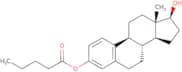
CAS:Producto controlado<p>Please enquire for more information about Estradiol 3-valerate including the price, delivery time and more detailed product information at the technical inquiry form on this page</p>Fórmula:C23H32O3Pureza:Min. 95%Forma y color:PowderPeso molecular:356.5 g/molAcetyl-ACTH (3-24) (human, bovine, rat) trifluoroacetate salt
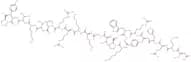
CAS:<p>Please enquire for more information about Acetyl-ACTH (3-24) (human, bovine, rat) trifluoroacetate salt including the price, delivery time and more detailed product information at the technical inquiry form on this page</p>Fórmula:C126H198N38O28SPureza:Min. 95%Peso molecular:2,725.23 g/molAngiotensin I [Des-Asp1-](Human)
CAS:<p>Please enquire for more information about Angiotensin I [Des-Asp1-](Human) including the price, delivery time and more detailed product information at the technical inquiry form on this page</p>Fórmula:C58H84N16O11Pureza:Min. 95%Peso molecular:1,181.39 g/molOchratoxin B
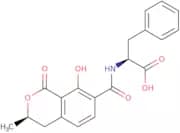
CAS:<p>Ochratoxin B is a mycotoxin that belongs to the group of toxic substances produced by fungi. It is found in animal feed and can contaminate food and water. Ochratoxin B has been shown to be genotoxic, inducing DNA damage in human serum, ochratoxin, tubule cells, and liver cells. It also inhibits the activity of complex enzymes such as DNA gyrase and topoisomerase II. The LC-MS/MS method for detecting ochratoxin B was developed based on its ability to react with an optical sensor that changes color when it binds to the substrate molecule. The hybridoma cell line was used to detect monoclonal antibodies against Ochratoxin B using a sample preparation technique with a detection sensitivity of 0.01 ng/mL.</p>Fórmula:C20H19NO6Pureza:Min. 95%Peso molecular:369.37 g/molOlanzapine pamoate monohydrate
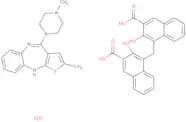
CAS:Producto controlado<p>Olanzapine pamoate monohydrate is a prodrug of the antipsychotic drug Olanzapine. It is used for the treatment of schizophrenia and bipolar disorder. The prodrug is converted to Olanzapine in vivo, which binds to histamine H1 receptors and blocks dopamine D2 receptors. This results in an antipsychotic effect, as well as a reduction in manic episodes associated with bipolar disorder. Olanzapine pamoate has been shown to be effective in treating schizophrenia, bipolar disorder, and major depressive disorder with psychotic features. The prodrug has also been shown to have a high oral bioavailability, good tissue distribution, and low toxicity.</p>Fórmula:C40H38N4O7SPureza:Min. 95%Peso molecular:718.82 g/molRuthenium(III) chloride trihydrate
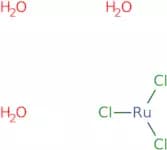
CAS:<p>Ruthenium(III) chloride trihydrate is a ruthenium carbonyl that is used as an oxidation catalyst. It has been used to prepare diagnostic agents for the detection of hydrochloric acid, sodium carbonate, or pharmaceutical preparations. The mechanism of the reaction was studied using potassium dichromate as an oxidant and the transfer reactions were determined by high-resolution electron microscopy. Ruthenium(III) chloride trihydrate is also a matrix effect reagent that has been used in conjunction with water vapor.</p>Fórmula:RuCl3·3H2OPureza:Min. 95%Forma y color:PowderPeso molecular:261.47 g/molTris(2-acryloyloxyethyl) Isocyanurate
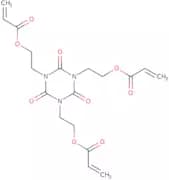
CAS:<p>Tris(2-acryloyloxyethyl) isocyanurate (TAAI) is a polyester that can be used for the treatment of water. It is made from acrylate, acrylic acid, and polyethylene glycol. TAAI has been shown to be effective in the removal of chromophoric organic matter from water. It can also be used as an immobilizing agent for various materials, such as dyes, metals, and semiconductors. TAAI can be cross-linked with a variety of reactive groups including amino groups, hydroxyl groups, carboxyl groups, thiols and amines. This process may lead to microstructural changes in the material being treated. It has been shown that TAAI may have supramolecular properties that are important for its function as a cross-linking agent.</p>Fórmula:C18H21N3O9Pureza:80%MinPeso molecular:423.37 g/molSodium acetate trihydrate
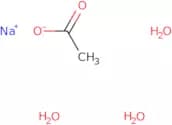
CAS:<p>Sodium acetate trihydrate is a salt that is used in the production of sodium salts and surface methodology, as well as in analytical methods. It is also used to prepare anhydrous sodium. Sodium acetate trihydrate can be used as a cell lysis agent for water vapor.</p>Fórmula:CH3COONa·3H2OPureza:Min. 95%Forma y color:White/Off-White SolidPeso molecular:136.08 g/mol(2,4-Dichlorophenoxy)acetic acid sodium salt monohydrate
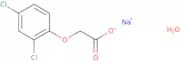
CAS:<p>(2,4-Dichlorophenoxy)acetic acid sodium salt monohydrate is a chemical that belongs to the phenoxy herbicides. It is used as a selective herbicide for control of annual and perennial grasses and broadleaf weeds in noncrop areas. This compound has been detected by gas chromatography/mass spectrometric analysis after a dispersive solid-phase extraction procedure. The target analytes were found to be acidic with an unknown molecular weight.</p>Fórmula:C8H5Cl2O3·Na·H2OPureza:Min. 95%Forma y color:PowderPeso molecular:261.03 g/molMono(lactosylamido) mono(succinimidyl)suberate
<p>Please enquire for more information about Mono(lactosylamido) mono(succinimidyl)suberate including the price, delivery time and more detailed product information at the technical inquiry form on this page</p>Fórmula:C24H38N2O15Pureza:Min. 95%Forma y color:SolidPeso molecular:594.56 g/molMAGE-3 Antigen (271-279) (human) trifluoroacetate salt
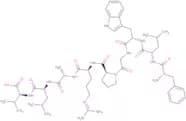
CAS:<p>ALPHA FACTOR SIGNALING PEPTIDE</p>Fórmula:C53H79N13O10Pureza:Min. 95%Peso molecular:1,058.28 g/molOchratoxin A
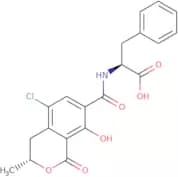
CAS:Producto controlado<p>Ochratoxin A is a mycotoxin that is found in cereals and cereal products. It can be detected by an analytical method that utilizes high performance liquid chromatography with fluorescence detection. Ochratoxin A has been implicated in the development of bowel diseases and has also been shown to inhibit catalase, peroxidase, and glucose-6-phosphate dehydrogenase activities. It also inhibits DNA polymerase, RNA polymerase, and mitochondrial enzymes involved in energy production. There is evidence that ochratoxin A may be genotoxic by inhibiting the repair of DNA damage caused by reactive oxygen species. The optimum concentration for ochratoxin A is between 0.1 and 1 micrograms per liter.br><br>Ochratoxin A is metabolized in plants via the phenylalanine pathway. This leads to increased levels of phenylalanine and p-hydroxybenzoic acid in the plant's tissues.br></p>Fórmula:C20H18ClNO6Pureza:(%) Min. 95%Forma y color:White PowderPeso molecular:403.81 g/mol


](/_next/image/?url=https%3A%2Fstatic.cymitquimica.com%2Fproducts%2F3D%2Fthumb-webp%2FFA73186.webp&w=3840&q=75)