Indicadores
Se han encontrado 575 productos de "Indicadores"
Thymolphthalein (0.1% in ca. 95% Ethanol) [for pH Determination and Titration]
CAS:Fórmula:C28H30O4Forma y color:Colorless to Almost colorless clear liquidPeso molecular:430.54α-Naphtholphthalein
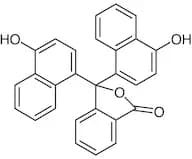
CAS:Fórmula:C28H18O4Pureza:>98.0%(HPLC)Forma y color:White to Brown powder to crystalPeso molecular:418.45Methyl Red - Methylene Blue Solution [Mixed Indicator for Neutralization Titration]
Forma y color:Green to Dark green clear liquid to cloudy liquidMethyl Red (0.1% in ca. 95% Ethanol) [for Titration]
CAS:Fórmula:C15H15N3O2Forma y color:Red clear liquidPeso molecular:269.30Bromocresol Green (0.04% in ca. 50% Ethanol) [for Titration]
CAS:Fórmula:C21H14Br4O5SForma y color:Light yellow to Amber to Dark green clear liquidPeso molecular:698.01Dithizone
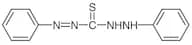
CAS:Producto controladoFórmula:C13H12N4SPureza:>90.0%(E)Forma y color:Brown to Black powder to crystalPeso molecular:256.33Phenolphthalein (1% in ca. 85% Ethanol) [for Titration]
CAS:Fórmula:C20H14O4Forma y color:Colorless clear liquidPeso molecular:318.33Bromochlorophenol Blue
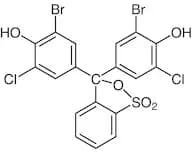
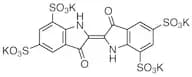
CAS:Fórmula:C19H10Br2Cl2O5SForma y color:Light yellow to Brown powder to crystalPeso molecular:581.05Indigotetrasulfonic Acid Tetrapotassium Salt
CAS:Fórmula:C16H6K4N2O14S4Pureza:>90.0%(HPLC)Forma y color:Red to Dark blue to Black powder to crystalPeso molecular:734.86Tropaeolin O
CAS:Fórmula:C12H9N2NaO5SForma y color:Orange to Brown powder to crystalPeso molecular:316.26PAR [=4-(2-Pyridylazo)resorcinol] [Spectrophotometric reagent for transition metals]
CAS:Fórmula:C11H9N3O2Pureza:>98.0%(T)(HPLC)Forma y color:Orange to Amber to Dark red powder to crystalPeso molecular:215.21Bromophenol Blue (0.1% in ca. 50% Ethanol) [for Titration]
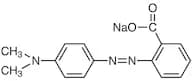
CAS:Fórmula:C19H10Br4O5SForma y color:Orange to Brown to Dark red clear liquidPeso molecular:669.96Methyl Red Sodium Salt
CAS:Fórmula:C15H14N3NaO2Forma y color:Orange to Brown powder to crystalPeso molecular:291.29TAN [=1-(2-Thiazolylazo)-2-naphthol] [Spectrophotometric reagent for transition metals]
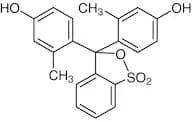
CAS:Fórmula:C13H9N3OSPureza:>99.0%(T)Forma y color:Orange to Brown powder to crystalPeso molecular:255.30Metacresol Purple
CAS:Fórmula:C21H18O5SForma y color:Brown to Black powder to crystalPeso molecular:382.43Indocyanine green
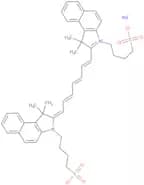
CAS:Indocyanine green is a fluorescent dye with a variety of applications in medical imaging. It has been used to diagnose and evaluate the activity of cancer cells and brain functions. Indocyanine green has also been used as an angiographic agent for diagnosis of solid tumours. In addition, it can be used to evaluate liver function and the blood flow in the brain. The biological properties of indocyanine green have not yet been fully elucidated, but it is known that it binds to hepatocyte-like cells in culture and is found at high levels in human serum. This dye shows fluorescence when bound to DNA or RNA, which indicates its possible use as a molecular probe for detecting carcinoma cells.
Indocyanine green is a STT3B inhibitor and has been shown to prevent α-amanitin toxicity in mice (Wang et al, 2023). This means it could be a possible antidote to poisoning by Amanita, such as death cap mushroom Amanita phalloides, which is the cause of over 90% of fatal mushroom poisoning.Fórmula:C43H47N2O6S2·NaPureza:(%) Min. 95%Forma y color:Green PowderPeso molecular:774.96 g/mol5-Carboxyfluorescein
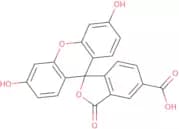
CAS:5-Carboxyfluorescein (5-FAM) is a self-quenching dye and one of the most common labelling agents for biomolecules, cell staining and localisation studies. The fluorescence is pH dependent, therefore it has been used to measure the internal pH of cells. As it is only membrane permeable to dead cells, it can be used as a staining agent to distinguish viable and non-viable cells. It is also used in PCR to label the 5â end of oligonucleotides in the presence of a quencher at the 3â end (dual labelled probe). During the amplification process, the dye is cleaved and the fluorescence increases proportionally with the amount of the specific sequence amplified during the PCR process. The development of the fluorescence signal is therefore specifically related to the amplification of the target sequence. The carboxylic acid can be activated to react with a primary amine.Fórmula:C21H12O7Pureza:Min. 98 Area-%Forma y color:Yellow PowderPeso molecular:376.32 g/mol8-Acetoxypyrene-1,3,6-trisulfonic acid trisodium salt
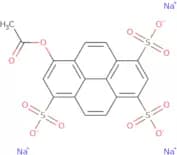
CAS:Fluorogenic substrate for esterase; cell-permeableFórmula:C18H9Na3O11S3Pureza:Min. 98.0 Area-%Forma y color:PowderPeso molecular:566.42 g/mol6-Carboxytetramethyl rhodamine
CAS:6-Carboxytetramethyl rhodamine is a fluorescent dye that is used to measure the presence of cancer cells in urine samples. It binds to human protein and has been shown to be a useful probe for fluorescence measurements. 6-Carboxytetramethyl rhodamine has also been used as a fluorescence probe for the detection of proliferative diabetic retinopathy and michaelis–menten kinetics in cyclic peptides.
Fórmula:C25H22N2O5Pureza:Min. 95%Forma y color:PowderPeso molecular:430.45 g/mol
![Thymolphthalein (0.1% in ca. 95% Ethanol) [for pH Determination and Titration]](/_next/image/?url=https%3A%2Fstatic.cymitquimica.com%2Fproducts%2F3B%2Fthumb-webp%2FT0130.webp&w=3840&q=75)

![Methyl Red - Methylene Blue Solution [Mixed Indicator for Neutralization Titration]](/_next/image/?url=https%3A%2Fstatic.cymitquimica.com%2Fproducts%2F3B%2Fthumb-webp%2FM0161.webp&w=3840&q=75)
![Methyl Red (0.1% in ca. 95% Ethanol) [for Titration]](/_next/image/?url=https%3A%2Fstatic.cymitquimica.com%2Fproducts%2F3B%2Fthumb-webp%2FM0067.webp&w=3840&q=75)
![Bromocresol Green (0.04% in ca. 50% Ethanol) [for Titration]](/_next/image/?url=https%3A%2Fstatic.cymitquimica.com%2Fproducts%2F3B%2Fthumb-webp%2FB0114.webp&w=3840&q=75)
![Phenolphthalein (1% in ca. 85% Ethanol) [for Titration]](/_next/image/?url=https%3A%2Fstatic.cymitquimica.com%2Fproducts%2F3B%2Fthumb-webp%2FP0700.webp&w=3840&q=75)

![PAR [=4-(2-Pyridylazo)resorcinol] [Spectrophotometric reagent for transition metals]](/_next/image/?url=https%3A%2Fstatic.cymitquimica.com%2Fproducts%2F3B%2Fthumb-webp%2FA5001.webp&w=3840&q=75)
![Bromophenol Blue (0.1% in ca. 50% Ethanol) [for Titration]](/_next/image/?url=https%3A%2Fstatic.cymitquimica.com%2Fproducts%2F3B%2Fthumb-webp%2FB0118.webp&w=3840&q=75)
![TAN [=1-(2-Thiazolylazo)-2-naphthol] [Spectrophotometric reagent for transition metals]](/_next/image/?url=https%3A%2Fstatic.cymitquimica.com%2Fproducts%2F3B%2Fthumb-webp%2FA5003.webp&w=3840&q=75)