Antimicrobianos
Subcategorías de "Antimicrobianos"
- Antibióticos(4.503 productos)
- Antifúngicos(939 productos)
- Antiparasitarios(807 productos)
- Antivirales(1.056 productos)
Se han encontrado 2643 productos de "Antimicrobianos"
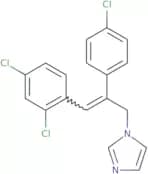
Aliconazole
CAS:Aliconazole is a triazole-based antifungal agent, which is a synthetic derivative developed through chemical synthesis. It functions by inhibiting the enzyme lanosterol 14α-demethylase, crucial in the biosynthesis of ergosterol, a vital component of fungal cell membranes. By disrupting ergosterol production, aliconazole compromises the structural integrity of the cell membrane, leading to increased permeability and eventual cell death.
Fórmula:C18H13Cl3N2Pureza:Min. 95%Peso molecular:363.7 g/molFinafloxacin
CAS:Finafloxacin is a fluoroquinolone antibacterial agent, which is a synthetic compound derived from the quinolone family. It functions through the inhibition of bacterial DNA gyrase and topoisomerase IV, crucial enzymes in the replication, transcription, and repair of bacterial DNA. This mechanism leads to the prevention of bacterial cell division and ultimately results in cell death.Fórmula:C20H19FN4O4Pureza:Min. 95%Peso molecular:398.39 g/molNigericin sodium
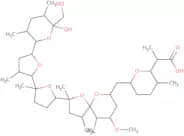
CAS:Nigericin transports cations across the membrane of the cell and it is used to study anion transport. It can be used as a buffer to control pH value inside of the cell.
Fórmula:C40H67NaO11Pureza:Min. 95%Peso molecular:746.94 g/molManumycin B
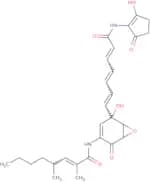
CAS:Manumycin B is a polyketide antibiotic, which is a secondary metabolite isolated from certain Streptomyces species. This compound is known for its complex biosynthetic origin involving iterative cycles of polyketide synthesis, leading to its characteristic structure. The mode of action of Manumycin B primarily involves the inhibition of farnesyltransferase, an enzyme critical for the post-translational modification of various proteins, including the Ras family of GTPases. By hindering this enzyme, Manumycin B disrupts the signaling pathways that are essential for tumor cell growth and proliferation.Fórmula:C28H34N2O7Pureza:Min. 95%Peso molecular:510.6 g/molSpiro-oxanthromicin A
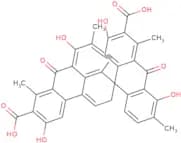
CAS:Spiro-oxanthromicin A is a novel antibiotic compound, which is derived from a rare species of actinomycete bacteria. The unique structure of Spiro-oxanthromicin A integrates spiroketal and oxanthrone moieties, facilitating its distinctive antimicrobial properties. It operates by selectively binding to bacterial ribosomal subunits, inhibiting protein synthesis and effectively curbing pathogenic proliferation.Fórmula:C36H26O10Pureza:Min. 95%Peso molecular:618.6 g/molAscomycin
CAS:Ascomycin is an immunosuppressive macrolide, which is a product derived from the fermentation of the bacterium *Streptomyces hygroscopicus*. Its mode of action involves binding to the intracellular protein FK506-binding protein (FKBP), inhibiting the calcium-dependent signal transduction pathway that is crucial for T-cell activation. This interference with the immune response is achieved through the inhibition of calcineurin, thus preventing the dephosphorylation and nuclear translocation of nuclear factor of activated T-cells (NF-AT), a necessary step in the activation of genes required for T-cell proliferation.Fórmula:C43H69NO12Pureza:Min. 95%Peso molecular:792.01 g/molIbafloxacin
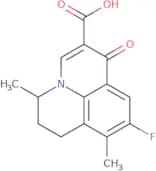
CAS:Ibafloxacin is an antibacterial agent, which is a synthetic fluoroquinolone derived from quinolone compounds. It functions by inhibiting bacterial DNA gyrase and topoisomerase IV, enzymes crucial for DNA replication and transcription in bacteria. By preventing the supercoiling and uncoiling of bacterial DNA, ibafloxacin disrupts essential DNA processes, leading to bacterial cell death.Fórmula:C15H14FNO3Pureza:Min. 95%Peso molecular:275.27 g/molCenicriviroc sulfone
CAS:Cenicriviroc sulfone is a small-molecule pharmaceutical compound, which is a synthetic product derived from medicinal chemistry optimization processes. It functions as a dual antagonist of the CCR2 and CCR5 receptors, which are chemokine receptors involved in inflammatory response and HIV entry, respectively. By blocking these receptors, Cenicriviroc sulfone inhibits the signaling pathways that lead to immune cell recruitment and inflammation.
Fórmula:C41H52N4O5SPureza:Min. 95%Peso molecular:712.90 g/molClindamycin-2,3-diphosphate
Clindamycin-2,3-diphosphate is a biochemical compound, which is derived from the antibiotic clindamycin, sourced through chemical modification to include diphosphate groups. Its mode of action involves inhibiting bacterial protein synthesis by binding to the 50S ribosomal subunit, thus interfering with peptide chain initiation and elongation. This disruption effectively halts bacterial growth, particularly in Gram-positive bacteria, and is crucial in combatting infections resistant to other antibiotics.Fórmula:C18H35ClN2O11P2SPureza:Min. 95%Peso molecular:584.94 g/molPhthalic acid, bis[2-(2-ethoxyethoxy)ethyl] ester
CAS:Phthalic acid, bis[2-(2-ethoxyethoxy)ethyl] ester is a specialized industrial plasticizer, which is a type of additive used to enhance the flexibility and durability of polymer-based materials. It is derived from phthalic acid through esterification with ethylene glycol ether derivatives, resulting in a compound that effectively reduces the brittleness of plastic formulations by increasing their plasticity.Fórmula:C20H30O8Pureza:Min. 95%Peso molecular:398.4 g/molThiadiazin
CAS:Thiadiazin is a synthetic compound, belonging to the class of heterocyclic chemical substances, which is primarily derived from chemical synthesis processes involving sulfur, nitrogen, and carbon atoms. It is characterized by a five-membered ring structure containing both sulfur and nitrogen atoms, which contributes to its diverse chemical properties.
Fórmula:C12H22N4S4Pureza:Min. 95%Peso molecular:350.6 g/molDioxohongdenafil
CAS:Dioxohongdenafil is a synthetic compound, which is a type of pharmaceutical analog. It is derived from sildenafil, a well-known phosphodiesterase type 5 (PDE5) inhibitor, originally conceptualized through chemical modification of the parent compound. The mode of action of Dioxohongdenafil involves competitive inhibition of the PDE5 enzyme, leading to an increase in cyclic guanosine monophosphate (cGMP) levels. This biochemical alteration results in vasodilation and increased blood flow, mimicking the therapeutic mechanism observed in sildenafil.
Fórmula:C25H30N6O5Pureza:Min. 95%Peso molecular:494.5 g/molPyflubumide-des(2-methyl-1oxopropyl)
CAS:Pyflubumide-des(2-methyl-1oxopropyl) is a selective miticide, which is synthesized through advanced chemical processes. Its mode of action involves inhibiting cellular respiration in spider mites, specifically targeting the activity of mitochondrial complex II. This disrupts the energy production pathway, leading to pest mortality.
Fórmula:C21H25F6N3O2Pureza:Min. 95%Peso molecular:465.4 g/molCeratotoxin A
CAS:Ceratotoxin A is a peptide toxin, which is derived from the venom of the female fruit fly *Ceratitis capitata*. This toxin is part of a group of antimicrobial peptides that play a crucial role in the innate immune response of the fly. Ceratotoxin A functions by integrating into the cell membranes of bacteria, leading to membrane disruption and subsequent bacterial cell death.
Fórmula:C135H243N35O32Pureza:Min. 95%Peso molecular:2,868.6 g/mol1-Ethyl-6-fluoro-7-(4-formylpiperazin-1-yl)-4-oxo-1,4-dihydroquinoline-3-carboxylic acid
CAS:1-Ethyl-6-fluoro-7-(4-formylpiperazin-1-yl)-4-oxo-1,4-dihydroquinoline-3-carboxylic acid is an advanced fluoroquinolone antibiotic, which is synthetically derived. This compound operates by efficiently inhibiting bacterial DNA gyrase and topoisomerase IV, enzymes which are critical for bacterial DNA replication, transcription, and repair. The inhibition of these enzymes interferes with the DNA processes, ultimately leading to bacterial cell death.Fórmula:C17H18FN3O4Pureza:Min. 95%Peso molecular:347.34 g/mol1-(4-Pentyloxy-3-trifluoromethylphenyl)-3-(pyridine-3-carbonyl)thiourea
CAS:1-(4-Pentyloxy-3-trifluoromethylphenyl)-3-(pyridine-3-carbonyl)thiourea is a synthetic compound employed largely in biochemical research and potential medicinal applications. As a small molecule derivative, it is synthesized through meticulous organic chemistry protocols designed to yield compounds with specific biophysical properties. The compound acts primarily by modulating distinct biochemical pathways, interacting with molecular targets such as enzymes or receptors, thereby influencing biological processes at the cellular level.Fórmula:C19H20F3N3O2SPureza:Min. 95%Peso molecular:411.4 g/molEnrofloxacin HCl
CAS:Enrofloxacin HCl is a fluoroquinolone antibiotic, which is a synthetic compound derived from chemical synthesis. Its mode of action involves the inhibition of bacterial DNA gyrase and topoisomerase IV, critical enzymes in bacterial DNA replication and transcription processes. This action disrupts bacterial cellular division and transcription, leading to cell death.Fórmula:C19H22FN3O3•HClPureza:Min. 95%Peso molecular:395.86 g/molCefotiam
CAS:Cefotiam is a broad-spectrum cephalosporin antibiotic, which is a beta-lactam compound derived from the mold Acremonium. It functions by inhibiting bacterial cell wall synthesis, particularly by targeting penicillin-binding proteins, which leads to cell lysis and death in susceptible bacteria. This mechanism of action makes it effective against various Gram-positive and Gram-negative bacteria.
Fórmula:C18H23N9O4S3Pureza:Min. 95%Forma y color:PowderPeso molecular:525.62 g/molCoumoxystrobin
CAS:Coumoxystrobin is a fungicide, which is a product of synthetic chemistry with a mode of action that involves the inhibition of mitochondrial respiration. Specifically, it disrupts the electron transport chain by binding to the Qo site in complex III, thereby preventing the transfer of electrons. This action halts ATP production, leading to the death of fungal cells.
Fórmula:C26H28O6Pureza:Min. 95%Peso molecular:436.5 g/mol



![Phthalic acid, bis[2-(2-ethoxyethoxy)ethyl] ester](/_next/image/?url=https%3A%2Fstatic.cymitquimica.com%2Fproducts%2F3D%2Fthumb-webp%2FAAA11785.webp&w=3840&q=75)