Azúcares troncales y bases nucleicas
Se han encontrado 1001 productos de "Azúcares troncales y bases nucleicas"
3’,5’-Di-O-acetyl-2’-azido-2’-deoxy-5-methyluridine
CAS:Please enquire for more information about 3’,5’-Di-O-acetyl-2’-azido-2’-deoxy-5-methyluridine including the price, delivery time and more detailed product information at the technical inquiry form on this pagePureza:Min. 95%1,3-Dimethyluracil
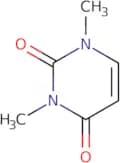
CAS:1,3-Dimethyluracil is a uracil derivative that is used as a hydrogen-bond donor, which helps to repair DNA. It has been shown to have a kinetic isotope effect in the deuterium isotope effect studies. The carbonyl group of 1,3-dimethyluracil can form hydrogen bonds with the guanine base in DNA and lead to the formation of an adduct. This adduct can be repaired by nucleotide excision repair when it forms a dimer with another 1,3-dimethyluracol molecule or by base excision repair when it forms a dimer with another purine or pyrimidine base. Aqueous solutions of 1,3-dimethyluracil are stable for short periods of time but decompose rapidly on heating. X-ray crystal structures show that 1,3-dimethyluracil binds to hydrochloric acid and x-ray crystallographic analysisFórmula:C6H8N2O2Pureza:Min. 95%Forma y color:Off-White Slightly Brown PowderPeso molecular:140.14 g/molHypoxanthine monosodium salt
CAS:Hypoxanthine is a nucleotide, which is a building block of DNA and RNA. It is a useful intermediate for the production of other chemicals and drugs. Hypoxanthine can be used as a reagent in biochemical research, to study the effects of hypoxia on cells, or as a catalyst in organic synthesis. Hypoxanthine monosodium salt is an important building block for complex compounds with many uses. It is also used as a reaction component in many chemical reactions as well as being a versatile scaffold for drug design.Fórmula:C5H4N4NaOPureza:Min. 97 Area-%Forma y color:White PowderPeso molecular:159.1 g/molNb-N-(benzhydryloxycarbonyl)cytosine)-1-acetic acid
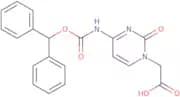
CAS:Nb-N-(benzhydryloxycarbonyl)cytosine)-1-acetic acid is a speciality chemical that is used as a reagent, building block, and scaffold for organic synthesis. This compound can be used in various reactions to produce complex compounds with high purity. Nb-N-(benzhydryloxycarbonyl)cytosine)-1-acetic acid is an excellent starting material for the production of fine chemicals, research chemicals, and versatile building blocks. It is also a useful intermediate for the production of pharmaceuticals and other useful compounds.Fórmula:C20H17N3O5Pureza:Min. 98 Area-%Forma y color:White PowderPeso molecular:379.37 g/mol6-Amino-1,3-dimethyluracil
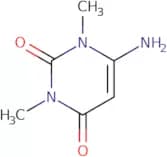
CAS:6-Amino-1,3-dimethyluracil is a synthetic compound that has been shown to have antiinflammatory activity. This drug was synthesized from recycled methylene biphenyls and quinoline derivatives. 6-Amino-1,3-dimethyluracil inhibits the synthesis of proteins in cells by inhibiting the production of amino acids such as methionine through an attack on the amino group of methionine. 6-Amino-1,3-dimethyluracil also has apoptotic activity, which may be due to its ability to inhibit protein synthesis and increase the levels of active methylene.Fórmula:C6H9N3O2Pureza:Min. 95%Forma y color:PowderPeso molecular:155.15 g/mol3'-Deoxy-2',3'-Didehydro-2'Fluorothymidine
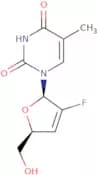
CAS:3'-Deoxy-2',3'-Didehydro-2'Fluorothymidine (3DFT) is a nucleoside analogue of thymidine. It has been shown to be an efficient inhibitor of HIV replication in vitro and in vivo. 3DFT is able to inhibit virus production by blocking the viral reverse transcriptase enzyme, which is responsible for copying the viral genomic RNA into DNA. This drug also inhibits the activity of human immunodeficiency virus type 1 integrase, which is an enzyme that catalyses the integration of proviral DNA into host cell chromosomes. 3DFT is a potent inhibitor of HIV infection in vitro and in vivo and has also been shown to inhibit other viruses such as cytomegalovirus, herpes simplex virus types 1 and 2, varicella zoster virus, influenza A virus, coxsackie B4 virus, echovirus 7, and erythrovirus 9.Fórmula:C10H11FN2O4Pureza:Min. 95%Peso molecular:242.2 g/mol3’-Deoxy-5-fluorouridine
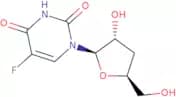
CAS:3’-Deoxy-5-fluorouridine is a synthetic compound that is used as an anticancer drug. It has been shown to induce apoptosis in cancer cells through the modulation of polymerase, synthetase and other enzymes involved in DNA synthesis. 3’-Deoxy-5-fluorouridine also inhibits the activity of viral thymidylate synthase, which prevents the conversion of deoxyuridine triphosphate (dUTP) to thymidylate monophosphate (dTMP), preventing DNA replication and cell division. This chemical can be synthesized by reacting uracil with trifluoroacetic acid followed by saponification.
Pureza:Min. 95%9-Deazaguanine
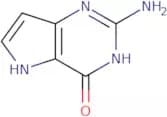
CAS:9-Deazaguanine is an analog of guanine, which has inhibitory properties. It reacts with the hydrogen bond of the enzyme and prevents its reaction with a substrate. 9-Deazaguanine binds to the target enzymes trifluoroacetic acid (TFA) and hydrogen bond interactions with water molecules. The reaction mechanism is based on the competitive inhibition of TFA, which is an important enzyme in DNA synthesis. 9-Deazaguanine inhibits the growth of k562 cells by inhibiting protein synthesis at specific sites in the ribosome. 9-Deazaguanine also shows inhibitory properties against autoimmune diseases and infectious diseases because it inhibits immune system reactions that are mediated by antibodies and T cells.
Fórmula:C6H6N4OPureza:Min. 95%Forma y color:PowderPeso molecular:150.14 g/mol3’,5’-Bis-O-benzoyl-2’-deoxy-2’-fluoro-β-D-arabino-6-azidouridine
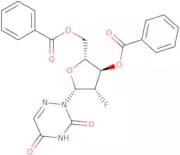
CAS:Please enquire for more information about 3’,5’-Bis-O-benzoyl-2’-deoxy-2’-fluoro-beta-D-arabino-6-azidouridine including the price, delivery time and more detailed product information at the technical inquiry form on this pagePureza:Min. 95%9-Methylxanthine
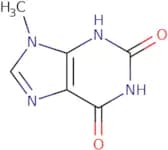
CAS:Producto controlado9-Methylxanthine is a purine alkaloid that is structurally related to caffeine. It is used as a bronchodilator and to treat cardiac arrhythmias. 9-Methylxanthine has been shown to have an effect on the rate of DNA replication by binding to the enzyme xanthosine phosphorylase, which converts xanthosine monophosphate (XMP) to xanthosine diphosphate (XDP). The drug's effect on other nucleobases, such as adenosine monophosphate (AMP), cannot be ruled out. 9-Methylxanthine also has a strong affinity for macrochelates, which are compounds that contain chelating agents with a large number of ethylenediaminetetraacetic acid (EDTA) groups. This property is due to the high number of nitrogen atoms in the molecule and its ability to form hydrogen bonds between water moleculesFórmula:C6H6N4O2Pureza:Min. 95%Forma y color:PowderPeso molecular:166.14 g/mol6-Mercaptopurine
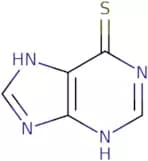
CAS:6-Mercaptopurine is an antigen binding molecule that is biocompatible with the human body. It binds to 6-mercaptopurine and inhibits the oxidation of proteins. The inhibition of protein oxidation has been shown to decrease disease activity in patients with inflammatory bowel disease. 6-Mercaptopurine also inhibits the production of inhibitor molecules, which are responsible for the development of cardiac effects such as arrhythmias and cardiomyopathy. 6-Mercaptopurine has inhibitory properties against polymerase chain reactions, which may be due to its ability to bind with protein thiols at high rates.Fórmula:C5H4N4SPureza:Min. 98 Area-%Forma y color:PowderPeso molecular:152.18 g/mol3’-Deoxy-3’-fluoro-6-thioinosine
CAS:Please enquire for more information about 3’-Deoxy-3’-fluoro-6-thioinosine including the price, delivery time and more detailed product information at the technical inquiry form on this page
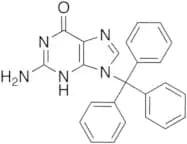
Pureza:Min. 95%9N-Trityl Guanine
CAS:Producto controladoApplications Protected Guanine.
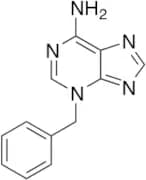
References Hakimelahi, G., et al.: J. Med. Chem., 44, 3710 (2001),Fórmula:C24H19N5OForma y color:NeatPeso molecular:393.443-Benzyladenine
CAS:Producto controladoApplications 3-BENZYLADENINE (cas# 7280-81-1) is a useful research chemical.
Fórmula:C12H11N5Forma y color:NeatPeso molecular:225.25N2,9-Diacetylguanine
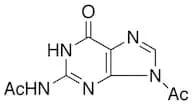
CAS:Producto controladoImpurity Acicclovir EP Impurity L
Applications N2,9-Diacetylguanine (Acicclovir EP Impurity L) is used to synthesize acyclic analogues of deoxyguanosine.
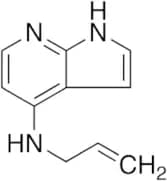
References Martin, J. C., et al.: J Med Chem. 26, 759 (1983)Fórmula:C9H9N5O3Forma y color:NeatPeso molecular:235.2N-Allyl-1,7-dideazaadenine
CAS:Producto controladoApplications Used in the preparation of pyrrolotriazines.
Fórmula:C10H11N3Forma y color:NeatPeso molecular:173.21Uracil Lyxonucleoside-13C,15N2 5'-Phosphate
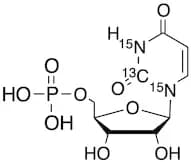
CAS:Producto controladoApplications Uracil Lyxonucleoside 5'-Phosphate is an intermediate in the synthesis of Trilithium UDP-glucuronic Acid-13C1, 15N2 (T886287), which is an isotope labelled analog of Trisodium UDP-glucuronic Acid (T886285). Trisodium UDP-glucuronic Acid is a reactant used in the enzymatic preparation of β-glucuronides.
References Stevenson, D.E., et. al.: Collect Czech. Chem. C., 65, 117 (2000); Robotham, S.A., Brodbelt, J.S.: Biochem. Pharmacol., 82, 1764 (2011); Kren, V., et. al.: Drug Metab. Dispos., 28, 1513 (2000)Fórmula:C813CH1315N2O9PForma y color:NeatPeso molecular:327.163’-O-t-Bulyldimethylsilyl thymidine
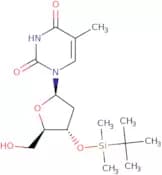
CAS:3’-O-t-Bulyldimethylsilyl thymidine is a nucleoside analog that is chemically stable and has been shown to be a potential biomarker for the diagnosis of fetal bovine spongiform encephalopathy (BSE). 3’-O-t-Bulyldimethylsilyl thymidine binds to basic proteins in the cell nucleus, which can be detected by immunoassay. It also has been shown to inhibit protein synthesis in tubule cells of the kidney and skin cancer cells. The drug is metabolized by dephosphorylation to t-butyldeoxyuridine, which is then converted into thymidine.Fórmula:C16H28N2O5SiPureza:Min. 95%Forma y color:White PowderPeso molecular:356.49 g/mol5-Bromo-6-azauracil
CAS:5-Bromo-6-azauracil is a nucleophilic compound that can be used to treat wastewater. It is also able to lyse cells and has been used as an immobilizing agent. The reactive nature of 5-Bromo-6-azauracil enables it to undergo nucleophilic substitutions with amines, which are present in the cell wall and other biomolecules. This process results in the formation of amide bonds, which leads to the inhibition of protein synthesis. 5-Bromo-6-azauracil has shown inhibitory effects on glucans, which may be due to its ability to form covalent bonds with glucose molecules.Fórmula:C3H2BrN3O2Pureza:Min. 95%Forma y color:White To Off-White SolidPeso molecular:191.97 g/mol8-Nitroguanine
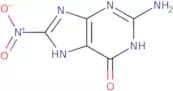
CAS:8-Nitroguanine is a reactive cell factor that can be found in the skin and other tissues. It is an endogenous product of nitric oxide, which can be formed by the reaction of nitric oxide with superoxide in the presence of peroxynitrite. 8-Nitroguanine has been shown to inhibit matrix metalloproteinase-9 activity and to have a protective effect on cells from UV radiation. 8-Nitroguanine also has been shown to be a potential biomarker for bowel disease and damage. The levels of 8-nitroguanine increase in chronic viral hepatitis and cancer tissues. This compound can also be used as an analytical method for detection of inflammation, oxidative stress, or DNA damage.Fórmula:C5H4N6O3Pureza:Min. 95%Forma y color:PowderPeso molecular:196.13 g/mol