Nucleótidos
Los nucleótidos son compuestos orgánicos que sirven como building blocks de los ácidos nucleicos, esenciales para la formación del ADN y ARN. Cada nucleótido está compuesto por una base nitrogenada, una molécula de azúcar y uno o más grupos fosfato. Estos nucleótidos se unen para formar largas cadenas, creando el material genético que lleva y transmite la información genética en todos los organismos vivos. En esta sección, encontrará una amplia variedad de nucleótidos cruciales para la investigación en genética, biología molecular y bioquímica. Son fundamentales para estudiar los procesos genéticos, sintetizar ácidos nucleicos y desarrollar herramientas diagnósticas y terapéuticas. En CymitQuimica, ofrecemos nucleótidos de alta calidad para apoyar su investigación científica y aplicaciones, asegurando precisión y fiabilidad en sus experimentos.
Subcategorías de "Nucleótidos"
Se han encontrado 2634 productos de "Nucleótidos"
Ordenar por
Pureza (%)
0
100
|
0
|
50
|
90
|
95
|
100
Guanosine-5'-[(b,γ)-methyleno]triphosphate sodium salt
CAS:Guanosine-5'-[(b,gamma)-methyleno]triphosphate sodium salt (GMPP) is an analog of guanosine triphosphate that is enzymatically inactivated by the enzyme kinesin. GMPP inhibits the polymerization of microtubules by binding to the kinesin molecule and preventing it from binding to tubulin. GMPP has been shown to inhibit sephadex g-100 chromatography and act as a competitive inhibitor for protein synthesis in vitro. GMPP has also been shown to have a fat cell differentiation effect which may be due to its ability to inhibit microtubule polymerization.Fórmula:C11H18N5O13P3·xNaPureza:Min. 95 Area-%Forma y color:PowderPeso molecular:521.21 g/mol2',3'-Dideoxy-5-iodouridine
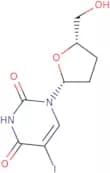
CAS:2',3'-Dideoxy-5-iodouridine is a synthetic nucleoside analog derived from uridine, one of the natural building blocks of RNA. This molecule has been chemically modified to disrupt the normal processes of DNA and RNA synthesis, making it a candidate for antiviral and anticancer research.Fórmula:C9H11IN2O4Pureza:Min. 95%Forma y color:PowderPeso molecular:338.1 g/mol2'-O-Methyl-5-propynyluridine
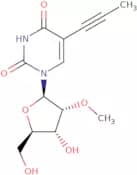
CAS:2'-O-Methyl-5-propynyluridine is a nucleoside that is selective to bacterial DNA. It has been shown to inhibit the binding of RNA polymerase and DNA gyrase, as well as the synthesis of RNA and DNA. This nucleoside also inhibits the formation of triplexes in vitro with oligonucleotides complementary to sequences in the 16S ribosomal RNA gene. 2'-O-Methyl-5-propynyluridine has been used for the measurement of RNA polymerase activity in bacteria, and its affinity for triplexes can be measured by gel shift assay.Fórmula:C13H16N2O6Pureza:Min. 95%Forma y color:PowderPeso molecular:296.28 g/molAdenosine
CAS:<p>Endogenous adenosine receptor ligand; regulator of innate immunity</p>Fórmula:C10H13N5O4Pureza:(Titration) 99.0 To 101.0%Forma y color:White PowderPeso molecular:267.25 g/mol8-Azaadenosine
CAS:8-Azaadenosine is a purine nucleoside that is used as a template for DNA replication. The zwitterionic form of 8-Azaadenosine is found in plants and is converted to the charged form by enzymatic reactions. 8-Azaadenosine binds to the dna template strand and acts as a hydrogen bond donor, which stabilizes the transition state of the reaction and inhibits enzyme activity. This drug has been shown to affect polymerase chain reaction (PCR) by inhibiting DNA synthesis and it has been used in cancer cell lines with resistant mutants, such as Herpes simplex virus type 1 (HSV1).Fórmula:C9H12N6O4Pureza:Min. 97 Area-%Forma y color:Off-White PowderPeso molecular:268.23 g/mol2',3',5'-Tri-O-benzoyl-N6-benzyl-2'-C-methyladenosine
CAS:2',3',5'-Tri-O-benzoyl-N6-benzyl-2'-C-methyladenosine is an adenosine analog for potential use in research into antiviral drug development or nucleoside analogs.Fórmula:C39H33N5O7Pureza:Min. 95%Forma y color:PowderPeso molecular:683.71 g/mol2'-O-Methyl-N6-phenoxyacetyladenosine
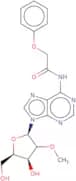
CAS:2'-O-Methyl-N6-phenoxyacetyladenosine is a phosphoramidite nucleoside that is used in the synthesis of DNA and RNA. It has antiviral, anticancer, and antiribonucleases properties. The chemical structure of 2'-O-Methyl-N6-phenoxyacetyladenosine is similar to that of adenosine, but contains a methyl group on C2' position and an oxyalkyl group on N6. This compound can be used as a novel anticancer agent and has been shown to have high affinity for the purine receptor, inhibiting cancer cell proliferation by activating the p53 tumor suppressor pathway.Fórmula:C19H21N5O6Pureza:Min. 95%Forma y color:White to off-white solid.Peso molecular:415.41 g/mol2-Methylthio-N6-isopentenyladenosine
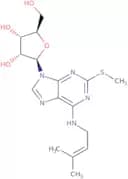
CAS:A nucleoside analogue of adenosine that arises from post-transcriptional modification. In humans, this is mediated by the enzyme CDK5RAP1 in mitochondrial transfer RNA (tRNA) at amino acid 37. Deficiency for this modification, for example due to CDK5RAP1 deficiency, leads to impaired mitochondrial protein synthesis. This has implications for mitochondrial diseases, as well as cancer, type II diabetes and vitiligo. Synthetic ms2i6A can be used to raise monoclonal antibodies against this nucleotide in vivo.Fórmula:C16H23N5O4SPureza:Min. 95%Forma y color:White PowderPeso molecular:381.45 g/molN3-Methylcytidine
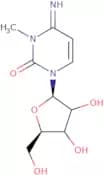
CAS:<p>N3-Methylcytidine is a synthetic analog of uridine. It is used for the treatment of syncytial virus infection, which is a group of diseases caused by viruses that have an RNA genome and replicate by forming syncytia—large groups of infected cells. N3-Methylcytidine inhibits the synthesis of proteins in cells and inhibits the growth of bacteria. This drug has been shown to inhibit actin polymerization and prevents cell spreading. N3-Methylcytidine also binds to RNA polymerase II and blocks its interaction with DNA, inhibiting protein synthesis at the ribosome level. N3-Methylcytidine is metabolized in vivo into methylated cytidine, which can be detected in urine samples using chemical biology methods or fluorescence resonance energy transfer (FRET) analysis. Synonyms: N3-methyluridine; 3-methyluridine</p>Fórmula:C10H15N3O5Pureza:Min. 95%Forma y color:White PowderPeso molecular:257.24 g/mol2'-Amino-2'-deoxyadenosine
CAS:2'-Amino-2'-deoxyadenosine is a modified nucleoside, closely related to adenosine in which the 2'-hydroxyl group is replaced by an amino group. This compound has potential research applicationsFórmula:C10H14N6O3Pureza:Min. 95%Forma y color:PowderPeso molecular:266.26 g/mol2-Thioadenosine
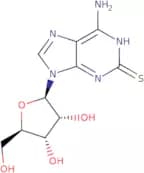
CAS:<p>Intermediate in the synthesis of cangrelor</p>Fórmula:C10H13N5O4SPureza:Min. 95%Forma y color:White PowderPeso molecular:299.31 g/mol1-(2'-Deoxy-5'-O-DMT-2'-fluoro-β-D-arabinofuranosyl)thymine
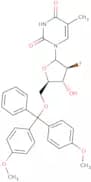
CAS:1-(2'-Deoxy-5'-O-DMT-2'-fluoro-b-D-arabinofuranosyl)thymine is a chemically modified nucleoside that contains a fluorinated sugar moiety and a thymine base, with a dimethoxytrityl (DMT) protecting group on the 5'-hydroxyl of the sugar.Fórmula:C31H31FN2O7Pureza:Min. 95%Peso molecular:562.6 g/mol1-(2'-Deoxy-3',5'-di-O-toluoyl-b-D-ribofuranosyl)-4-amino-1,2-dihydro-2-oxo-1,3,5-triazine
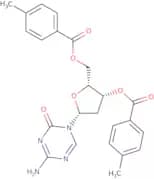
CAS:1-(2'-Deoxy-3',5'-di-O-toluoyl-b-D-ribofuranosyl)-4-amino-1,2-dihydro-2-oxo-1,3,5-triazine is a nucleoside derivative that features a modified pyrimidinone (triazine) base attached to a protected deoxyribose sugar. This molecule can be used in research.Fórmula:C24H24N4O6Pureza:Min. 95%Forma y color:White To Off-White SolidPeso molecular:464.48 g/molInosine 5'-triphosphate trisodium
CAS:Inosine 5'-triphosphate trisodium (ITP) is a nucleotide that is found in human cells. It is produced by the enzyme inosine monophosphate dehydrogenase and acts as an intermediate in cellular metabolism. ITP has been shown to be involved in a number of diseases, such as infectious, autoimmune, and cardiovascular diseases. For example, ITP has been shown to induce the expression of TLR-2 and TLR-4 on human monocyte-derived dendritic cells. The molecule also plays a role in pediatric disease activity, bowel disease, and congestive heart failure.Fórmula:C10H12N4O14P3Na3Pureza:Min. 90 Area-%Forma y color:PowderPeso molecular:574.11 g/mol6-Benzyl-2-thiouracil
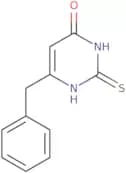
CAS:<p>6-Benzyl-2-thiouracil (BTS) is a benzyl group with the chemical formula C12H8N2OS. It has been used as an anti-infective agent and has been shown to have a clinical relevance in treating hepatitis, cutaneous lesions, and inflammatory bowel disease. BTS is metabolized through oxidation of the benzyl group by cytochrome P450 enzymes. This active form has been shown to inhibit mitochondrial fatty acid synthesis, which may be a pathogenic mechanism for BTS in women with metabolic syndrome. The metabolism of BTS also results in its conversion to 2-benzylpyrimidine, which can be converted into a carcinogen by N-nitrosation.</p>Fórmula:C11H10N2OSPureza:Min. 95%Forma y color:PowderPeso molecular:218.28 g/mol1-(3',5'-Di-O-benzoyl-2'-deoxy-2'-fluoro-β-D-arabinofuranosyl)thymine
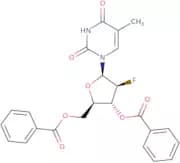
CAS:1-(3',5'-Di-O-benzoyl-2'-deoxy-2'-fluoro-b-D-arabinofuranosyl)thymine is a chemically modified nucleoside analog. This compound contains a thymine base, a 2'-fluoro-β-D-arabinofuranose sugar, which alters biological stability and function and benzoyl protecting groups at the 3' and 5' positions, commonly used in nucleoside synthesis to control selective modifications.Fórmula:C24H21FN2O7Pureza:Min. 95%Forma y color:White To Off-White SolidPeso molecular:468.43 g/mol3',5'-O-(1,1,3,3-Tetraisopropyl-1,3-disiloxanediyl)uridine
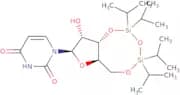
CAS:Used as aprotected uridine nucleoside in RNA synthesis. The 1,1,3,3-tetraisopropyl-1,3-disiloxanediyl (TIPDS or TBDPSi2) group serves as a bulky and selectively acid-labile protecting group for the 3' and 5' hydroxyl groups of the uridine ribonucleoside during RNA oligonucleotide synthesis.Fórmula:C21H38N2O7Si2Pureza:Min. 95%Forma y color:White PowderPeso molecular:486.71 g/mol2'-Deoxy-L-adenosine
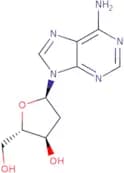
CAS:<p>2'-Deoxy-L-adenosine is an adenosine analogue that has been shown to inhibit the growth of tumor cells in mice. The mechanism of this inhibition is not well understood, but it is thought that 2'-deoxy-L-adenosine inhibits the adenosine A3 receptor and blocks the activation of toll-like receptors. This drug also has been shown to have anti-inflammatory properties, which may be due to its ability to inhibit prostaglandin synthesis. It has been used as a model system for studying cellular responses to DNA damage caused by ultraviolet radiation. 2'-Deoxy-L-adenosine also has been shown to have a cytotoxic effect on human HL60 cells, which is mediated by nuclear DNA fragmentation.</p>Fórmula:C10H13N5O3Pureza:Min. 98 Area-%Forma y color:Off-White PowderPeso molecular:251.25 g/mol7-Deaza 2-C-methyl-N6-methyladenosine
CAS:<p>7-Deaza 2-C-methyl-N6-methyladenosine is a nucleoside that is modified with a methyl group at the 7 position of the deoxyribose ring. It has antiviral and anticancer properties. 7-Deaza 2-C-methyl-N6-methyladenosine is an activator of phosphoramidites, which are compounds that can be used to synthesize DNA or RNA.</p>Fórmula:C13H18N4O4Pureza:Min. 95 Area-%Peso molecular:294.31 g/mol8-Bromoadenosine
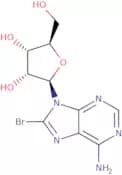
CAS:<p>8-Bromoadenosine is a nucleotide that is structurally related to adenosine. It can be used as an inhibitor of guanine nucleotide-binding proteins and has shown biological properties in vitro. 8-Bromoadenosine has been shown to inhibit the mitochondrial membrane potential, cytosolic Ca2+, and the synthesis of RNA and protein. 8-Bromoadenosine also inhibits leukemia inhibitory factor (LIF) production by 3T3-L1 preadipocytes and induces apoptosis in T84 cells. The drug may be useful for the treatment of leukemia or obesity-related diseases such as diabetes mellitus type 2.</p>Fórmula:C10H12BrN5O4Pureza:Min. 95%Forma y color:Yellow PowderPeso molecular:346.14 g/mol
![Guanosine-5'-[(b,γ)-methyleno]triphosphate sodium salt](/_next/image/?url=https%3A%2Fstatic.cymitquimica.com%2Fproducts%2F3D%2Fthumb-webp%2FNG46689.webp&w=3840&q=75)