Nucleótidos
Los nucleótidos son compuestos orgánicos que sirven como building blocks de los ácidos nucleicos, esenciales para la formación del ADN y ARN. Cada nucleótido está compuesto por una base nitrogenada, una molécula de azúcar y uno o más grupos fosfato. Estos nucleótidos se unen para formar largas cadenas, creando el material genético que lleva y transmite la información genética en todos los organismos vivos. En esta sección, encontrará una amplia variedad de nucleótidos cruciales para la investigación en genética, biología molecular y bioquímica. Son fundamentales para estudiar los procesos genéticos, sintetizar ácidos nucleicos y desarrollar herramientas diagnósticas y terapéuticas. En CymitQuimica, ofrecemos nucleótidos de alta calidad para apoyar su investigación científica y aplicaciones, asegurando precisión y fiabilidad en sus experimentos.
Subcategorías de "Nucleótidos"
Se han encontrado 2634 productos de "Nucleótidos"
Ordenar por
Pureza (%)
0
100
|
0
|
50
|
90
|
95
|
100
8-(p-Chlorophenylthio)-cGMP
CAS:<p>8-(p-Chlorophenylthio)-cGMP is a modified nucleoside that has anticancer activity. It inhibits DNA synthesis and the activation of protein kinases, which are enzymes that transmit signals from the cell surface to the nucleus. 8-(p-Chlorophenylthio)-cGMP can also inhibit viral replication by inhibiting the production of new virus particles and by inhibiting the action of reverse transcriptase, an enzyme that converts RNA into DNA.</p>Fórmula:C16H15ClN5O7PSPureza:Min. 95%Peso molecular:487.81 g/mol2',3'-Dideoxyadenosine-5'-triphosphate lithium salt
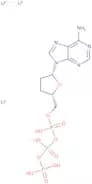
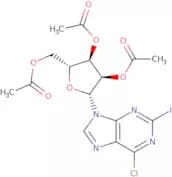
CAS:<p>2',3'-Dideoxyadenosine-5'-triphosphate lithium salt is a nucleoside for use in research applications</p>Fórmula:C10H16N5O11P3·xLiPureza:Min. 95%Forma y color:Clear liquid.Peso molecular:475.18 g/mol6-Chloro-2-iodo-9-(2',3',5'-tri-O-acetyl-b-D-ribofuranosyl)purine
CAS:<p>6-Chloro-2-iodo-9-(2',3',5'-tri-O-acetyl-b-D-ribofuranosyl)purine is a protected purine nucleoside</p>Fórmula:C16H16ClIN4O7Pureza:Min. 95%Peso molecular:538.68 g/mol2-Methylthio-N6-methyladenosine
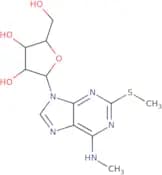
CAS:<p>2-Methylthio-N6-methyladenosine is an adenosine nucleoside that is found in the DNA of eukaryotes. It is similar to 2-methylthio-n6-isopentenyladenosine, which is a modified form of n6-methyladenosine. The chemical structures of both molecules are related to the thermodynamic properties of the molecule and their ability to be postsynthetically modified. These modifications can lead to changes in their translation, which can have implications for the development and progression of disease. 2-Methylthio-N6-methyladenosine has a role in epigenetics, which is defined as changes in gene expression without any alterations in DNA sequence. In this case, it may modify the chloride ion concentration by changing its chemical structure, leading to epigenetic changes that can affect how genes are expressed or translated into proteins.</p>Fórmula:C12H17N5O4SPureza:Min. 95%Forma y color:White PowderPeso molecular:327.36 g/mol5-Methoxyuridine 5′-triphosphate sodium, 85mM/L aqueous solution
CAS:Please enquire for more information about 5-Methoxyuridine 5′-triphosphate sodium, 85mM/L aqueous solution including the price, delivery time and more detailed product information at the technical inquiry form on this pageFórmula:C10H17N2O16P3•NaxPureza:Min. 95%2-Deoxycytidine 3',5'-diphosphate
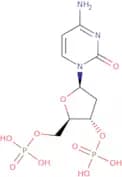
CAS:<p>2-Deoxycytidine 3',5'-diphosphate is an additive that is used in the production of DNA. It is a single-stranded nucleotide with a guanine base. 2-Deoxycytidine 3',5'-diphosphate has been shown to inhibit bacterial growth by reacting with hydrogen peroxide, which is produced during the process of oxidative phosphorylation. This reaction leads to the formation of reactive oxygen species, which damage DNA and cause cell death. The compound also binds to metal ions and prevents them from interacting with cellular components. 2-Deoxycytidine 3',5'-diphosphate can be used as a chromatographic agent for separating DNA fragments according to their size.</p>Fórmula:C9H15N3O10P2Pureza:Min. 95%Peso molecular:387.18 g/mol5,6-Dihydrothymidine
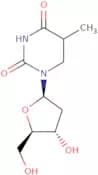
CAS:<p>5,6-Dihydrothymidine is a hydroxylated thymidine analogue. It binds to the leukocyte antigen, which is found on many different types of cells. 5,6-Dihydrothymidine inhibits the replication of herpes simplex virus and can be used for diagnostic purposes. 5,6-Dihydrothymidine has been shown to have conformational properties that are similar to those of thymine, which allows it to bind to the template strand in DNA. This binding prevents the synthesis of messenger RNA from DNA. 5,6-Dihydrothymidine is also able to inhibit cell growth in culture and can be used as a cell culture medium supplement.</p>Fórmula:C10H16N2O5Pureza:Min. 95%Forma y color:PowderPeso molecular:244.24 g/molγ-[(6-Azidohexyl)-imido]-ATP sodium
Please enquire for more information about γ-[(6-Azidohexyl)-imido]-ATP sodium including the price, delivery time and more detailed product information at the technical inquiry form on this pageFórmula:C16H28N9O12P3•NaxPureza:Min. 95%2′-O-Succinyladenosine 3′,5′-monophosphate
CAS:<p>Please enquire for more information about 2′-O-Succinyladenosine 3′,5′-monophosphate including the price, delivery time and more detailed product information at the technical inquiry form on this page</p>Fórmula:C14H16N5O9PPureza:Min. 95%Peso molecular:429.28 g/mol2'-Deoxyinosine-5'-triphosphate sodium,100mM aqueous solution
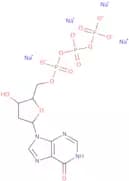
CAS:<p>2'-Deoxyinosine-5'-triphosphate sodium (2'-dITP) is a modified nucleotide that has antiviral and anticancer properties. It has been shown to be an activator for ribonucleosides, deoxyribonucleosides, and DNA. 2'-DITP has also been shown to inhibit the growth of human breast cancer cells in vitro.</p>Fórmula:C10H11N4Na4O13P3Pureza:Min. 95%Forma y color:Clear LiquidPeso molecular:580.09 g/mol5′-O-DMT-LNA N-Bz adenosine
CAS:<p>5′-O-DMT-LNA N-Bz adenosine is a novel nucleoside that has been modified with an aminooxy group. The compound is synthesized by the phosphoramidite method and it is designed for use in antiviral and anticancer research. 5′-O-DMT-LNA N-Bz adenosine can be used as a substrate for DNA polymerases and other enzymes to produce nucleic acid strands. This product is CAS No. 206055-74-5, monophosphate, Phosphoramidites, Synthetic, Deoxyribonucleosides, Anticancer, Ribonuclesides, High purity.</p>Fórmula:C39H35N5O7Pureza:Min. 95%Peso molecular:685.73 g/mol2'-Amino-2'-deoxycytidine
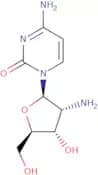
CAS:2'-Amino-2'-deoxycytidine is a modified nucleoside, based on cytidine. In this compound 2'-hydroxyl group has been replaced by an amino group, which can change hydrogen bonding patterns potentially affecting how it interacts with biomolecules.Fórmula:C9H14N4O4Pureza:Min. 95%Forma y color:PowderPeso molecular:242.24 g/molGuanosine 5'-diphosphate sodium
CAS:<p>Pyruvate kinase substrate</p>Fórmula:C10H15N5O11P2•Na2Pureza:Min. 95%Forma y color:PowderPeso molecular:466.19 g/molGuanosine5'-diphosphate
CAS:<p>Pyruvate kinase substrate</p>Fórmula:C10H15N5O11P2Pureza:Min. 95%Forma y color:PowderPeso molecular:443.2 g/mol2',3'-O-Isopropylideneinosine
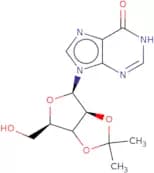
CAS:<p>2',3'-O-Isopropylideneinosineis a nucleoside for use in research applications</p>Fórmula:C13H16N4O5Pureza:Min. 95%Forma y color:PowderPeso molecular:308.3 g/molLamivudine-5'-triphosphate tetratriethylammonium salt - ca.15 mM Aqueous solution
<p>Lamivudine-5'-triphosphate tetratriethylammonium salt - ca.15 mM Aqueous solution is an antiviral drug used to treat HIV/AIDS and hepatitis B infections. It is a potent inhibitor of human immunodeficiency virus type 1 (HIV-1) replication, acting by blocking the viral enzyme reverse transcriptase. Lamivudine-5'-triphosphate tetratriethylammonium salt - ca.15 mM Aqueous solution also inhibits cellular viral DNA synthesis and has been shown to exhibit anticancer activity in vitro and in vivo. This product is synthesized from raw materials through a novel process that involves modification of the phosphoramidite monophosphate with tetratriethylammonium salts.</p>Fórmula:C32H74N7O12P3SPureza:Min. 95%Peso molecular:873.96 g/mol2'-Deoxy-3',5'-O-(1,1,3,3-tetraisopropyl-1,3-disiloxanediyl)uridine
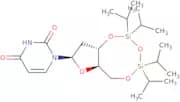
CAS:<p>2'-Deoxy-3',5'-O-(1,1,3,3-tetraisopropyl-1,3-disiloxanediyl)uridine is a novel and synthetic nucleoside analog with antiviral activity. It inhibits the synthesis of DNA by binding to the enzyme ribonucleotide reductase. This compound has been shown to be an activator of PPARs in vitro.</p>Fórmula:C21H38N2O6Si2Pureza:Min. 95%Peso molecular:470.72 g/molN2-Benzoylguanosine
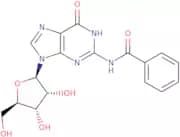
CAS:<p>N2-Benzoylguanosine is a nucleotide derivative that is formed by the acetylation of guanosine. It has been shown to act as a buffer in alkaline solutions and isomerizes to its n-oxide form when heated. N2-Benzoylguanosine reacts with peroxides such as hydrogen peroxide, glyoxal, and organic peroxides, forming hydroperoxide intermediates that can be converted into other products. The acidic hydrolysis of N2-benzoylguanosine yields the corresponding 6-benzoyladenosines. It has been shown to enhance the activity of uridine in inhibiting bacterial growth, while also acting as an inhibitor of viral RNA synthesis. This compound also reacts with nitrous acid to form an n6-benzoyladenosine derivative that inhibits the formation of RNA chains during transcription.</p>Fórmula:C17H17N5O6Pureza:Min. 95%Forma y color:White to beige solid.Peso molecular:387.35 g/molKinetin riboside-5'-monophosphate sodium salt
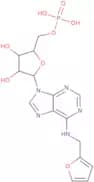
CAS:Kinetin riboside-5'-monophosphate sodium salt is a synthetic nucleotide that has been modified to include a phosphate group at the 5' position. Kinetin riboside-5'-monophosphate sodium salt is an activator of DNA synthesis and can be used for the treatment of viral infections. It also shows anticancer activity and is effective against cancer cells that are resistant to other cancer drugs.Fórmula:C15H16N5Na2O8P·H2OPureza:Min. 95%Forma y color:PowderPeso molecular:489.29 g/molRibavirin 5'-triphosphate triethylammonium salt - 10 mM aqueous solution
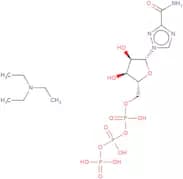
CAS:<p>Ribavirin triphosphate is the biologically active metabolite of antiviral nucleoside analog ribavirin. In cells, the prodrug ribavirin gets triphosphorylated and in it inhibits viral RNA polymerases, interfering with the synthesis of newly formed RNA.</p>Fórmula:C8H15N4O14P3•(C6H15N)xPureza:Min. 95 Area-%Forma y color:Clear LiquidPeso molecular:789.73



![γ-[(6-Azidohexyl)-imido]-ATP sodium](/_next/image/?url=https%3A%2Fstatic.cymitquimica.com%2Fproducts%2F3D%2Fthumb-webp%2FNA183120.webp&w=3840&q=75)