Nucleósidos
Se han encontrado 3569 productos de "Nucleósidos"
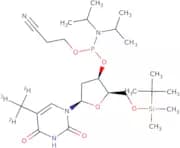
5'-O-tert-Butyldimethylsilyl-D3-thymidine 3'-CE phosphoramidite
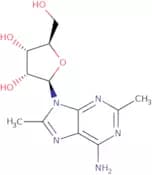
Producto controlado5'-O-tert-Butyldimethylsilyl-D3-thymidine 3'-CE phosphoramidite is a novel, modified ribonucleoside which is an activator of DNA synthesis and antiviral. It is synthesized by the reaction of 5'-O-tert-butyldimethylsilyl-D3-thymidine with 3'-chloroethoxycyanoethyl phosphate in the presence of tetrazole. The CAS number for this compound is 108881-52-2. This product has been shown to inhibit cancer cells through the inhibition of RNA synthesis and activation of DNA synthesis, as well as inhibiting viral replication.Fórmula:C25H42N4O6PSiD3Pureza:Min. 95%Peso molecular:559.74 g/mol2,8-Dimethyladenosine
CAS:2,8-Dimethyladenosine is a methylated derivative of the purine nucleoside adenosine, in which methyl groups are added at the 2-position and 8-position of the adenine base.Fórmula:C12H17N5O4Pureza:Min. 95%Forma y color:White PowderPeso molecular:295.29 g/mol2'-Deoxy-5-methylcytidine
CAS:2'-Deoxy-5-methylcytidine is a nucleoside analogue that inhibits the synthesis of DNA. It prevents methylation of guanine, which disrupts the binding of guanine nucleotide-binding proteins to the dna template and prevents polymerase chain reactions. 2'-Deoxy-5-methylcytidine has been shown to inhibit colon cancer cells in vitro, and may be a potential biomarker for bowel disease. This drug is also a methyltransferase inhibitor, which means it blocks the enzyme responsible for adding methyl groups to cytosine molecules.
Fórmula:C10H15N3O4Pureza:Min. 98 Area-%Forma y color:White PowderPeso molecular:241.25 g/molThymidine-3',5'-diphosphate sodium salt
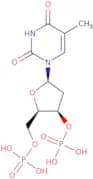
CAS:Thymidine-3',5'-diphosphate sodium salt is a nucleoside that is used in the synthesis of oligonucleotides. It is an antiviral and anticancer agent. Thymidine-3',5'-diphosphate sodium salt has been shown to inhibit DNA synthesis, leading to cell death. It also has been shown to be effective against Hepatitis B virus and HIV-1.
Fórmula:C10H16N2O11P2·xNaPureza:Min. 98 Area-%Forma y color:White PowderPeso molecular:402.19 g/mol3'-Deoxythymidine
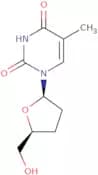
CAS:3'-Deoxythymidine (3DT) is a nucleoside analog that has high resistance to HIV. It is an analogue of the human insulin-like growth factor-1 (IGF-1), which binds to the IGF-1 receptor and inhibits the binding of IGF-1 to its receptor, thereby inhibiting the growth of cells. 3DT has been shown to have a protective effect against radiation in mice, with an LD50 at a dose of 5.0 mg/kg for radiation exposure. 3DT also has antiviral activity against murine sarcoma virus, as well as other biological properties such as enzyme activities and disease activity. This drug may be used in future research on polymerase chain reactions (PCRs) and DNA sequencing, since it is chemically stable and can be easily synthesized.Fórmula:C10H14N2O4Pureza:Min. 95%Forma y color:White PowderPeso molecular:226.23 g/molN4-Benzoyl-2'-deoxy-a-cytidine
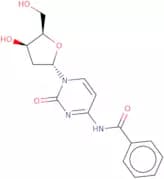
CAS:N4-Benzoyl-2'-deoxy-a-cytidine is a novel, modified nucleoside that has shown anticancer and antiviral activity. It is synthesized by the enzymatic oxidation of 2'-deoxyadenosine with benzoyl chloride and sodium bicarbonate. N4-Benzoyl-2'-deoxy-a-cytidine has been shown to activate transcription, increase DNA synthesis, and inhibit virus replication. It also inhibits bacterial growth, but does not appear to have any effect on mammalian cells.Fórmula:C16H17N3O5Pureza:Min. 95%Forma y color:PowderPeso molecular:331.32 g/mol2'-O-Acetyl-3'-deoxy-3'-fluoro-5-methoxy-5'-O-toluoyluridine
CAS:2'-O-Acetyl-3'-deoxy-3'-fluoro-5-methoxy-5'-O-toluoyluridine is a modified nucleoside that has antiviral, anticancer and antimalarial activities. This compound has been synthesized as a monophosphate derivative of the natural nucleoside uridine. It is an activator of DNA polymerase, which helps to synthesize DNA in cells. 2'-O-Acetyl-3'-deoxy-3'-fluoro-5-methoxy-5'-O-toluoyluridine also has anticancer activity due to its ability to inhibit the replication of the human tumor virus KSHV.Pureza:Min. 95%2'-Deoxy-6-thioguanosine
CAS:2'-Deoxy-6-thioguanosine is a purine nucleoside analog that inhibits the activation of transcription factors such as nuclear factor kappa-B (NF-κB) and activator protein 1 (AP-1). It also inhibits the synthesis of proinflammatory cytokines, such as IL-1β, IL-6, and TNFα. The matrix effect is an important factor in the prevention of tumor progression. 2'-Deoxy-6-thioguanosine has been shown to inhibit cell proliferation and induce apoptosis in squamous cell carcinoma cells by modulating the expression of HLA class II molecules on tumors. It also prevents invasion by blocking matrix metalloproteinase activity. 2'-Deoxy-6-thioguanosine has been found to be effective against bowel diseases such as ulcerative colitis and Crohn's disease, as well as infectious diseases such as HIV/AIDS.Fórmula:C10H13N5O3SPureza:Min. 97 Area-%Forma y color:PowderPeso molecular:283.31 g/molMorpholino T monomer
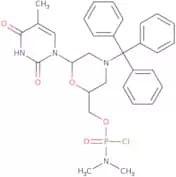
CAS:Morpholino T is a modified nucleoside amidite used to prepare morpholino oligomers
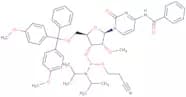
Fórmula:C31H34ClN4O5PPureza:Min. 98 Area-%Forma y color:White PowderPeso molecular:609.05 g/molN4-Benzoyl-5'-O-DMT-2'-O-methylcytidine 3'-CE phosphoramidite
CAS:N4-Benzoyl-5'-O-DMT-2'-O-methylcytidine 3'-CE phosphoramidite is a diploid DNA molecule that is synthesized by the enzyme diploid. The clone was obtained from a yeast strain, and it has been shown to catalyze the conversion of isoprene to isopentenyl diphosphate. The optical spectra of this compound have been characterized in detail, and it has been found to have an absorption maximum at 243 nm. This compound has also been used in the disruption of yeast chromosomes, and its spectrum has been used as a reference for other compounds with similar chemical structures.Fórmula:C47H54N5O9PPureza:Min. 98 Area-%Forma y color:PowderPeso molecular:863.96 g/mol6-Mercapto-9-(2'-deoxy-β-D-ribofuranosyl)purine
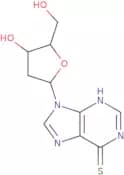
CAS:6-Mercapto-9-(2'-deoxy-b-D-ribofuranosyl)purine (6MPD) is a purine nucleoside that is used in the preparation of glycosidic bonds. It forms a glycosidic bond with the terminal residue of an oligosaccharide, which leads to the formation of an oligodeoxynucleotide. 6MPD also has binding properties to DNA binding proteins, and it can be used as a growth factor. 6MPD is obtained by reacting 3-chloroperoxybenzoic acid with sodium trifluoroacetate in the presence of mercaptoethanol and sodium hydroxide. This reaction yields 6MPD as a white solid with a melting point of 179°C.Fórmula:C10H12N4O3SPureza:Min. 95%Forma y color:PowderPeso molecular:268.29 g/mol2,2'-Anhydrouridine
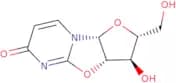
CAS:The nucleophilic opening of 2,2'-Anhydrouridine represents a novel synthetic approach for elaborating the ring of nucleosides. For example, compounds such as 2-amino-, 2-fluoro- and 2-phenylseleno-2-deoxyuridines are prepared from the nucleophilic opening of 2,2'-Anhydrouridine.Â2,2'-Anhydrouridine inhibits uridine phosphorylase, a key enzyme targeted by some antitumor drugs.
Fórmula:C9H10N2O5Pureza:Min. 98 Area-%Forma y color:White Off-White PowderPeso molecular:226.19 g/mol5-Methylcytidine-5'-monophosphate
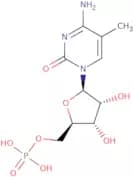
CAS:5-Methylcytidine-5'-monophosphate is a nucleotide that is an intermediate in the synthesis of DNA. It is a neutral form and has been sequenced. 5-Methylcytidine-5'-monophosphate is found in cellular components, such as mitochondria and nuclei. The biochemical properties of this molecule are dependent on its methylation state. This molecule also plays a role in mitochondrial functions and nuclear DNA modifications.
Fórmula:C10H16N3O8PPureza:Min. 95%Forma y color:White Off-White PowderPeso molecular:337.22 g/molN4-Acetyl-2'-O-tert-butyldimethylsilyl-5'-O-DMT-5-methylcytidine 3'-CE phosphoramidite
N4-Acetyl-2'-O-tert-butyldimethylsilyl-5'-O-DMT-5-methylcytidine 3'-CE phosphoramidite is a novel monophosphate nucleotide that can be used for the synthesis of DNA and RNA. It has antiviral, anticancer, and activating properties. N4-Acetyl-2'-O-tert-butyldimethylsilyl-5'-O-DMT-5-methylcytidine 3'-CE phosphoramidite is synthesized by modifying cytosine with an acetyl group at the 4th position in the ribose ring, a tertiary butyldimethylsilyl group at the 2nd position on the 5' carbon atom, and a DMT group at the 5' position on the 5' carbon atom. The CAS number for this compound is 868312050.Pureza:Min. 95%1-(2’-Deoxy-2’-fluoro-b-D-arabinofuranosyl)-N3-(2S)-(2-amino-3-carbonyl]propyluracil
CAS:1-(2’-Deoxy-2’-fluoro-β-D-arabinofuranosyl)-N3-(2S)-(2-amino-3-carbonyl]propyluracil is a novel, anticancer drug. It is active against both RNA and DNA viruses, such as HIV, influenza virus and herpes virus. 1-(2’-Deoxy-2’-fluoro-β-D-arabinofuranosyl)-N3-(2S)-(2-amino-3-carbonyl]propyluracil has been shown to be an activator for phosphoramidites in aqueous solution. This compound is of high purity with CAS No. 2072145–25–4. It is also a synthesized, monophosphate nucleoside that can be used in the production of modified nucleosides for therapeutic purposes or as antiviral agentsPureza:Min. 95%Cytidine
CAS:Cytidine is a pyrimidine nucleoside that is important in the synthesis of RNA and DNA. Cytidine deaminase is an enzyme that catalyzes the conversion of cytidine to uridine. Cytidine deaminase has been shown to be inhibited by its substrate, cytidine, and by other compounds that are structurally similar to cytidine such as uracil, thymine, and guanine. Cytidine deaminase has been shown to have a role in the development of autoimmune diseases and HIV infection. This enzyme also has an important role in the polymerization of DNA during replication. Cytidine can be used for transfection experiments and to inhibit viral replication.Fórmula:C9H13N3O5Pureza:Min. 99 Area-%Peso molecular:243.22 g/mol2’-Deoxyisoguanosine
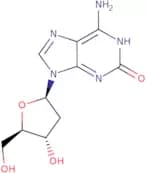
CAS:Incorporated in DNA/RNA hybrids and mismatch pairs to analyse helix stabilityFórmula:C10H13N5O4Pureza:Min. 95%Forma y color:PowderPeso molecular:267.24 g/mol2-Azidoadenosine
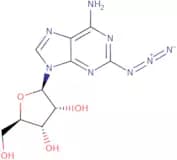
CAS:2-Azidoadenosine is a nucleoside analog of adenosine, where the 2'-hydroxyl group of the ribose sugar is replaced with an azido group (–N₃). This substitution imparts unique chemical properties, notably enabling molecules to undergo bioorthogonal reactions, such as click chemistry, which involves the cycloaddition of the azide group with alkynes.
Fórmula:C10H12H8O4Pureza:Min. 95%Forma y color:PowderPeso molecular:308.25 g/molN6-Benzyl-2-deoxyadenosine
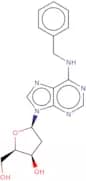
N6-Benzyl-2-deoxyadenosine is a modified nucleotide that can be incorporated into DNA during replication. The compound has antiviral properties and can act as an activator for the transcription of genes involved in the immune response. It is synthesized by coupling two phosphate groups to adenosine monophosphate, which is then modified with a benzyl group. This modification prevents N6-benzyl-2-deoxyadenosine from being phosphorylated and degraded to adenosine monophosphate, resulting in a stable molecule that can be incorporated into DNA.Fórmula:C17H19N5O3Pureza:Min. 95%Forma y color:PowderPeso molecular:341.36 g/mol2-Chloro-2'-deoxyadenosine 5'-triphosphate sodium salt
2-Chloro-2'-deoxyadenosine 5'-triphosphate sodium salt is a nucleoside that can be used in the synthesis of DNA and RNA. It is a synthetic, high quality, and novel compound that has been shown to have antiviral, anticancer, and anti-inflammatory properties. This compound has been shown to inhibit the growth of cancer cells by inhibiting the production of proteins vital for cell division. 2-Chloro-2'-deoxyadenosine 5'-triphosphate sodium salt has also been shown to be an activator of nucleoside phosphorylase and deoxynucleotide kinase, which are enzymes that catalyze the conversion of nucleosides into their corresponding monophosphates.Pureza:Min. 95%





![1-(2’-Deoxy-2’-fluoro-b-D-arabinofuranosyl)-N3-(2S)-(2-amino-3-carbonyl]propyluracil](/_next/image/?url=https%3A%2Fstatic.cymitquimica.com%2Fproducts%2F3D%2Fthumb-webp%2FND162854.webp&w=3840&q=75)