Nucleósidos
Se han encontrado 3569 productos de "Nucleósidos"
3',5'-Di-O-acetyl-5-chloro-2'-deoxyuridine
CAS:3',5'-Di-O-acetyl-5-chloro-2'-deoxyuridine (3,5'-diacetyl-2'-deoxyuridine) is a modified nucleoside with antiviral and anticancer properties. This nucleoside is synthesized from 2',3,5'-tri-O-acetyl-5-chloro-alpha-(1,3,5 triphosphate), which is also known as acyclovir. 3',5'-Di-O-acetyl-2'-deoxyuridine has been shown to be a potent activator of the transcriptional activator protein in cultured human cells. 3',5'-Di-O acetyl 2' deoxyuridine is also a novel phosphoramidite monomer that can be used in the synthesis of DNA and RNA. The high purity of this product ensures an excellent quality for research purposes.Fórmula:C13H15ClN2O7Pureza:Min. 95%Peso molecular:346.73 g/mol9-(5'-O-t-Butyldimethylsilyl-2',3'-O-isopropylidene-b-D-ribofuranosyl)-6-chloro-7-deazaguanine
CAS:9-(5'-O-t-Butyldimethylsilyl-2',3'-O-isopropylidene-b-D-ribofuranosyl)-6-chloro-7-deazaguanine is a novel nucleoside phosphoramidite. It is an analogue of the nucleoside 7-(4,4'-dimethoxytrityl)guanine and 9-(4,4'-dimethoxytrityl)guanine. This product has been shown to have anticancer activity and antiviral activity against HIV in vitro. 9-(5'-O-t-Butyldimethylsilyl-2',3'-O-isopropylidene b -D ribofuranosyl)-6 chloro -7 deazaguanine has also been shown to inhibit DNA synthesis in cells. The purity of this product is over 98%. It is a novel compound thatFórmula:C20H33ClN4O4SiPureza:Min. 95%Peso molecular:457.04 g/molN4-Benzoyl-2'-deoxy-5'-O-DMT-cytidine 3'-phosphonate triethylammonium salt
CAS:N4-Benzoyl-2'-deoxy-5'-O-DMT-cytidine 3'-phosphonate triethylammonium salt (BENZYT) is a novel nucleoside analogue that is phosphorylated to the monophosphate (BENZYTP). BENZYTP inhibits DNA synthesis in tumor cells and has been shown to be effective against HIV, herpes simplex virus type 1, and hepatitis B virus.Fórmula:C37H35N3O9P·C6H16NPureza:Min. 95%Peso molecular:798.86 g/molCyclic di-adenosine monophosphate sodium salt
CAS:Cyclic di-adenosine monophosphate sodium salt (c-di-AMP) is a cyclic nucleotide that is structurally similar to its natural counterpart, Adenosine 5'-triphosphate. It binds to the Toll-like receptor 4 (TLR4) and blocks the activation of TLR4 by lipopolysaccharide, thereby inhibiting the downstream inflammatory response. c-di-AMP also inhibits the production of proinflammatory cytokines such as TNFα, IL1β, and IL6 in vitro. c-di-AMP has shown anti-inflammatory properties in vivo and can be used for the treatment of infectious diseases.Fórmula:C20H24N10O12P2·xNaPureza:Min. 95%Peso molecular:658.41 g/molCytidine hemisulfate salt
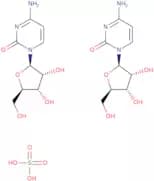
CAS:Cytidine hemisulfate salt is a postulated inhibitor of the blood group antigen. It inhibits the phosphatase activity of blood group-specific phosphatases, which may be caused by its specific inhibition of α-tocopherol and phenolphthalein. Cytidine hemisulfate salt has been shown to inhibit both adenylic and uridylic phosphatases, but does not inhibit other phosphatases. This drug is also an antigen that can stimulate B cells, which produce antibodies against it. Cytidine hemisulfate salt is found in DNA and RNA.Fórmula:C9H13N3O5H2SO4Pureza:Min. 95%Peso molecular:292.26 g/molN4-Acetyl-2'-deoxy-5'-O-DMT-cytidine 3'-succinyl CPG 1400 Å
N4-Acetyl-2'-deoxy-5'-O-DMT-cytidine 3'-succinyl CPG 1400 Å is a novel antiviral agent that inhibits the synthesis of viral RNA. This compound has been shown to be effective against influenza A and B, human cytomegalovirus, and herpes simplex virus type 1. N4-Acetyl-2'-deoxy-5'-O-DMT-cytidine 3'-succinyl CPG 1400 Å also has anticancer activity in vitro and in vivo. It has been shown to inhibit the proliferation of tumor cells by interfering with DNA replication, RNA synthesis, and protein synthesis.
Pureza:Min. 95%2-Chloro-5'-N-ethylcarboxamide-2',3'-O-isopropylidene adenosine
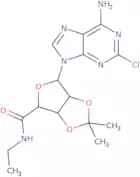
CAS:2-Chloro-5'-N-ethylcarboxamide-2',3'-O-isopropylidene adenosine is an antiviral agent that inhibits the synthesis of deoxyribonucleic acid (DNA) and ribonucleic acid (RNA). It is a synthetic, modified nucleoside. 2-Chloro-5'-N-ethylcarboxamide-2',3'-O-isopropylidene adenosine has been shown to be active against human tumor cell lines in vitro and in vivo. The compound inhibits the activity of DNA polymerase and RNA polymerase by competitive inhibition of the enzyme phosphoramidite. 2CECA has also been shown to have anticancer properties as it induces apoptosis in cancer cells.
Fórmula:C15H19ClN6O4Pureza:Min. 95%Peso molecular:382.8 g/mol5'-O-p-Anisoyl-3'-fluoro-3'-deoxythymidine
5'-O-p-Anisoyl-3'-fluoro-3'-deoxythymidine is a novel anticancer agent that has been shown to be active against leukemia, lymphoma and myeloma. The compound is a nucleoside analogue that inhibits DNA synthesis by inhibiting the activity of DNA polymerase. It has been shown to have antiviral activity in vitro against herpes simplex virus type 1 and type 2, influenza A virus and HIV. 5'-O-p-Anisoyl-3'-fluoro-3'-deoxythymidine can also inhibit protein synthesis by blocking the incorporation of amino acids into protein. This drug is synthesized from 3',5'-dideoxyuridine (dU) and fluoroacetyl chloride to produce 5'-O-p-anisoyl-3',5'-difluoroacetyl dU (ADUF). ADUF is then reacted with anisole to produce 5
Fórmula:C18H19FN2O6Pureza:Min. 95%Peso molecular:378.4 g/molO6-Diphenylcarbonyl-N2-isobutyryl-1-(5'-O-DMT-b-D-arabinofuranosyl) guanine
O6-Diphenylcarbonyl-N2-isobutyryl-1-(5'-O-DMT-b-D-arabinofuranosyl) guanine is a synthetic nucleoside. It is an activator of antiviral, anticancer, and antimalarial agents. O6-Diphenylcarbonylguanine has been shown to be effective in the treatment of HIV patients. It also inhibits the replication of herpes simplex virus type 1 (HSV1) and can be used for the treatment of HSV1 encephalitis. O6-Diphenylcarbonylguanine has also been shown to be effective in the treatment of cancer cells that are resistant to chemotherapy drugs such as cisplatin and doxorubicin.Fórmula:C47H47N5O9Pureza:Min. 95%Peso molecular:825.9 g/molAdenosine 5'-diphosphate trilithium salt
CAS:Adenosine 5'-diphosphate trilithium salt is a lithium salt of adenosine 5'-diphosphate. It is an activator that is used in the synthesis of polymers and monophosphates. Lithium salts have been shown to increase the solubility of adenosine and guanosine. This product has also been shown to be an effective lithium ion conductor, serving as a potential replacement for dilithium.Fórmula:C10H12N5O10P2·Li3Pureza:Min. 95%Peso molecular:445 g/mol4-Amino-3-benzyl-1H-pyrazolo[3,4-d]pyrimidine 1-b-D-ribofuranose
CAS:4-Amino-3-benzyl-1H-pyrazolo[3,4-d]pyrimidine 1b-D-ribofuranose is a novel diphosphate activator that can modify the properties of deoxyribonucleosides and nucleosides. It has antiviral activity against human immunodeficiency virus type 1 (HIV) and herpes simplex virus type 2 (HSV). 4-Amino-3-benzyl-1H-pyrazolo[3,4-d]pyrimidine 1b -D--ribofuranose is also an anticancer agent that has been shown to have DNA binding ability, in addition to its ability to inhibit the proliferation of cancer cells.Fórmula:C17H19N5O4Pureza:Min. 95%Peso molecular:357.36 g/mol8-Chloroadenosine 3',5'-cyclic monophosphate dihydrate
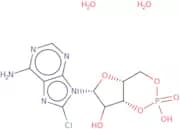
CAS:8-Chloroadenosine 3',5'-cyclic monophosphate dihydrate (8-Cl-cAMP) is an anticancer drug that inhibits the growth of cells in vitro and in vivo. 8-Cl-cAMP is a cytostatic agent that can inhibit the proliferation of cancer cells, especially renal cell cancer cells. It also has synergistic activity with epidermal growth factor, which may be due to its ability to increase the production of reactive oxygen species and decrease mitochondrial membrane potential. 8-Cl-cAMP may have potential as an anticancer agent due to its ability to induce apoptosis and inhibit protein synthesis.
Fórmula:C10H11ClN5O6P·2H2OPureza:Min. 95%Peso molecular:399.69 g/mol8-Methoxyadenosine
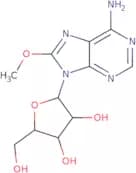
CAS:8-Methoxyadenosine is an acidic adenosine that acts as a competitive antagonist of the A1 receptor. It has a high affinity for this receptor and blocks the binding of adenosine to the receptor, thereby inhibiting its function. 8-Methoxyadenosine is also a competitive antagonist of the uridine nucleotide, which inhibits enzymatic catalysis by ribonucleoside kinase and ribonucleotide reductase. It has been shown to have properties similar to those of other pyrimidine nucleosides such as cytidine, thymine, and uridine. This molecule has a hydroxyl group in its structure, which is essential for binding to these enzymes. 8-Methoxyadenosine also has a phosphate group in its structure, which is necessary for the synthesis of DNA or RNA from deoxyribonucleotides. The benzoate group in 8-methoxyadenosine's structure makesPureza:Min. 95%8-Bromo-9-[3',5'-O-(1,1,3,3-tetraisopropyl-1,3-disiloxanediyl)-2'-deoxy-b-D-ribofuranosyl]guanine
CAS:8-Bromo-9-[3',5'-O-(1,1,3,3-tetraisopropyl-1,3-disiloxanediyl)-2'-deoxy-b-D-ribofuranosyl]guanine is a nucleoside analog that inhibits DNA synthesis in the cancer cells. This agent is an activator of nucleases and can inhibit RNA synthesis by inhibiting the enzyme ribonucleotide reductase. 8-Bromo-9-[3',5'-O-(1,1,3,3-tetraisopropyl-1,3-disiloxanediyl)-2'-deoxy-b-Dribofuranosyl]guanine also has antiviral activity against herpes simplex virus type 1 and 2. The drug is a novel compound with anticancer activity that targets DNA synthesis by binding to the enzyme topoisomerase II. ThisFórmula:C22H38BrN5O5Si2Pureza:Min. 95%Peso molecular:588.64 g/mol6-(2-Cyanoethylthio)-2'-deoxy-5'-O-DMT-N2-trifluoroacetylguanosine 3'-CE phosphoramidite
CAS:6-(2-Cyanoethylthio)-2'-deoxy-5'-O-DMT-N2-trifluoroacetylguanosine 3'-CE phosphoramidite is a novel, modified nucleoside with antiviral, anticancer and other potential therapeutic activities. It is synthesized by the reaction of 6-(2-cyanoethylthio)-2'-deoxy-5'-O-DMT nucleoside with 2,4,6-trifluoroacetic anhydride in the presence of N,N'-diisopropylethylamine. The product is purified on a column to yield high quality material. The CAS number for this compound is 146691-59-0.Fórmula:C45H50N8O7PSPureza:Min. 95%Peso molecular:934.96 g/mol2’,3’,5’-Tri-O-(tert-butyldimethylsilyl)-adenosine
2’,3’,5’-Tri-O-(tert-butyldimethylsilyl)-adenosine is a novel nucleoside that is synthetically modified by the replacement of the ribose sugar with an amino sugar. The modification of the sugar reduces the likelihood of hydrolysis to ribose and phosphate. This product has shown anticancer effects against human tumor cells in vitro and in vivo. It also has antiviral activities against herpes simplex virus type 1 (HSV-1). 2’,3’,5’-Tri-O-(tert-butyldimethylsilyl)-adenosine is a monophosphate nucleoside that inhibits DNA synthesis by inhibiting DNA polymerase. It acts as a competitive inhibitor for deoxyribonucleotides and phosphoramidites, which are used in DNA synthesis. 2’,3’,5’-
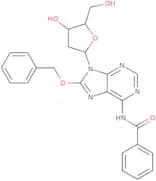
Pureza:Min. 95%N6-Benzoyl-8-benzyloxy-2'-deoxyadenosine
CAS:N6-Benzoyl-8-benzyloxy-2'-deoxyadenosine is a novel nucleoside with anticancer and antiviral properties. It is an antiviral that inhibits the synthesis of viral DNA by blocking the incorporation of ribonucleotide triphosphates into DNA, while leaving intact the synthesis of deoxyribonucleotides and phosphoramidites. In addition, it is a potent inhibitor of cellular DNA polymerases that catalyze synthesis of DNA from deoxyribonucleoside triphosphates. N6-Benzoyl-8-benzyloxy-2'-deoxyadenosine also has antitumor activity in animal models.
Fórmula:C24H23N5O5Pureza:Min. 95%Peso molecular:461.5 g/mol3'-Deoxythymidine-5'-triphosphate lithium salt - 100mM aqueous solution
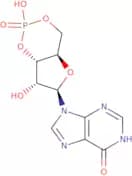
CAS:3'-Deoxythymidine-5'-triphosphate lithium salt - 100mM aqueous solution is a phosphoramidite. It is an antiviral agent that inhibits the replication of DNA and RNA viruses by inhibiting the synthesis of viral nucleic acid. 3'-Deoxythymidine-5'-triphosphate lithium salt - 100mM aqueous solution has been shown to be effective against some cancer cells with high purity and novel properties.Fórmula:C10H17N2O13P3·xLiPureza:Min. 95%Peso molecular:466.17 g/molInosine-3',5'-cyclic-monophosphate free acid
CAS:Inosine-3',5'-cyclic-monophosphate free acid is an ester of inosine 3',5'-cyclic-monophosphate that is structurally related to adenosine. It has been shown to have a physiological function as a cyclic nucleotide phosphodiesterase inhibitor, and also inhibits voltage-dependent calcium channels. Inosine-3',5'-cyclic-monophosphate free acid has been shown to be effective against infectious diseases, such as Mycobacterium tuberculosis and Galleria mellonella. It has also been shown to reduce the production of peptide hormones, nucleotides, and cyclic AMP (cAMP). Inosine-3',5'-cyclic-monophosphate free acid does not exhibit any pharmacological activity on its own but can modulate the activities of other pharmacological agents.Fórmula:C10H11N4O7PPureza:Min. 95%Peso molecular:330.19 g/mol2'-O-tert-Butyldimethylsilyl-N2-DMF-5'-O-DMT-guanosine 3'-CE phosphoramidite
2'-O-tert-Butyldimethylsilyl-N2-DMF-5'-O-DMT-guanosine 3'-CE phosphoramidite is a nucleoside monophosphate with CAS No. 58822-52-3. It is an activator that has anticancer and antiviral properties. This product is modified, novel and high purity and quality. 2'-O-tert-Butyldimethylsilyl-N2-DMF-5'-O-DMT-guanosine 3'-CE phosphoramidite can be used in the synthesis of oligonucleotides for use as probes or drugs in the treatment of cancer, HIV, hepatitis B and influenza A.Fórmula:C49H67N8O8PSiPureza:Min. 95%Peso molecular:955.19 g/mol





![4-Amino-3-benzyl-1H-pyrazolo[3,4-d]pyrimidine 1-b-D-ribofuranose](/_next/image/?url=https%3A%2Fstatic.cymitquimica.com%2Fproducts%2F3D%2Fthumb-webp%2FNA16507.webp&w=3840&q=75)
![8-Bromo-9-[3',5'-O-(1,1,3,3-tetraisopropyl-1,3-disiloxanediyl)-2'-deoxy-b-D-ribofuranosyl]guanine](/_next/image/?url=https%3A%2Fstatic.cymitquimica.com%2Fproducts%2F3D%2Fthumb-webp%2FNB04668.webp&w=3840&q=75)