Nucleósidos
Los nucleósidos son building blocks fundamentales de los ácidos nucleicos, compuestos por una base nitrogenada unida a una molécula de azúcar. En esta sección, puede encontrar una amplia variedad de nucleósidos esenciales para la investigación en biología molecular, bioquímica y farmacología. Estos compuestos juegan roles cruciales en la síntesis de ADN y ARN, y son vitales en varios procesos metabólicos. Los nucleósidos se utilizan para estudiar material genético, desarrollar terapias antivirales y anticancerígenas, y comprender los mecanismos celulares. En CymitQuimica, proporcionamos nucleósidos de alta calidad para apoyar sus necesidades de investigación y desarrollo, asegurando pureza y fiabilidad para sus aplicaciones experimentales.
Se han encontrado 3569 productos de "Nucleósidos"
Ordenar por
Pureza (%)
0
100
|
0
|
50
|
90
|
95
|
100
3'-O-Methyluridine
CAS:<p>3'-O-Methyluridine is a nucleoside that is used in the preparation of oligonucleotides and as a substrate for uridine phosphorylase. It is used to study the termination of RNA synthesis, which occurs when there are no more ribose residues in the RNA template strand. When this happens, an adenosine residue is added by polyphosphate kinase to the 3' end of the RNA strand. This addition causes a release of pyrophosphate and leads to end of DNA synthesis. The acid hydrolysis technique can be used to separate 3'-O-methyluridine from other nucleotides. This reaction produces guanosine, which can be detected using polymerase chain reaction (PCR) techniques such as polyacrylamide gel electrophoresis (PAGE).</p>Fórmula:C10H14N2O6Pureza:Min. 95%Forma y color:White PowderPeso molecular:258.23 g/molN2-DMF-5'-O-DMT-2'-O-methylguanosine
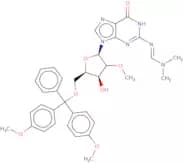
CAS:<p>N2-DMF-5'-O-DMT-2'-O-methylguanosine is a novel nucleoside analog that has antiviral, anticancer and immunomodulating properties. It is synthesized from 2′,3′-dideoxyadenosine 5′-monophosphate by the condensation of 2,6-dimethylaniline with methylguanosine 5′-monophosphate and 5,6-dimethylaniline. The modification of the guanine base in N2-DMF-5'-O-DMT-2'-O-methylguanosine to an O6 -methyl group results in increased affinity for the ribonucleotide reductase enzyme (RNR) and inhibition of DNA synthesis.</p>Fórmula:C35H38N6O7Pureza:Min. 95%Peso molecular:654.71 g/molRef: 3D-ND08425
Producto descatalogado2',3'-O-Isopropylideneadenosine
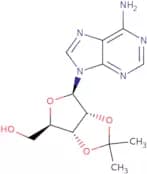
CAS:<p>2',3'-O-Isopropylideneadenosine is a nucleoside that has a possible usage as an organic chemical synthesis intermediate</p>Fórmula:C13H17N5O4Pureza:Min. 98 Area-%Forma y color:White PowderPeso molecular:307.31 g/mol2’-Deoxy-N4-dimethylcytidine
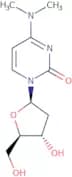
CAS:<p>2’-Deoxy-N4-dimethylcytidine is a synthetic nucleoside analog that is used to inhibit viral replication in the treatment of AIDS and cancer. It is phosphorylated by adenosine kinase to form deoxydimethylcytidine monophosphate (dDMP), which inhibits viral DNA synthesis by inhibiting the activity of reverse transcriptase, an enzyme involved in the production of viral DNA. 2’-Deoxy-N4-dimethylcytidine has also been shown to inhibit cancer cell growth by interrupting mitosis and inducing apoptosis.</p>Pureza:Min. 95%5-Iodocytidine
CAS:<p>5-Iodocytidine is a nucleoside analogue that has been shown to possess potent antitumor activity. It is also used as a fluorescent probe for detection of uridine in biological samples. 5-Iodocytidine is structurally similar to uridine, which allows it to be taken up by cells and incorporated into RNA. This analog can also be detected with antibody response, as well as with the use of a fluorescence microscope. 5-Iodocytidine may have the potential to treat infectious diseases and autoimmune diseases because it binds to response elements on DNA and activates gene transcription.</p>Fórmula:C9H12IN3O5Pureza:Min. 98 Area-%Forma y color:White PowderPeso molecular:369.11 g/mol7-Cyano-7-deaza-2'-deoxyadenosine
CAS:<p>7-Cyano-7-deaza-2'-deoxyadenosine is a nucleoside analog that inhibits the growth of virus by competing with deoxyadenosine for incorporation into DNA and RNA. 7-Cyano-7-deaza-2'-deoxyadenosine also stabilizes dna duplexes and prevents them from breaking down. It has been shown to be effective against herpes simplex virus, which causes painful blisters on the skin or genitals. This drug has been used in clinical trials as an antiviral agent. 7-Cyano-7-deaza-2'-deoxyadenosine is synthesized from 2',3'-didehydrocytidine under the following conditions:</p>Fórmula:C12H13N5O3Pureza:Min. 95%Forma y color:PowderPeso molecular:275.26 g/molRef: 3D-NC144684
Producto descatalogadoCytidine 5'-triphosphate disodium salt
CAS:<p>Please enquire for more information about Cytidine 5'-triphosphate disodium salt including the price, delivery time and more detailed product information at the technical inquiry form on this page</p>Fórmula:C9H14N3Na2O14P3Pureza:Min. 97 Area-%Peso molecular:527.12 g/molN6-Benzoyl-2'-O-methyladenosine
CAS:<p>N6-Benzoyl-2'-O-methyladenosine is a novel nucleoside that has been synthesized by chemical modification of adenosine. It is an activator of the ribonucleotide reductase enzyme and is currently being studied as an anticancer and antiviral agent. N6-Benzoyl-2'-O-methyladenosine has shown antitumor activity against human breast cancer cells in vitro and in vivo, inhibiting tumor growth. It also inhibits the replication of herpes simplex virus type 1 (HSV1) and type 2 (HSV2).</p>Fórmula:C18H19N5O5Peso molecular:385.37 g/molN4-Acetyl-2'-deoxy-5-methylcytidine
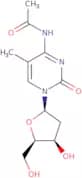
<p>N4-Acetyl-2'-deoxy-5-methylcytidine is a novel nucleoside analog of cytidine. It has been shown to be an activator of the immune system, and has antiviral and anticancer properties. This synthetic nucleoside is phosphorylated by kinases in cells to form N4-acetyl-2'-deoxy-5'-methyluridine monophosphate. The phosphate group can be removed by phosphatases in cells to yield N4-acetyl-2'-deoxycytidine, which is a precursor for DNA synthesis.</p>Fórmula:C12H17N3O5Pureza:Min. 95%Forma y color:PowderPeso molecular:283.28 g/molRef: 3D-NA15219
Producto descatalogado3'-O-Amino-2'-deoxycytidine
CAS:<p>3'-O-Amino-2'-deoxycytidine (3'-AAC) is an activator nucleoside that has antiviral and anticancer properties. It can be used with other anticancer agents such as doxorubicin, methotrexate, and 5-fluorouracil to increase the efficacy of these compounds. 3'-AAC is a phosphoramidite monophosphate that can be used in the synthesis of oligodeoxynucleotides. This product is also a novel chemical entity that has not been previously described in any publication or patent application.</p>Fórmula:C9H14N4O4Pureza:Min. 95%Peso molecular:242.23 g/molN6-Benzoyl-2'-deoxy-5'-O-trityladenosine 3'-CE phosphoramidite
CAS:<p>N6-Benzoyl-2'-deoxy-5'-O-trityladenosine 3'-CE phosphoramidite is a novel nucleoside analog that inhibits the proliferation of cancer cells. It has been shown to inhibit the proliferation of tumor cells in vitro and in vivo, as well as to induce apoptosis. The monophosphate form of this compound has been shown to be an effective antiviral agent against influenza virus. This compound also has high quality and purity.</p>Fórmula:C45H48N7O5PPureza:Min. 95%Peso molecular:797.9 g/molN4-Acetyl-2'-O-acetyl-5'-O-DMT-arabinosyl cytosine 3'-CE phosphoramidite
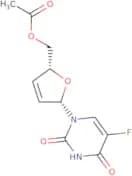
<p>N4-Acetyl-2'-O-acetyl-5'-O-DMT-arabinosyl cytosine 3'-CE phosphoramidite is a prodrug that is activated by intracellular enzymes. It has been shown to be an immunostimulatory agent, which modulates the immune system for the treatment of cancer and autoimmune disorders. N4-Acetyl-2'-O-acetyl-5'-O-DMT-arabinosyl cytosine 3'-CE phosphoramidite can also act as a ligand for various cell surface receptors and transporters, including CD28, interleukin 2 receptor alpha chain, CD40, CD84, and MHC class II. The compound has been shown to inhibit tumor cells in culture and induces apoptosis in these cells.</p>Pureza:Min. 95%1-(5-O-Acetyl-2,3-dideoxy-ß-L-glycero-pent-2-enofuranosyl)-5-fluorouracil
CAS:<p>1-(5-O-Acetyl-2,3-dideoxy-ß-L-glycero-pent-2-enofuranosyl)-5-fluorouracil is a modified nucleoside analog with structural alterations that enhance its biological properties and stability. The compound features 5-fluorouracil as the nucleobase, a fluorinated pyrimidine often used in chemotherapy due to its ability to interfere with DNA replication. The sugar component is 2,3-dideoxy-β-L-glycero-pent-2-enofuranose and has a specific glycerol and enol configuration, which alters its interactions with enzymes involved in nucleic acid metabolism. The compound includes a 5-O-acetyl protecting group at the 5'-position, which shields the hydroxyl group during synthesis.</p>Fórmula:C11H11FN2O5Pureza:Min. 95%Peso molecular:270.21 g/molRef: 3D-NA182971
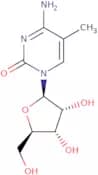
Producto descatalogado5-Methylcytidine
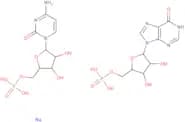
CAS:<p>5-Methylcytidine is a nucleoside that is found in DNA and RNA. It is used in structural biology to probe the structure of DNA. 5-Methylcytidine binds to the enzyme methyl transferase, which catalyzes the transfer of a methyl group from S-adenosylmethionine to produce 5-methyluridine. This reaction occurs in long-term toxicity studies using primary cells, such as lymphocytes and fibroblasts. 5-Methylcytidine has been shown to inhibit tumour growth in mice by binding to nuclear dna polymerase and blocking transcription. The binding site for this drug on the polymerase is located at the same site as that for nucleoside analogues like azidothymidine (AZT) and zidovudine (AZT).</p>Fórmula:C10H15N3O5Pureza:Min. 95%Forma y color:White PowderPeso molecular:257.24 g/molPolyinosinic-polycytidylic acid sodium salt
CAS:<p>Polyinosinic acid-polycytidylic acid (Poly I:C), an agonist of TLR3 toll-like receptors, is a synthetic double-stranded RNA analog, consisting of polyinosinic acid (poly I) paired with polycytidylic acid (poly C), forming a stable duplex structure. PolyI:C stimulates the secretion of pro-inflammatory cytokines and type I interferon through its interaction with endosomal Toll-like receptor 3 (TLR-3) and the cytoplasmic receptors melanoma differentiation-associated gene 5 (MDA-5) and retinoic acid-inducible gene I (RIG-I). This immunostimulant activity makes Poly I:C a useful vaccine adjuvant and is used in vaccine formulations. Poly I:C and its stabilized analogs (e.g., poly-ICLC) are also being actively researched for their dual role in oncology: directly targeting tumors and acting as immune potentiators. For example Poly I:C can induce apoptosis in tumor cells and stimulate immunogenic cell death and is therefore being explored alongside chemotherapy, radiotherapy, and checkpoint inhibitors, helping to overcome resistance mechanisms and strengthen treatment outcomes. We can supply PolyI:C to all stages of your project - from R&D and preclinical phases right up to GMP commercial manufacture. Contact our team for custom Poly I:C products.<br>For more on poly I:C read out blog 'Poly I:C: A Vaccine Adjuvant With Oncological Potential.'</p>Fórmula:(C10H13N4O8P)x•(C9H14N3O8P)x•NaxForma y color:White PowderRef: 3D-TP36521
Producto descatalogado5-(Aminomethyl)-2-thiouridine
CAS:<p>5-(Aminomethyl)-2-thiouridine is a bifunctional molecule that can be used in chromatography and as a precursor for the epigenetic modifications of DNA. 5-(Aminomethyl)-2-thiouridine has been shown to have an effect on the methyltransferase pathway, which is involved in the epigenome. This molecule has also been shown to affect the growth rate of bacteria in vitro.</p>Fórmula:C10H15N3O5SPureza:Min. 95%Peso molecular:289.31 g/molPolyinosinic acid tripotassium salt
CAS:<p>Polyinosinic acid is a single stranded RNA analog which is combined with polycytidylic acid (poly C) to form a stable duplex structure known as Polyinosinic acid-polycytidylic acid (Poly I:C). PolyI:C stimulates the secretion of pro-inflammatory cytokines and type I interferon through its interaction with endosomal Toll-like receptor 3 (TLR-3) and the cytoplasmic receptors melanoma differentiation-associated gene 5 (MDA-5) and retinoic acid-inducible gene I (RIG-I). This immunostimulant activity makes Poly I:C a useful vaccine adjuvant and is used in vaccine formulations. Poly I:C and its stabilized analogs (e.g., poly-ICLC) are also being actively researched for their dual role in oncology: directly targeting tumors and acting as immune potentiators. For example Poly I:C can induce apoptosis in tumor cells and stimulate immunogenic cell death and is therefore being explored alongside chemotherapy, radiotherapy, and checkpoint inhibitors, helping to overcome resistance mechanisms and strengthen treatment outcomes. We can supply PolyI:C to all stages of your project - from R&D and preclinical phases right up to GMP commercial manufacture. Contact our team for custom Poly I:C products.<br>For more on poly I:C read out blog 'Poly I:C: A Vaccine Adjuvant With Oncological Potential.'</p>Pureza:Min. 95%Ref: 3D-TP65775
Producto descatalogado3'-O-Aminoacetoxythymidine 5'-O-triphosphate triethylammonium salt
<p>Please enquire for more information about 3'-O-Aminoacetoxythymidine 5'-O-triphosphate triethylammonium salt including the price, delivery time and more detailed product information at the technical inquiry form on this page</p>Fórmula:C13H22N3O14P3•(C6H15N)xPureza:Min. 99 Area-%Forma y color:PowderPeso molecular:537.25 g/molGuanosine-5'-monophosphate triethylammonium salt
CAS:<p>Guanosine-5'-monophosphate triethylammonium salt is a synthetic nucleoside that is an activator of DNA. It is used in antiviral and anticancer treatments, as well as in the synthesis of deoxyribonucleosides. This product has been shown to have high purity and high quality.</p>Fórmula:C10H14N5O8P•C6H15NPureza:Min. 95%Peso molecular:464.41 g/molCytidine 5'-monophosphate sodium salt
CAS:<p>Cytidine 5'-monophosphate sodium salt is a nucleotide that is found in RNA and DNA. Cytidine 5'-monophosphate sodium salt is an intermediate in the biosynthesis of uridine, choline, and saccharose. It also plays an important role in the immune system as it can be a precursor for immunoglobulins. The reaction rate of cytidine 5'-monophosphate sodium salt with lipase has been shown to be constant at pH 7.5-8.0 and 37°C. This product has been shown to have emulsifying properties by forming micelles with water-immiscible solvents such as hexane or heptane, which may be due to its ability to form hydrogen bonds with other molecules such as saccharose or guanosine. Cytidine 5'-monophosphate sodium salt can also be used as a chromatographic material for separating saccharose from other sugars</p>Fórmula:C9H14N3O8P·xNaPureza:Min. 95 Area-%Forma y color:White Off-White PowderPeso molecular:323.2 g/mol