Nucleósidos
Los nucleósidos son building blocks fundamentales de los ácidos nucleicos, compuestos por una base nitrogenada unida a una molécula de azúcar. En esta sección, puede encontrar una amplia variedad de nucleósidos esenciales para la investigación en biología molecular, bioquímica y farmacología. Estos compuestos juegan roles cruciales en la síntesis de ADN y ARN, y son vitales en varios procesos metabólicos. Los nucleósidos se utilizan para estudiar material genético, desarrollar terapias antivirales y anticancerígenas, y comprender los mecanismos celulares. En CymitQuimica, proporcionamos nucleósidos de alta calidad para apoyar sus necesidades de investigación y desarrollo, asegurando pureza y fiabilidad para sus aplicaciones experimentales.
Se han encontrado 3569 productos de "Nucleósidos"
Ordenar por
Pureza (%)
0
100
|
0
|
50
|
90
|
95
|
100
Octanoyl coenzyme A lithium salt hydrate
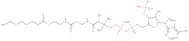
CAS:<p>Octanoyl coenzyme A lithium salt hydrate (OCCA) is a metabolite of octanoic acid, which is formed by the oxidation of fatty acids. OCCA has been shown to have relevance in the metabolism of fatty acids, as it can be conjugated with other molecules and transported into cells. This compound has been detected in human liver tissues and was found to be metabolized by primary rat hepatocytes in vitro. The metabolic pathway of OCCA is not yet fully understood, but it has been investigated in vivo studies.</p>Fórmula:C29H50N7O17P3S·xLi·yH2OPureza:Min. 95%Peso molecular:893.73 g/molCytidine 5'-diphosphoglycerol disodium salt
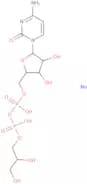
CAS:Cytidine 5'-diphosphoglycerol disodium salt is a modified nucleotide that belongs to the group of phosphoramidites. It is a cytidine derivative with a 2-hydroxymethylene bridge, which makes it resistant to degradation by cytidine deaminase and therefore enhances its anticancer activity. Cytidine 5'-diphosphoglycerol disodium salt has been shown to inhibit the growth of cancer cells in vitro and in vivo models, as well as inhibit viral replication. Cytidine 5'-diphosphoglycerol disodium salt is stable at high temperatures and can be used for activation of DNA synthesis in vitro. This product has not been tested on animals or humans and should not be taken internally.Fórmula:C12H19N3Na2O13P2Pureza:Min. 95%Peso molecular:521.22 g/mol2',3'-Dehydro-5'-O-tritylthymidine
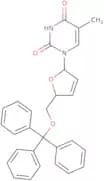
CAS:<p>2',3'-Dehydro-5'-O-tritylthymidine is an anticancer compound, which is a novel nucleoside phosphoramidite. It is synthesized from thymidine in two steps: first, the 2',3'-dideoxyribose phosphate moiety is prepared by reacting 2',3'-dideoxyribose with chloroacetic acid in the presence of triethylamine, followed by reaction with trityl chloride to form the 5' position of the thymidine. 2',3'-Dehydro-5'-O-tritylthymidine has been shown to inhibit DNA synthesis and antiviral activity.</p>Fórmula:C29H26N2O4Pureza:Min. 95%Peso molecular:466.54 g/mol5-(Carboxyhydroxymethyl)uridine methyl ester
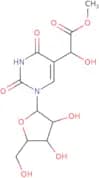
CAS:<p>5-(Carboxyhydroxymethyl)uridine methyl ester is a modified form of uridine that is used in biochemical reactions. It is found in the ovary, where it interacts with acidic environments to produce the corresponding hydroxymethyl derivatives. The hydroxymethyl derivatives are then converted to the corresponding 5-carboxy-hydroxymethyl derivatives by conjugates and modifications, which can be analyzed using various assays. 5-(Carboxyhydroxymethyl)uridine methyl ester has also been shown to have epigenetic effects on cellular activity and cancer.</p>Fórmula:C12H16N2O9Pureza:Min. 95 Area-%Forma y color:Slightly Yellow Clear LiquidPeso molecular:332.26 g/mol3'-Amino-2',3'-dideoxyguanosine-5'-triphosphate lithium salt - 100 mM aqueous solution
CAS:3'-Amino-2',3'-dideoxyguanosine's lack of a 3'-hydroxyl group makes it a chain terminator for DNA polymerase, a key application in Sanger sequencing. Additionally, the 3'-amino group serves as a functional handle for modifying the 3' end of oligonucleotides with various labels or conjugates, expanding their utility in research and diagnostics. The lithium salt ensures better handling and solubility.Fórmula:C10H17N6O12P3(freeacid)Pureza:Min. 95%Forma y color:Clear LiquidPeso molecular:506.2 g/molTrebler phosphoramidite
CAS:<p>Please enquire for more information about Trebler phosphoramidite including the price, delivery time and more detailed product information at the technical inquiry form on this page</p>Fórmula:C86H101N2O14PPeso molecular:1,417.7 g/mol5-Carboxymethyl-2-thiouridine
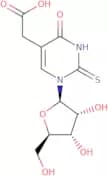
CAS:<p>5-Carboxymethyl-2-thiouridine is a modified form of uridine that has been synthesized by the reaction of 5-carboxymethyluracil with thiourea. It is used in chemical biology to study protein synthesis and to analyze the structural changes that occur during this process. 5-Carboxymethyl-2-thiouridine has also been shown to be effective as a viral RNA polymerase inhibitor, preventing the synthesis of viral proteins and thus reducing viral replication. This drug is also used in chromatographic methods for separating amino acids, peptides, and proteins.</p>Fórmula:C11H14N2O7SPureza:Min. 95%Peso molecular:318.3 g/molN4-Benzoyl-3',5'-O-(1,1,3,3-tetraisopropyl-1,3-disiloxanediyl)cytidine
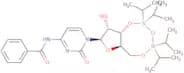
CAS:<p>N4-Benzoyl-3',5'-O-(1,1,3,3-tetraisopropyl-1,3-disiloxanediyl)cytidine is a boron trifluoride etherate catalyst that catalyzes the synthesis of cytidine from uridine. This catalyst is stable and can be used for many reactions. It yields a trifluoromethanesulfonate as a byproduct. The trifluoromethanesulfonate can be converted to a boronic acid or ester by treatment with base or acid respectively. The etherate can also be converted to an alcohol using hydrogen chloride gas and methanol. N4-Benzoyl-3',5'-O-(1,1,3,3-tetraisopropyl-1,3-disiloxanediyl)cytidine has been shown to catalyze the isomer</p>Fórmula:C28H43N3O7Si2Pureza:Min. 95%Forma y color:PowderPeso molecular:589.83 g/mol3'-Amino-2',3'-dideoxythymidine-5'-triphosphate lithium salt - 100 mM aqueous solution
CAS:<p>3'-Amino-2',3'-dideoxythymidine-5'-triphosphate lithium salt - 100 mM aqueous solution is the sodium salt of the monophosphate ester of 3'-amino-2',3'-dideoxy-5'-thiacytidine. It is used as an antiviral and antineoplastic agent. 3'-Amino-2',3'-dideoxythymidine-5'-triphosphate lithium salt - 100 mM aqueous solution has been shown to be an activator of RNA polymerase II and DNA polymerase, which are enzymes that synthesize proteins and DNA, respectively. This drug also inhibits the synthesis of deoxyribonucleosides, diphosphates, and nucleosides. END></p>Fórmula:C10H18N3O13P3(freeacid)Pureza:Min. 95%Forma y color:Clear LiquidPeso molecular:481.18 g/molArchaeosine
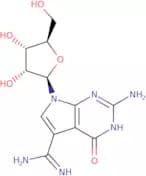
CAS:<p>Archaeosine is a low energy chemical compound that inhibits the enzyme transcriptase polymerase chain reaction (PCR), which is an enzyme that catalyzes the synthesis of DNA from RNA. Archaeosine has significant interactions with human proteins, such as leukocyte antigen, and can be used to study protein-protein interactions and enzyme kinetics. The asymmetric synthesis of archaeosine has been studied in rat liver microsomes, which is a type of cell found in the tissues of the liver. Archaeosine also prevents bacterial enzymes from synthesizing DNA.</p>Fórmula:C12H16N6O5Pureza:Min. 95%Peso molecular:324.29 g/mol3'-Amino-2',3'-dideoxyadenosine-5'-triphosphate lithium salt - 100 mM aqeous solution
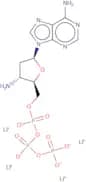
CAS:<p>3'-Amino-2',3'-dideoxycytidine-5'-triphosphate lithium salt is a chain-terminating nucleotide analog for DNA synthesis, similar to ddCTP but with a 3'-amino group. While its role in traditional Sanger sequencing might be limited compared to standard ddCTP, the 3'-amino modification offers potential advantages for specialized sequencing techniques, post-synthetic labeling, and as a research tool to study DNA polymerases. The lithium salt ensures better handling and solubility.</p>Fórmula:C10H17N6O11P3(freeacid)Pureza:Min. 95%Forma y color:Clear LiquidPeso molecular:490.2 g/mol3'-Amino-2',3'-dideoxycytidine-5'-triphosphate lithium salt - 100 mM aqueous solution
CAS:<p>3'-Amino-2',3'-dideoxycytidine's lack of a 3'-hydroxyl group makes it a chain terminator for DNA polymerase, a key application in Sanger sequencing. Additionally, the 3'-amino group serves as a functional handle for modifying the 3' end of oligonucleotides with various labels or conjugates, expanding their utility in research and diagnostics. The lithium salt ensures better handling and solubility.</p>Fórmula:C9H17N4O12P3(freeacid)Pureza:Min. 95%Forma y color:Clear LiquidPeso molecular:466.17 g/molUDP-N-azidoacetylglucosamine
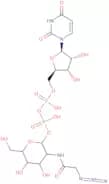
CAS:<p>UDP-N-azidoacetylglucosamine is a UDP sugar with an azide functional handle on the glucosamine making it suitable for modification via click chemistry.</p>Fórmula:C17H26N6O17P2Pureza:Min. 95%Forma y color:PowderPeso molecular:648.37 g/mol7-Deaza-3'-deoxyadenosine
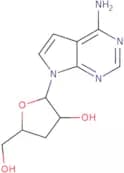
CAS:<p>7-Deaza-3'-deoxyadenosine is a synthetic nucleoside that is used in the synthesis of DNA. It has antiviral activity and is effective against HIV, herpes simplex virus and hepatitis B. 7-Deaza-3'-deoxyadenosine also has anticancer activity and can be used as a chemotherapeutic agent for leukemia, lymphoma, and breast cancer. This drug has been shown to inhibit the growth of cultured human tumor cells by inhibiting DNA synthesis through inhibition of DNA polymerase alpha and beta.</p>Fórmula:C11H14N4O3Pureza:Min. 95%Peso molecular:250.25 g/molLysidine
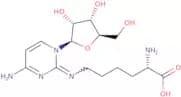
CAS:<p>Derivative of cytidine found in tRNA which enhances translation fidelity</p>Fórmula:C15H25N5O6Pureza:Min. 95%Peso molecular:371.39 g/mol[(2S,6R)-6-{N2-(Isobutyryl)-O6-(diphenylcarbomoyl)guanin-9-yl}-4-tritylmorpholin-2-yl]methyl dimethyl-phosphoramidochloridate
CAS:<p>[(2S,6R)-6-{N2-(Isobutyryl)-O6-(diphenylcarbamoyl)guanin-9-yl}-4-tritylmorpholin-2-yl]methyl dimethylphosphoramidochloridate is a novel antiviral agent that is structurally related to the nucleoside analogues. It is synthesized by reacting an N2-(isobutyryl)O6-(diphenylcarbamoyl)guanin with 2,6-bis(trityl)morpholine and methyl dimethyl phosphite in dichloromethane. This compound has been shown to be active against herpes simplex virus type 1 (HSV1), HSV type 2 (HSV2), and cytomegalovirus (CMV). [(2S,6R)-6-{N2-(Isobutyryl)-O</p>Fórmula:C48H48ClN8O6PPureza:Min. 95%Peso molecular:899.37 g/mol5-Carbamoylmethyl-2'-O-methyluridine
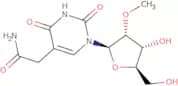
CAS:5-Carbamoylmethyl-2'-O-methyluridine is a nucleoside analog that inhibits the synthesis of proteins by inhibiting the translation process. It has been shown to be effective against tuberculosis and other mycobacterial diseases. 5-Carbamoylmethyl-2'-O-methyluridine binds to the ribosomal RNA, preventing protein synthesis and causing cell death. This drug has pleiotropic effects on cells, including inhibition of frameshifting, which is a mechanism used by some viruses to avoid immune responses. 5-Carbamoylmethyl-2'-O-methyluridine also interacts with cellular genes in response to stress (e.g., ultraviolet radiation). The mechanism of action for this drug is similar to that of 5-methoxycarbonylmethyl 2'-thiouridine (5MMCU), which inhibits protein synthesis by binding to the 30S ribosomal subunit and blocking the formation ofFórmula:C12H17N3O7Pureza:Min. 95%Forma y color:PowderPeso molecular:315.28 g/mol5-Amino-1-β-D-ribofuranosyl-1H-imidazole-4-carboxamide
CAS:Fórmula:C9H14N4O5Pureza:95%Forma y color:SolidPeso molecular:258.23132,2'-Anhydro-5'-O-toluoyluridine
<p>2,2'-Anhydro-5'-O-toluoyluridine is a synthetic nucleoside analog that is used as an antiviral agent for the treatment of herpes simplex virus. It activates ribonucleotide reductase and inhibits DNA synthesis by inhibiting the enzyme DNA polymerase. 2,2'-Anhydro-5'-O-toluoyluridine has been shown to be active against colon cancer cells in vitro and in vivo. This drug has also been shown to inhibit the growth of certain types of leukemia cells and may be useful in treating patients with chronic myeloid leukemia.</p>Fórmula:C17H16N2O6Pureza:Min. 95%Peso molecular:344.32 g/molN2-Isobutyryl-N-trityl-morpholino guanine
CAS:<p>N2-Isobutyryl-N-trityl-morpholino guanine is a synthetic nucleoside analogue. It has been shown to be an activator of ribonucleotide reductase, and it is a potential anticancer agent. N2-Isobutyryl-N-trityl-morpholino guanine has also been shown to inhibit the replication of DNA and RNA viruses. This compound is being studied for its possible use in the treatment of HIV infection, as well as other viral infections that affect the central nervous system.</p>Pureza:Min. 95%



![[(2S,6R)-6-{N2-(Isobutyryl)-O6-(diphenylcarbomoyl)guanin-9-yl}-4-tritylmorpholin-2-yl]methyl dimet…](/_next/image/?url=https%3A%2Fstatic.cymitquimica.com%2Fproducts%2F3D%2Fthumb-webp%2FNI58200.webp&w=3840&q=75)