Nucleósidos
Se han encontrado 3569 productos de "Nucleósidos"
2'-O-Acetyl-5'-O-benzoyl-3'-deoxy-3'-C-methyluridine
CAS:2'-O-Acetyl-5'-O-benzoyl-3'-deoxy-3'-C-methyluridine is a synthetic analog of the antiviral agent 5'-O-benzoyl-2'-O-acetyl-3'-deoxyadenosine (BAEA). BAEA is a nucleoside that functions as an activator, which stimulates the activity of ribonucleosides. BAEA has been shown to inhibit the replication of HIV and other viruses, and may be useful in treating cancer or other diseases. 2'-O-Acetyl-5'-O-benzoyl-3'-deoxy-3'-C methyluridine has been shown to have antiviral properties against herpes simplex virus type 1 (HSV1) and HSV2 and cytomegalovirus (CMV), with higher activity against CMV than BAEA. This compound may also be used in the development of new anticFórmula:C19H20N2O7Pureza:Min. 95%Peso molecular:388.37 g/mol3-Deazauridine 5'-O-triphosphate lithium salt - 100 mM aqueous solution
3-Deazauridine 5'-O-triphosphate lithium salt is a nucleotide that can be found in the monophosphate form. It is an activator of RNA polymerase and is used to synthesize DNA. 3-Deazauridine 5'-O-triphosphate lithium salt functions as a novel anticancer agent, inhibiting the synthesis of DNA. This substance is also used as a building block for phosphoramidites and as a reagent for DNA synthesis.Pureza:Min. 95%1-(2'C-Methyl-b-D-ribofuranosyl)-5-nitropyridine-2(1H)-one
CAS:1-(2'C-Methyl-b-D-ribofuranosyl)-5-nitropyridine-2(1H)-one (1) is a synthetic nucleoside that has been modified to be activated with the addition of a phosphoryl group. It inhibits viral replication by inhibiting viral DNA synthesis. It also inhibits cancer cell growth, and has shown potential as an antiviral agent against HIV, herpes simplex type 2, and influenza A viruses. 1 is a novel monophosphate nucleoside with high purity and high quality. CAS No. 2072145-17-4.Pureza:Min. 95%N6-Benzoyl-2’-O,4’-C-methyleneadenosine
CAS:N6-Benzoyl-2’-O,4’-C-methyleneadenosine is a novel nucleoside analogue with antiviral activity. It is a modified deoxyribonucleoside that is synthesized from adenosine. N6-Benzoyl-2’-O,4’-C-methyleneadenosine has been shown to be an effective inhibitor of the replication of DNA and RNA in vitro. This drug effectively inhibits human immunodeficiency virus type 1 (HIV1) in cell culture and has been shown to inhibit tumor growth in laboratory animals.Pureza:Min. 95%N6-Benzoyl-2'-O-tert-butyldimethylsilyladenosine
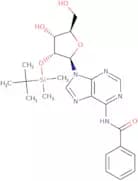
CAS:N6-Benzoyl-2'-O-tert-butyldimethylsilyladenosine (BTS) is a novel phosphoramidate monophosphate nucleoside analog that has been modified to be resistant to the ribonuclease A enzyme. BTS is an activator of DNA synthesis and inactivator of RNA synthesis, which makes it useful for the treatment of cancer and antiviral infections. This drug is synthesized using high quality reagents and can be used for the production of phosphoramidites to produce high purity oligonucleotides.Fórmula:C23H31N5O5SiPureza:Min. 95%Forma y color:PowderPeso molecular:485.61 g/mol2'-O-Methylguanosine-5'-triphosphate sodium salt - 100mM aqueous solution
CAS:2'-O-Methylguanosine-5'-triphosphate sodium salt is a nucleotide that is synthesized by the phosphorylation of guanosine at the 5' position. It has been shown to have significant activation of cardiac protein synthesis and translation. This nucleotide has also been shown to stabilize RNA in vitro, which may be due to its ability to activate adenylate cyclase activity. 2'-O-Methylguanosine-5'-triphosphate sodium salt is a potent inhibitor of hepatitis B virus replication, but does not inhibit the replication of other viruses.Fórmula:C10H18N3O14P3·NaPureza:Min. 95%Forma y color:Clear LiquidPeso molecular:520.17 g/mol1-(b-L-Arabinofuranosyl)uracil 5'-triphosphate triethylammonium salt
1-(b-L-Arabinofuranosyl)uracil 5'-triphosphate triethylammonium salt is a novel antiviral agent that is synthesized from ribonucleosides. It is an activator of the monophosphate form of RNA polymerase and inhibits the synthesis of DNA in cells. This drug has also been shown to be effective against cancer cells and may be useful for treatment of leukemia.Pureza:Min. 95%N4-Acetylcytidine
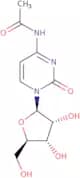
CAS:N4-Acetylcytidine is a modified nucleoside and endogenous urinary nucleoside product of the degradation of tRNA. N4-Acetylcytidine is a biological marker for various cancers with elevated concentrations present in urine. N4-Acetylcytidine is also a partially protected cytidine and therefore can be used as a synthetic building block to prepare further derivatized nucleosides such as 2’,3’-dideoxycytidine.Fórmula:C11H15N3O6Pureza:Min. 95%Forma y color:White PowderPeso molecular:285.25 g/mol2'-O-Methyl-N6-phenoxyacetyladenosine
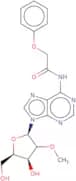
CAS:2'-O-Methyl-N6-phenoxyacetyladenosine is a phosphoramidite nucleoside that is used in the synthesis of DNA and RNA. It has antiviral, anticancer, and antiribonucleases properties. The chemical structure of 2'-O-Methyl-N6-phenoxyacetyladenosine is similar to that of adenosine, but contains a methyl group on C2' position and an oxyalkyl group on N6. This compound can be used as a novel anticancer agent and has been shown to have high affinity for the purine receptor, inhibiting cancer cell proliferation by activating the p53 tumor suppressor pathway.Fórmula:C19H21N5O6Pureza:Min. 95%Forma y color:White to off-white solid.Peso molecular:415.41 g/mol2'-Deoxy-N6-(2-hydroxyethyl)adenosine
CAS:2'-Deoxy-N6-(2-hydroxyethyl)adenosine is a synthetic nucleoside that is used as a building block for the chemical synthesis of oligonucleotides. It is also an antiviral agent and has been shown to have anticancer properties. 2'-Deoxy-N6-(2-hydroxyethyl)adenosine is used in the manufacture of phosphoramidites, deoxyribonucleosides, and ribonucleosides. This product can be synthesized at high purity and quality, with CAS No. 137058-94-7.Fórmula:C12H17N5O4Pureza:Min. 95%Peso molecular:295.29 g/mol9-(2'-C-methyl-b-D-ribofuranosyl)6-methylpurine
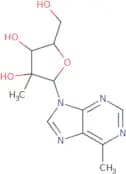
CAS:9-(2'-C-methyl-b-D-ribofuranosyl)6-methylpurine is a modified monophosphate nucleoside that is an antiviral agent. It can be used as a building block for the synthesis of ribonucleosides, deoxyribonucleosides, and phosphoramidites. This product has been shown to have anticancer properties and may be used in the development of new anticancer drugs. 9-(2'-C-methyl-b-D-ribofuranosyl)6-methylpurine has also been shown to inhibit the growth of bacteria by inhibiting DNA synthesis.Pureza:Min. 95%2,6-Diamino-9-(2'-deoxy-2'-fluoro-β-D-ribofuranosyl)purine
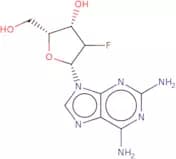
CAS:2,6-Diamino-9-(2'-deoxy-2'-fluoro-β-D-ribofuranosyl)purine is a modified purine nucleoside analog. This compound has modification that have the potential to influence its ability to interfere with nucleic acid synthesis, such as DNA or RNA.Fórmula:C10H13FN6O3Pureza:Min. 95%Forma y color:White PowderPeso molecular:284.25 g/mol8-Azidoadenosine 5'-monophosphate sodium salt
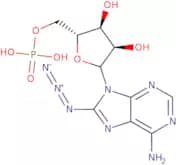
CAS:8-Azidoadenosine 5'-monophosphate sodium salt is an azido-conjugated adenosine monophosphate derivative used to introduce a label on oligonucleotides. A click reaction between the azide-functionalised nucleotide and a terminal alkyne-functionalised labelled moiety (with either a fluorophore or biotin) generates a stable conjugate containing a triazole link.Fórmula:C10H13N8O7PPureza:Min. 95%Peso molecular:388.23 g/molb-L-2',3'-Dideoxy-5-fluorocytidine
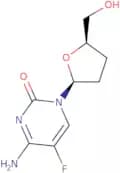
CAS:b-L-2',3'-Dideoxy-5-fluorocytidine is a pyrimidine nucleoside that inhibits the deoxycytidine kinase enzyme, which catalyzes conversion of deoxycytidine to cytidine. It has potent inhibition against human lymphocytes and liver cells, as well as virus replication. b-L-2',3'-Dideoxy-5-fluorocytidine has potent antitumor activity in vitro and in vivo, with an inhibitory effect on immunodeficiency and hepatitis. This drug also has a potent inhibitory effect on T-cell growth in cell culture. b-L-2',3'-Dideoxy-5-fluorocytidine is converted to 5'-deoxyfloxuridine by cellular enzymes and then to 5'-deoxyuridylate by the enzyme uridylate kinase. The latter compound inhibits DNA synthesis by inhibiting thymidylFórmula:C9H12FN3O3Pureza:Min. 95%Peso molecular:229.21 g/mol2-Iodoadenosine
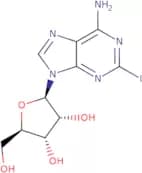
CAS:2-Iodoadenosine is a chemical compound that is produced from the oxidation of uridine. It is used in the synthesis of peptides, which are important for biological processes like signal transduction and cell growth. 2-Iodoadenosine can be made by coupling other molecules to an adenosine molecule. This process involves a cross-coupling reaction with palladium catalysts or hydroxylation reactions with sodium borohydride. The resulting product has been shown to have anticancer and anti-microbial activities against protozoan parasites and cyclic peptide structures.Fórmula:C10H12IN5O4Pureza:Min. 97 Area-%Forma y color:PowderPeso molecular:393.14 g/molAdenosine 5'-diphosphate magnesium salt
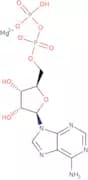
CAS:Adenosine 5'-diphosphate magnesium salt (ADP-Mg) is a pharmacological agent that has inhibitory properties. It is used as a model system to study platelet function and the effect of adenosine on platelet aggregation. ADP-Mg is also used as a reagent in the study of protein synthesis and regulation. This chemical has been shown to potentiate the activity of serotonin receptors, which may contribute to its anti-inflammatory effects. Adenosine 5'-diphosphate magnesium salt also inhibits papillary muscle contractions by inhibiting Ca2+ currents, leading to an improved ejection fraction in patients with congestive heart failure.Fórmula:C10H13N5O10P2·MgPureza:Min. 95%Forma y color:PowderPeso molecular:449.49 g/mol7-Deaza-2'-deoxy-7-iodoguanosine
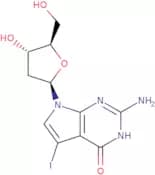
CAS:7-Deaza-2'-deoxy-7-iodoguanosine is a purine nucleoside that is synthesized from guanosine and iodine. It is used as a marker in sequencing reactions because it can be easily detected by UV light at 254 nm. 7-Deaza-2'-deoxy-7-iodoguanosine can be synthesized using the following general equation:
Fórmula:C11H13IN4O4Pureza:Min. 97 Area-%Forma y color:White PowderPeso molecular:392.16 g/molN4-Benzoyl-2-aza-3’-deazaadenine
CAS:N4-Benzoyl-2-aza-3’-deazaadenine is a modified nucleoside that is synthesized from the natural deoxyribonucleoside adenine. It has been shown to have antiviral and anticancer properties. N4-Benzoyl-2-aza-3’-deazaadenine is a DNA Activator and can be used in the treatment of viral infections, such as HIV and herpes, as well as cancer. The drug binds to the viral DNA polymerase and prevents it from making new copies of the virus. This results in an accumulation of defective viruses within infected cells and ultimately cell death.Pureza:Min. 95%2-Thiocytidine
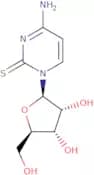
CAS:2-Thiocytidine is a nucleoside that is an intermediate in the synthesis of thiamine. It has been shown to be effective in the treatment of prostate cancer cells, which may be due to its ability to inhibit protein synthesis. 2-Thiocytidine binds to the catalytic site of ribonucleotide reductase (RR) and inhibits the enzyme's activity, thereby inhibiting DNA synthesis. This drug also has been shown to inhibit crosslinking caused by UV light or other agents that generate reactive oxygen species. 2-Thiocytidine binds to the active site of RR and prevents the formation of the enzyme-substrate complex. This binding prevents reduction of ribose into ribonucleotides and inhibits DNA synthesis.
Fórmula:C9H13N3O4SPureza:Min. 95%Forma y color:Yellow PowderPeso molecular:259.28 g/mol2'-O-tert-Butyldimethylsilyl-5'-O-DMT-N3-methylcytidine 3'-CE phosphoramidite
2'-O-tert-Butyldimethylsilyl-5'-O-DMT-N3-methylcytidine 3'-CE phosphoramidite is a modified nucleoside that is synthesized by the reaction of 2'-deoxycytidine with bis(2,4,6-trichlorophenyl)carbonate in the presence of a base. 2'-O-tert-Butyldimethylsilyl-5'-O-DMT-N3 methylcytidine 3'-CE phosphoramidite has been shown to have anticancer activity and is used as an activator in the synthesis of oligonucleotides. This product is available as a white powder and can be used for research purposes only.Pureza:Min. 95%