Polisacáridos
Los polisacáridos son compuestos orgánicos formados por la unión de múltiples monómeros, los cuales están unidos por enlaces glucosídicos para crear moléculas grandes y a menudo ramificadas. Estos carbohidratos complejos desempeñan roles cruciales en diversas funciones biológicas, incluyendo el almacenamiento de energía, el soporte estructural y la comunicación celular. En esta sección, encontrará una amplia gama de polisacáridos esenciales para la investigación en bioquímica, biología molecular y glicociencia. Estos compuestos son vitales para estudiar las vías metabólicas, las estructuras de las paredes celulares y el potencial terapéutico de los carbohidratos. En CymitQuimica, proporcionamos polisacáridos de alta calidad para apoyar su investigación científica, asegurando precisión y fiabilidad en sus resultados experimentales.
Se han encontrado 503 productos de "Polisacáridos"
Ordenar por
Pureza (%)
0
100
|
0
|
50
|
90
|
95
|
100
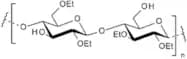
Ethyl cellulose
CAS:Ethyl cellulose is similar in structure to methyl cellulose with ethyl replacing the methyl groups. It is approved for use in regulated markets such as food and pharmaceuticals. In pharmaceuticals it can mask the taste of bitter actives, enhance the strength and appearance of tablets and capsules, and enable controlled release formulations. In food products it functions as a binder, film former and flavour fixative.Pureza:Min. 95%Forma y color:White Yellow PowderCellulose - Arbocel
CAS:<p>Cellulose is a linear polysaccharide of β 1-4 linked glucose residues. The polysaccharide chains are bundled as microfibrils in cell walls and provide the essential structural components within growing plants. Each microfibril exhibits a high degree of three-dimensional internal bonding resulting in a crystalline structure that is insoluble in water, resistant to reagents and very strong.</p>Forma y color:PowderFucogalactan - from Undaria pinnatifida
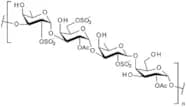
CAS:<p>Fucogalactan (GFS) is a polysaccharide isolated and purified from the brown seaweed Undaria pinnatifida. The polysaccharide is a sulphated galactose containing fucan. Fucogalactan is currently under investigation for possible therapeutic indications including anti-inflammatory properties, immuno- modulating activities, inhibition of tumor growth, stem cell replentishment, antiviral activity, dementia and ulcer healing.Fucoidan ≥ 75 %<br>The image was kindly provided by Prof Mike Guiry from Cork who runs ‘The Seaweed Site’.</p>Pureza:(%) Min. 75%Forma y color:Off-White PowderWheat starch
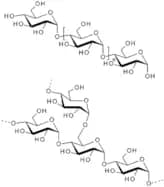
CAS:<p>Starch is an energy storing polysaccharide produced by higher plants and some algae. Pure starch is a white, tasteless and odorless powder that is insoluble in cold water or alcohol. It consists of two types of polysaccharide: the linear and helical amylose (α-1,4-linked glucose) and the branched amylopectin (α-1,4 and α-1,6-linked glucose). Depending on the plant, starch generally contains 20 to 25% amylose and 75 to 80% amylopectin by weight.</p>Pureza:Min. 95%Forma y color:PowderBacterial alginate - from fermentation of Azotobacter vinelandii or Pseudomonas mendocina
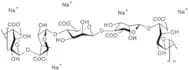
<p>An alginate-like polysaccharide produced by the fermentation of Azotobacter vinelandii or Pseudomonas mendocina. The chemical structure consists of blocks of (1,4) linked-β-D-polymannuronic acid (poly M), (1,4) linked-α-L-polyguluronic acid (poly G) and alternating blocks of the two uronic acids (poly MG). Unlike the alginate from seaweed, this polysaccharide is partially acetylated.</p>Forma y color:PowderPeso molecular:~100KDaDextran sulfate sodium - MW 5,000-8,000
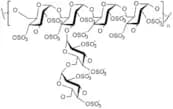
CAS:<p>Dextran sulphate is a dextran derivative whose ulcer (colitis) -causing properties were first reported in hamsters and extrapolated a few years later to mice and rats. The exact mechanisms through which dextran sulphate induces intestinal inflammation are unclear but may be the result of direct damage of the monolayer of epithelial cells in the colon, leading to the crossing of intestinal contents (for e.g. commensal bacteria and their products) into underlying tissue and therefore induction of inflammation. The dextran sulphate sodium induced ulceration model in laboratory animals has some advantages, when compared to other animal models of colitis, due to its simplicity and similarities to human inflammatory bowel disease.</p>Fórmula:(C6H7Na3O14S3)nPureza:Min. 95%Forma y color:PowderHydroxypropyl cellulose - Average MW 80,000
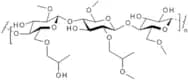
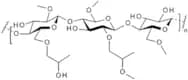
CAS:<p>In water, hydroxypropyl cellulose forms liquid crystals with many mesophases depending on concentration. These mesophases include isotropic, anisotropic, nematic and cholesteric, the latter resulting in many colors such as violet, green and red. Pharmaceutical applications include treatments for medical conditions such as dry eye syndrome (keratoconjunctivitis sicca), recurrent corneal erosions, decreased corneal sensitivity, exposure and neuroparalytic keratitis. It is also used as a binder in tablets. Hydroxypropylcellulose is also used as a thickener, a binder and emulsion stabiliser in foods with E number E463. HPC is used as a support matrix for DNA separations by capillary and microchip electrophoresis.</p>Pureza:Min. 95%Glycogen - from oyster for molecular biology
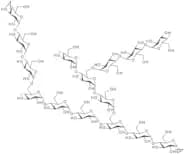
CAS:<p>Glycogen is a highly branched polysaccharide of glucose that serves as a form of energy storage in animals and fungi. It is the main storage form of glucose in the body. In humans, glycogen is made and stored primarily in liver and muscle cells and functions as the second most important energy storage molecule to fat which is held in adipose tissue. Glycogen is analogous to starch and has a structure similar to amylopectin, but is more extensively branched and compact than starch. It occurs as granules in the cytosol/cytoplasm in many cell types, and plays an important role in the glucose cycle.</p>Pureza:Min. 95%Fluorescein isothiocyanate-dextran - Average MW 70,000
CAS:<p>Anterograde and retrograde tracer in neurons; biologically inert</p>Pureza:Min. 95%D-Aminogalacturonic Acid Hydrochloride
CAS:Producto controlado<p>Applications 2-Amino-2-deoxygalacturonic acid was a component of the lipopolysaccharide from P. aeruginosa NCTC 8505 and probably occurs in the region of polysaccharide responsible for O-antigenic specificity.<br>References Wilkinson, S.G., et al.: Biochem. J., 149, 783 (1975),<br></p>Fórmula:C6H12ClNO6Forma y color:NeatPeso molecular:229.62Isomaltopentaose
CAS:<p>Applications Isomaltopentaose, is an isomalto-oligosaccharides (IMO) compound, used as functional food ingredients.<br>References Hu, Y., et al.: Lett. App. Microbio., 57, 108 (2013);<br></p>Fórmula:C30H52O26Forma y color:NeatPeso molecular:828.72Low calcium heparin
CAS:<p>Low calcium heparin is a glycosaminoglycan, which occurs in many mammalian tissues and has important anticoagulant and thrombolytic properties. The chemical structure is composed mainly of two disaccharide repeating units A and B. A is L-iduronic acid 2-suplhate linked α-(1,4) to 2-deoxy-2-sulfamido-D-galactose 6-sulphate, while B is D-glucuronic acid β-(1,4) linked to 2-deoxy-2-sulfamido-D-glucose 6-sulphate.</p>Pureza:Min. 95%Fluorescein isothiocyanate-carboxymethyl-dextran - Average MW 4,000
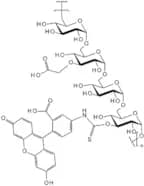
<p>Fluorescein isothiocyanate carboxymethyl dextran (FITC-CM Dextran) has been reported to provide a valuable carrier for nanoparticles of iron oxide. These products provide a potent tool for contrast enhancement in magnetic resonance imaging.</p>Pureza:Min. 95%Forma y color:PowderCellulose acetate hydrogen phthalate
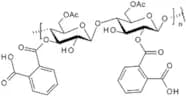
CAS:<p>Cellulose acetate phthalate (CAP) finds use in the formulation of pharmaceuticals, such as the enteric coating of tablets or capsules and for controlled release formulations, where it is often used with other coating agents such as ethyl cellulose. It contains about 50% acetate and 25% as the phthalate ester with the rest as free hydroxyl groups. Enteric coatings based on CAP are resistant to acidic gastric fluids, but easily soluble in mildly basic medium of the intestine. The pH-sensitive solubility of CAP is mainly determined (as are other properties of this mixed ester) by the degree of substitution and by the molar ratio (acetyl and phthaloyl groups).</p>Pureza:Min. 95%Hydroxypropyl cellulose - Average MW 100,000
CAS:In water, hydroxypropyl cellulose forms liquid crystals with many mesophases depending on concentration. These mesophases include isotropic, anisotropic, nematic and cholesteric, the latter resulting in many colors such as violet, green and red. Pharmaceutical applications include treatments for medical conditions such as dry eye syndrome (keratoconjunctivitis sicca), recurrent corneal erosions, decreased corneal sensitivity, exposure and neuroparalytic keratitis. It is also used as a binder in tablets. Hydroxypropylcellulose is also used as a thickener, a binder and emulsion stabiliser in foods with E number E463. HPC is used as a support matrix for DNA separations by capillary and microchip electrophoresis.Pureza:Min. 95%Galactan - from gum arabic
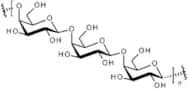
CAS:<p>A linear β-(1,4)-galactan from Acacia gum. Other linear β-(1,4)-galactans have been isolated from lemon peel, potato tubers and Norwegian spruce compresssion wood.</p>Pureza:Min. 95%Forma y color:White PowderHydroxyethyl cellulose - Viscocity 4500-6500mPa·s
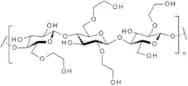
CAS:Water thickener; rheological control additive; has industrial appplicationsPureza:Min. 95%Fluorescein isothiocyanate-dextran - Average MW 10,000
CAS:<p>Fluorescein dextran (FD) is widely used as both an anterograde and retrograde tracer in neurons and for numerous other applications. It is biologically rather inert having α-1,6-linked glucose residues resistant to cleavage by most endogenous cellular glycosidases. It has low immunogenicity and makes an ideal long-term tracer for live cells. FD also serves as a valuable marker for cell loading of macromolecules by micro-injection, vesicular fusion, and electroporation, as well as for the uptake and internal processing of exogenous materials by phagocytotic and endocytic pathways.</p>Pureza:Min. 95%Fluorescein isothiocyanate-carboxymethyl-dextran - Average MW 150,000
<p>Fluorescein isothiocyanate carboxymethyl dextran (FITC-CM Dextran) has been reported to provide a valuable carrier for nanoparticles of iron oxide. These products provide a potent tool for contrast enhancement in magnetic resonance imaging.</p>Pureza:Min. 95%Arthrobacter stabilis exopolysaccharide
<p>The extracellular polysaccharide produced by Arthrobacter stabilis NRRL B-3225 contains D-glucose, D-galactose, pyruvic acid, O-succinyl, and O-acetyl in the approximate molar ratio of 6:3:1:1:1.5. Succinyl is linked as its half-ester, making it readily removable. The viscosity of aqueous, salt-free solutions of both native and deacylated polymer is relatively low, but atypical of anionic polysaccharides, increases rapidly in the presence of salts, acids, or alkali.</p>Pureza:Min. 95%