Enzimas en Proteínas Recombinantes
Las enzimas aceleran las reacciones químicas, actuando como catalizadores biológicos, actuando sobre sustratos y convirtiéndolos en diferentes moléculas llamadas productos. Estas proteínas son indispensables en procesos bioquímicos y aplicaciones industriales, facilitando reacciones en condiciones suaves con alta especificidad y eficiencia. En CymitQuimica, ofrecemos una amplia selección de enzimas de alta calidad para apoyar sus aplicaciones en investigación, industriales y clínicas.
Se han encontrado 3315 productos de "Enzimas en Proteínas Recombinantes"
Ordenar por
Pureza (%)
0
100
|
0
|
50
|
90
|
95
|
100
Nitrilhydratase Kit, 10 recombinant enzymes with different substrate specificities - ENH Kit
<p>Kit of 10 unique, nitrile hydratases recombinantly expressed in E. coli for screening. Nitrile hydratases can be utilized to convert nitriles into their corresponding amides, e.g. to produce acrylamide from acrylonitrile. Additional applications include the removal of nitriles from industrial wastewater. Please note, that the kit enzymes can also be supplied as whole cell biocatalysts in large scale.</p>Glutaminase from escherichia coli
CAS:<p>Glutaminase (glutaminase I, L-glutaminase, glutamine aminohydrolase; EC 3.5.1.2) is an enzyme that catalyzes the following reaction: L-glutamine + H2O → L-glutamate + NH4+ One unit of glutaminase will convert 1.0 μmole of L-glutamine into L-glutamate per min at pH 4.9 and 37 °C.</p>Pureza:Min. 95%L-Glutamic dehydrogenase (nadp) from proteus sp.
CAS:<p>L-Glutamic dehydrogenase (NADP+ dependent, from proteus sp., EC 1.4.1.4) is an enzyme that catalyzes the following reaction: L-glutamate + H2O + NADP+ ⇌ 2-oxoglutarate + NH3 + NADPH + H+ One unit of L-Glutamic dehydrogenase will generate 1.0 μmole of 2-oxoglutarate from L-glutamate per min at pH 8.3, 30 °C and the presence of NADPH and ammonium. NADP+ is available here and NADPH is available here, depending on whether you require the reaction to proceed from left to right or from righ to left, respectively.</p>Pureza:Min. 95%Peso molecular:300 g/molEUCODIS® Nitrilhydratase 05, recombinant enzyme - ENH005
<p>Nitrile hydratase 05 recombinantly expressed in E. coli comes in a freeze-dried formulation. Nitrile hydratases can be utilized to convert nitriles into their corresponding amides, e.g. to produce acrylamide from acrylonitrile. Additional applications include the removal of nitriles from industrial wastewater. Our nitrile hydratases have been tested for hydrolysis of the following substrates:cyclohexanecarbonitrile, cinnamonitrile, benzonitrile, methacrylonitrile, pivalonitrile.</p>Carbonodithioic Acid O-(Octahydro-4,7-methano-1H-inden-5-yl) Ester Potassium Salt
CAS:Producto controladoFórmula:C11H15KOS2Forma y color:NeatPeso molecular:266.464Ubiquitin Conjugating enzyme E2C Human Recombinant
<p>Ubiquitin Conjugating enzyme E2C (other names UBE2C, UBCH10, dJ447F3.2, ubiquitin conjugating enzyme E2 C; EC 2.3.2.24) is an essential mediator of mitotic destruction events and cell cycle progression. It catalyzes the destruction of cyclins A and B in conjunction with the anaphase-promoting complex, and therefore, plays an important role in the control of the cell exit from mitosis This activity is essential at then end of mitosis for the inactivation of their partner kinase Cdc2 and exit from mitosis into G1 of the next cell cycle. In addition, UBE2C bears homology to yeast PAS2, a gene that is essential for biogenesis of peroxisomes. UBE2C is useful for in vitro ubiquitinylation reactions.</p>Neuron-specific enolase human
CAS:<p>Neuron-specific enolase human (ENO2, Enolase 2, Neural enolase, Gamma-enolase, Phosphopyruvate hydratase, 2-phospho-D-glycerate hydro-lyase; EC 4.2.1.11) is the enzyme that is catalyzes the following reaction: 2-phospho-D-glycerate ⇌ phosphoenolpyruvate + H2O One unit of enolase will convert 1.0 μmole of 2-phosphoglycerate to phosphoenolpyruvate per min.</p>β-Glucanase 2, thermostable
CAS:<p>Thermostable β-Glucanase 2 is an enzyme that hydrolases β-Glucans into glucose. One unit of β-Glucanase 2 will produce 1.0 μmole of glucose from β-glucan per minute at pH 5.8 and 70 °C.</p>Pureza:Min. 95%Transglutaminase from guinea pig liver
CAS:<p>Transglutaminase (2.3.2.13) is an enzyme that catalyzes formation of isopeptide bonds between the γ-carboxamide groups ( -(C=O)NH2 ) of glutamine side chains and amino groups. The donor of the amino group is usually (but not always) an ε-amino group ( -NH2 ) of lysine residue. The reaction also releases ammonia: Gln-(C=O)NH2 + NH2-Lys → Gln-(C=O)NH-Lys + NH3One unit of transglutaminase will catalyze the formation of 1.0 μmole transglutamination product per min at pH 6.0 and 37 °C.</p>Pureza:Min. 95%Cellulose catalase
<p>Cellulose catalase is an enzyme-based product, designed specifically to act as a catalyst in the oxidative processes associated with cellulose applications. It is derived from a microbial source, where bacilli or fungi are employed to produce robust catalase enzymes in a fermentation process. The mode of action involves the catalase enzyme’s ability to facilitate the decomposition of hydrogen peroxide into water and oxygen, thereby reducing oxidative damage during cellulose processing.</p>EUCODIS® CalB01, engineered variant of Candida antarctica Lipase B - ELCB01
<p>Lipases belong to the family of esterases and naturally act on triglycerides at lipid-water interfaces. Lipases/esterases can be used as versatile tools in hydrolytic reactions, esterifications and transesterification reactions in industrial and food applications. The CalB01 lipase has a temperature optimum in the 40 - 50 °C range and pH optimum between pH 5 and 8.</p>Diaphorase (from Clostridium kluyveri)
CAS:<p>Diaphorase (lipoyl dehydrogenase, EC 1.8.1.4) is an NAD+/NADH-dependent oxidoreductase. One unit of diaphorase will convert 1.0 μmole NADH into NAD+ the presence of substrate at pH 7.5 and 25 °C.</p>Pureza:Min. 95%Malate dehydrogenase,buffered aqueous glycerol solution, 600-1000 units/mg protein (biuret)
CAS:<p>Malic dehydrogenase is a mitochondrial isozyme and an important catalyst in the tricarboxylic acid cycle. The enzyme catalyzes the following reaction: Oxaloacetate + β-NADH → L-Malate + β-NADOne unit will convert 1.0 μmole of oxalacetate and β-NADH to L-malate and β-NAD per min at pH 7.5 at 25 °C.</p>Pureza:Min. 95%Lipase 077, acidic lipase - recombinant
<p>Lipase 77 recombinantly expressed in P. pastoris comes in a spray-dried formulation. It has its pH optimum at 4-5. Lipases belong to the family of esterases and naturally act on triglycerides at lipid-water interfaces catalyzing hydrolytic reactions, esterifications and transesterification reactions in industrial and food applications. Lipase 77 was shown to hydrolyze p-Nitrophenyl esters of butyrate and triglycerides.</p>Alcohol dehydrogenase, from yeast
CAS:<p>Alcohol dehydrogenase (EC 1.1.1.1) is the enzyme that catalyzes interconversion between alcohols and aldehydes or ketones, using NAD+/NADH as a cofactor in the following reaction: CH3CH2OH + NAD+ ⇔ CH3CHO + NADH + H+ One unit of alcohol dehydrogenase will convert 1.0 µmol of ethanol to acetaldehyde per minute at pH 8.8 and 25 °C.</p>Protease from Streptomyces griseus
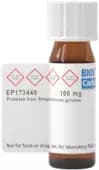
CAS:<p>Protease enzymes break down proteins and are essential for many biological processes, including digestion, cellular regulation and blood clotting. They are also used in many industrial and biotechnological applications for example in food processing and in detergents.</p>Pureza:Min. 95%Forma y color:Powderβ-Glucuronidase from Helix pomatia - Type H-2, aqueous solution, ≥85,000 units/mL
CAS:<p>β-Glucuronidase (EC 3.2.1.31) is an enzyme that hydrolyzes glucuronides. It can also be used to cleave benzodiazepine and steroid conjugates. One unit of β-Glucuronidase will hydrolyze a chromogenic substrate mimic 4-nitrophenyl-β-D-glucuronide to produce 1.0 μmole of 4-nitrophenol per minute at pH 5.0 and 37 °C.</p>Pureza:Min. 95%Forma y color:Clear Liquid