Enzimas en Proteínas Recombinantes
Se han encontrado 3320 productos de "Enzimas en Proteínas Recombinantes"
Amidase, from Pseudomonase aeruginosa, recombinant, lyophilized - EAM01
CAS:Amidase is a hydrolase acting on carbon-nitrogen bonds in linear amides, and can be used in hydrolysis of amides to acids. Amidase 01 is of bacterial origin (P. aeruginosa) and has been produced in E.coli.EUCODIS® Peroxidase 12, from microbial origin, recombinant
CAS:Peroxidases can be utilized as enzymes catalyzing e.g. aromatic ring hydroxylation, epoxidation, halogenation, N- or S-oxidation, ether cleavage and alcohol/aldehyde oxidation reactions.Creatinine amidohydrolase, 150 units/mg solid, 250 U
CAS:Creatinine amidohydrolase (also sometimes reffered as creatininase, EC 3.5.2.10) is an enzyme that catalyses the following reaction: creatinine + H2O ⇌ creatine One unit of creatinine amidohydrolase will produce 1.0 µmole of creatine at pH 7.5 and 37 °C.Pureza:Min. 95%EUCODIS® Lipase 001, screening grade, recombinant, from microbial sources - EL001
Lipase 01 recombinantly expressed in E. coli comes in a spray-dried formulation. It has its pH optimum at 6-7 and temp. optimum at 25-45°C. Lipases belong to the family of esterases and naturally act on triglycerides at lipid-water interfaces catalyzing hydrolytic reactions, esterifications and transesterification reactions in industrial and food applications. Lipase 01 was shown to hydrolyze p-Nitrophenyl esters of butyrate (100 % activity), octanoate (57 %), laurate (13 %), palmitate (9 %), stearate (6 %), arachidate (2 %) and behenate (0.1 %).Cocarboxylase tetrahydrate
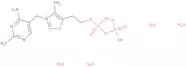
CAS:Cocarboxylase tetrahydrate is a coenzyme form of vitamin B1; cofactor for enzymes involved in carbohydrate catabolismFórmula:C12H18N4O7P2S·4H2OPureza:Min 96%Forma y color:White PowderPeso molecular:496.37 g/molLacBuster™-S bulk (β-Lactamase)
CAS:This product shows beta-lactamase activity against clinically relevant beta-lactam antibiotics such as penicillins, carbapenems and cephalosporins. This product may be of particular interest for laboratory teams who require the sterility testing of biological specimens or for environmental monitoring applications.
Mutanolysin - lyophilized powder, >4000 units/mg
CAS:A N-Acetyl Muramidase enzyme that cleaves N-acetylmuramyl-β(1-4)-N-acetylglucosamine linkage in peptidoglycan within the bacterial cell wall.Pureza:Min. 95%Isoamylase 5MU, from Pseudomonase sp., recombinant, lyophilized - EIA01
Isoamylase (also known as debranching enzyme, systemic name glycogen α-1,6-glucanohydrolase; EC 3.2.1.68) is an enzyme from the family of carbohydrolases acting specifically on α-1,6-glucosidic branch linkages in polysaccharides such as amylopectin or glycogen, but rarely hydrolyzes such bonds in pullulan. Isoamylase has been obtained from P. amyloderamosa and has a temperature optimum in the 30 – 40 °C range and pH optimum between pH 3 and 4.Catalase ECAT01™, EUCODIS® Patent: US 9951306 and EP2861715
CAS:A proprietary potent and stable alternative to chemical neutralizers such as pyruvate - for the utilization in environmental monitoring applications. Use of catalase as a supplement in media plates offers a more effective and reliable solution for safe and secure environmental monitoring of sterilization in clean rooms, isolators or production facilities by also removing remaining traces and spots of high concentration of H2O2. Currently, agar plates for monitoring disinfection or sterilization are supplemented with pyruvate, which is consumed during the neutralization of hydrogen peroxide. One of the main benefits of this catalase is its high stability in agar media at 50°C, which allows easy preparation of media and processing into plates. Due to the high stability no special storage conditions are needed and a shelf-life of > 6 months at 4-25°C can be guaranteed. Key features are:Chloramphenicol acetyltransferase from escherichia coli
CAS:Chloramphenicol acetyltransferase from escherichia coli (EC 2.3.1.28) detoxfies the antibiotic Chloramphenicol by attaching aceryl group. This renders chroramphenicol inactive, as it looses its ability to bind and inactivate ribosomes. One unit of Chloramphenicol acetyltransferase will convert 1 nmol of chloramphenicol and acetyl-CoA to chloramphenicol 3-acetate and CoA per min at pH 7.8 and 25 °C.Pureza:Min. 95%Lipase 020
CAS:Lipases belong to the family of esterases and naturally act on triglycerides at lipid-water interfaces. Lipases/esterases can be used as versatile tools in hydrolytic reactions, esterifications and transesterification reactions in industrial and food applications.LacBuster™ TSA broad range β-lactamase settle plates, 10 plates per pack, barcoded
CAS:A general purpose growth medium supplemented with LacBuster™ to effectively neutralize beta-lactam antibiotics. This product is suitable for the cultivation of a wide variety of microorganisms for environmental monitoring within the pharmaceutical industry and for high performance monitoring of your isolators and clean rooms during beta lactam manufacturePenicillin amidase from escherichia coli
CAS:As a member of the family of hydrolases this enzyme acts on carbon-nitrogen bonds and may be used in the commercial production of semisynthetic penicillin.
Pureza:Min. 95%LacBuster™-L concentrate
CAS:Beta-lactamase solution targeting beta-lactam antibiotics such as penicillins, carbapenems and cephalosporins. According to US Pharmacopeia (USP <71>) and EP, LacBusterTM-L is suitable for sterility testing methods such as membrane filtration and direct inoculation.
β-Glucosidase from almonds
CAS:β-Glucosidase (β-D-glucosidase, systematic name β-D-glucoside glucohydrolase; EC 3.2.1.21) is an enzyme that catalyzes the release the terminal glucose monomers from cellulose and the other oligo- and poly saccharides with β-1,4-linked glucosyl residues. One Unit of β-Glucosidase will release 1.0 µmole of p-nitrophenol from the chromogenic substrate mimic p-nitrophenyl β-glucoside per minute under optimum conditions.Forma y color:PowderRibonuclease H from escherichia coli
CAS:Ribonuclease H from Escherichia Coli is the enzyme that breaks down RNA strand in RNA-DNA duplexes. It acts by cleaving the phosphodiester bonds of RNA and produces 3' hydroxyl and a 5' phosphate groups at the cleavage site. A common use of Ribonuclease H is to remove RNA template after reverse transcription reaction.
Amylase protein (Porcine)
Alpha Amylase (Amylase, α-Amylase, 1,4-α-D-glucan glucanohydrolase, glycogenase, PPA; systematic name 4-α-D-glucan glucanohydrolase; EC 3.2.1.1, CAS Number [9000-90-2]) is an enzyme that catalyzes hydrolysis of large polysaccharides into smaller fragments. Alpha amylase targets alpha bonds of 1→4 glycosidic linkages of poly- and oligosaccharides with three or more D-glucose units. One unit of Alpha Amylase will catalyze the hydrolysis of 1.0 μmol of 2-chloro-4-nitrophenyl-α-D-maltotrioside to yield 2-chloro-4-nitrophenol per minute at 37°C. Porcine pancreatic Alpha Amylase is supplied as lyophilized, off-white to white powder, lyophilized from tris chloride and mannitol, pH 7.2. Activity is ≥70U/mL, specific activity ≥100 U/mg protein. Store at -20°C on arrival.Pureza:Min. 95%LacBuster™ TSA broad range β-lactamase contact plates, 10 plates per pack, barcoded
CAS:A general purpose growth medium supplemented with LacBuster™ to effectively neutralize beta-lactam antibiotics. This product is suitable for the cultivation of a wide variety of microorganisms for environmental monitoring within the pharmaceutical industry and for high performance monitoring of your isolators and clean rooms during beta lactam manufactureAdenosine deaminase, type X, buffered aqueous glycerol solution
CAS:Adenosine deaminase catalyzes deamination of adenosine, converting it to inosine. It happens by the substituting of the amino group by a keto group. One Unit of the enzyme converts one micromole of adenosine to inosine per minute at 25°C, pH 7.4. Adenosine deaminase is also known by names of adenosine aminohydrolase, and ADA, EC 3.5.4.4.Peso molecular:1,000 g/mol