Otros
Se han encontrado 6275 productos de "Otros"
Ordenar por
Pureza (%)
0
100
|
0
|
50
|
90
|
95
|
100
5-Bromo-3-indolyl β-D-glucuronide cyclohexylammonium
CAS:<p>chromogenic substrate for beta-glucuronidase</p>Fórmula:C14H14BrNO7•C6H13NPureza:Min. 95%Forma y color:PowderPeso molecular:487.34 g/mol4-Nitrophenyl b-D-cellobioside heptaacetate
<p>4-Nitrophenyl b-D-cellobioside heptaacetate is a chromogenic substrate for enzymes that catalyze the hydrolysis of glycosidic bonds. This product is used as a diagnostic tool for identifying and characterizing glycosidases and other enzymes that degrade glycosidic bonds. 4-Nitrophenyl b-D-cellobioside heptaacetate is also used in culture media to measure the activity of cellulase enzymes by measuring the release of reducing sugars. The color change of this substrate can be detected at 405 nm, 490 nm, or 550 nm.</p>Pureza:Min. 95%Peso molecular:757.65 g/mol5-Bromo-4-chloro-3-indolyl N-acetyl-a-D-neuraminic acid methyl ester
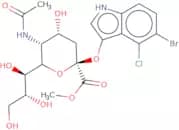
CAS:<p>5-Bromo-4-chloro-3-indolyl N-acetyl-a-D-neuraminic acid methyl ester is a chromogenic substrate that reacts with enzymes to produce a colored product. It can be used in diagnostic tests for the detection of various bacteria, including Salmonella and Brucella, as well as for the determination of concentration in food testing or environmental testing. 5B4C3INA can also be conjugated to other substances, such as biotin or an antibody, which allows it to be used in immunoassays.</p>Fórmula:C20H24BrClN2O9Pureza:Min. 95%Peso molecular:551.77 g/molTetrabutylphosphonium p-toluenesulfonate
CAS:<p>Tetrabutylphosphonium p-toluenesulfonate is a fluorogenic substrate that is used in the diagnosis of cytochrome P450 enzymes. It is a ligand that binds to metal ions, such as copper and zinc. This compound is also used for the preparation of bioluminescent substrates for use in diagnostics and research.</p>Fórmula:C16H36P•C7H7O3SPureza:Min. 95%Peso molecular:430.63 g/mol4-Nitrophenyl hepta-O-acetyl-1-thio-b-lactoside
CAS:<p>4-Nitrophenyl hepta-O-acetyl-1-thio-b-lactoside is an inorganic molecule that binds to the surface of bacteria. It has been used as a fingerprinting tool for a variety of organisms, including corynebacterium glutamicum. The molecule can be used to measure the metabolic activity of corynebacterium glutamicum with a technique called incremental acidification. This technique is based on the observation that the concentration of 4-nitrophenol decreases by one unit for each glucose metabolized by corynebacterium glutamicum. The use of 4NPHTBL and other primers can also be useful in diagnosing patients with autoimmune diseases such as celiac disease and inflammatory bowel disease.</p>Pureza:Min. 95%Aldol® 484 acetate, Biosynth Patent: EP 2427431 and US 8940909
CAS:Producto controlado<p>Aldol® 484 acetate is a chromogenic substrate for carboxylesterases yielding a red precipitate. In contrast to classical indoxyl substrates, Aldol substrates work not only under aerobic but also under anaerobic conditions</p>Fórmula:C22H16ClFN2O3Pureza:Min. 95.0 Area-%Peso molecular:410.83 g/mol4-Nitrophenyl 4-O-(b-D-mannopyranosyl)-b-D-glucopyranoside
<p>4-Nitrophenyl 4-O-(b-D-mannopyranosyl)-b-D-glucopyranoside is a fluorogenic substrate that can be used for the detection of β-glucosidase activity in biological samples. It is an excellent substrate for the enzyme β-glucosidase, which catalyzes the hydrolysis of ester bonds in glycosides with release of glucose and formation of a phenolic product. The 4-nitrophenol group reacts with oxygen to produce light, making it useful as a chemiluminescent or bioluminescent substrate. The conjugate may also be used to detect β-glucosidase activity in culture media by adding the substrate to the culture medium and measuring its fluorescence.<br>4NP4OBG has been shown to have high purity, with only trace amounts of impurities detected such as benzaldehyde and 2,6-dinitro</p>Pureza:Min. 95%Peso molecular:463.39 g/mol2-Nitrophenyl hexyl ether
CAS:<p>2-Nitrophenyl hexyl ether is a chromogenic substrate commonly used to assay the activity of esterases. Upon cleavage of the ester bond by esterases, the released 2-nitrophenyl group yields a yellow color detectable by spectrophotometry. This substrate has been used in a variety of applications, including environmental monitoring and studies of insecticide resistance. It is particularly useful for screening large numbers of samples because of its rapid reaction rate and high sensitivity. However, it should be noted that some non-specific hydrolysis may occur with this substrate, particularly at high concentrations or in the presence of strong nucleophiles.</p>Pureza:Min. 95%Peso molecular:223.27 g/mol4-Nitrophenyl 2,4,6-tri-O-acetyl-3-O-(2,3,4,6-tetra-O-acetyl-b-D-glucopyranosyl)-b-D-glucopyranoside
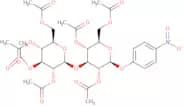
CAS:<p>4-Nitrophenyl 2,4,6-tri-O-acetyl-3-O-(2,3,4,6-tetra-O-acetyl-β-D-glucopyranosyl)-β-D-glucopyranoside is an advanced bifunctional chromogenic pNP substrate specifically tailored for the simultaneous detection and quantification of multiple glycosidase enzymes. This dual-action substrate undergoes cleavage by two separate enzymatic reactions, which increases the range and sensitivity of detection. The resulting 4-Nitrophenol release can be easily measured spectrophotometrically, providing rapid and reliable enzyme analysis for advanced enzymology studies, enabling new discoveries in biochemistry and biotechnology.</p>Pureza:Min. 95%Peso molecular:757.65 g/mol4-Nitrophenyl phosphate potassium salt
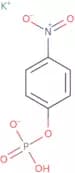
CAS:<p>4-Nitrophenyl phosphate potassium salt is a high quality, non-radioactive chemiluminescence substrate that is used in the detection of oxidase activity. This product can be used to measure the activity of peroxidase and catalase enzymes, as well as the accumulation of hydrogen peroxide. It also has been shown to be a ligand for some sulfhydryl groups and an inhibitor of phosphatases. 4-Nitrophenyl phosphate potassium salt has been tested for its ability to inhibit bacterial growth and fluorescence by staining cells. This product has also been shown to have bioluminescent properties and can be used for diagnostics or culture media.</p>Pureza:Min. 95%Peso molecular:257.18 g/mol2-Nitrophenyl 2,3-di-O-acetyl-4-O-triethylsilyl-b-D-xylopyranoside
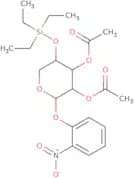
CAS:<p>2-Nitrophenyl 2,3-di-O-acetyl-4-O-triethylsilyl-b-D-xylopyranoside is a chromogenic substrate for enzmatic assays to measure xylosidase activity. It is a derivative of xylose that can be hydrolyzed by xylosidase to release the yellow-colored 2-nitrophenyl group, which can be detected spectrophotometrically. By modifying the xylose molecule with acetyl and triethylsilyl groups, the enzyme substrate becomes more stable and resistant to degradation. This substrate is commonly used in the study of plant biomass degradation and in the detection of xylosidase activity in microorganisms.</p>Pureza:Min. 95%Peso molecular:469.56 g/molAldol® 491 acetate, Biosynth Patent: EP 2427431 and US 8940909
CAS:<p>Aldol 491 acetate is a food and environmental testing chemical, which can be used for the detection of bacteria. Aldol 491 acetate provides a chromogenic substrate for the detection of enzymes and can be used as a substrate in enzyme-linked immunosorbent assay (ELISA) procedures. Aldol 491 acetate also has chemiluminescent properties and can be used as a fluorogenic substrate.</p>Fórmula:C22H17NO4Pureza:Min. 95 Area-%Peso molecular:359.37 g/mol4-Nitrophenyl b-D-cellobioside heptacetate
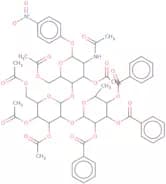
CAS:<p>4-Nitrophenyl b-D-cellobioside heptacetate is a fluorogenic substrate that is used in food testing and environmental testing. The product is an enzyme substrate that can be used as a conjugate to produce chemiluminescence or bioluminescence. 4-Nitrophenyl b-D-cellobioside heptacetate has CAS number 69948-03-4 and is of high purity and quality. It has been shown to have good fluorescence properties, which makes it ideal for use in fluorescence microscopy applications.</p>Pureza:Min. 95%Peso molecular:757.65 g/mol4-Nitrophenyl 2-acetamido-3,6-di-O-acetyl-4-O-[2-O-(2,3,4-tri-O-benzoyl-a-L-fucopyranosyl)-3,4,6-tri-O-acetyl-b-D-galactopyranosyl]- 2-deoxy-b-D-glucopyranoside
<p>This chemical is a ligand that can bind to the enzyme luciferase. In a bioluminescence reaction, this chemical reacts with oxygen and ATP to produce light. This product has been tested for purity and quality and is suitable for use in culture media, environmental testing, or diagnostics. It has also been shown to be an excellent fluorescent substrate for fluorogenic or chromogenic substrates in enzyme substrate assays.</p>Pureza:Min. 95%Peso molecular:1,173.08 g/mol4-Nitrophenyl b-D-galactopyranoside hydrate
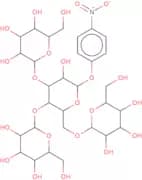
CAS:<p>4-Nitrophenyl b-D-galactopyranoside hydrate is a water-soluble pNP-based enzyme substrate ideal for quantifying b-galactosidase activity in a variety of sample types. This chromogenic substrate features a unique hydrate composition, which allows for enhanced solubility and stability when compared to standard pNP-galactosides. With its high sensitivity and robust performance, this substrate is widely used in biotechnology, biochemistry, and molecular biology fields, including the investigation of enzyme kinetics, characterization of glycoside hydrolase specificity, and assessment of gene expression levels.</p>Pureza:Min. 95%Peso molecular:319.27 g/mol4-Nitrophenyl 3,4,6-tri-O-(a-D-mannopyranosyl)-b-D-mannopyranoside
CAS:<p>This compound inhibits the enzyme protein kinase. It has been shown to inhibit the activity of a number of protein kinases including those that are involved in cell proliferation, differentiation and apoptosis. This drug is also known to be a potent inhibitor of human c-Jun N-terminal kinase (JNK) and other types of kinases such as cyclin-dependent protein kinases. The inhibition of these enzymes results in the prevention of tumorigenesis, inflammation and immunological responses.</p>Pureza:Min. 95%Peso molecular:787.67 g/molN-Acetyl-L-glutamine p-nitroanilide
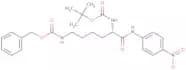
CAS:<p>N-Acetyl-L-glutamine p-nitroanilide is a fluorogenic substrate that can be used in the diagnosis of bacterial infections. It is a ligand that can bind to enzymes involved in the production of bioluminescence, such as luciferase, and can be used for the detection of bacteria. It is also used for food testing, environmental testing, and diagnostics. N-Acetyl-L-glutamine p-nitroanilide has high purity and high quality, which makes it suitable for conjugation with other molecules.</p>Fórmula:C13H15N3O6Pureza:Min. 95%Forma y color:PowderPeso molecular:309.27 g/molN-a-Boc-N-ε-cbz-L-lysine 4-nitroanilide
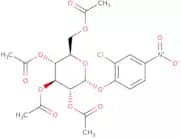
CAS:<p>N-a-Boc-N-epsilon-cbz-L-lysine 4-nitroanilide is a compound that has been shown to regulate the production of angiotensin. It also acts as an inhibitor for the production of fibronectin, which is key in the regulation of inflammation and wound healing. N-a-Boc-N-epsilon-cbz-L-lysine 4 nitroanilide has been shown to be a trifunctional molecule and can yield three different products: oxychlorides, hydrated and solvates. This molecule also regulates phosphorus levels. There are many functions that this molecule performs, including binding with amino acids and regulating their function, which is why it is so important to study this molecule more closely.</p>Pureza:Min. 95%Peso molecular:500.54 g/mol2-Chloro-4-nitrophenyl 2,3,4,6-tetra-O-acetyl-a-D-glucopyranoside
CAS:<p>2-Chloro-4-nitrophenyl 2,3,4,6-tetra-O-acetyl-a-D-glucopyranoside is a chromogenic substrate used to characterize enzymes in biochemical assays. The substrate is cleaved by enzymes, such as esterases and glycosidases, releasing the chromogenic group, which can be detected by its yellow color.</p>Pureza:Min. 95%Peso molecular:503.84 g/mol2,4-Dinitrophenyl 2-acetamido-2-deoxy-b-D-glucopyranoside
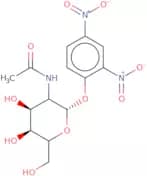
<p>2,4-Dinitrophenyl 2-acetamido-2-deoxy-b-D-glucopyranoside is a fluorogenic substrate for use in diagnostic testing. It reacts with the enzyme β -galactosidase to produce a blue color. This product is used as an indicator of β -galactosidase activity in bacterial cultures or as an indicator of the presence of this enzyme in food or other materials. It can be used to detect and measure the level of β -galactosidase in a sample. The reaction can be monitored by measuring light emission at 450 nm.<br>2,4-Dinitrophenyl 2 acetamido 2 deoxy b D glucopyranoside has a CAS number of 47868-87-0 and is available in high purity (>97%).</p>Pureza:Min. 95%Peso molecular:387.31 g/mol