Otros
Se han encontrado 6305 productos de "Otros"
Aldol® 467 β-D-galactopyranoside, Biosynth Patent: EP 2427431 and US 8940909
CAS:Aldol® 467 beta-D-galactopyranoside is a chromogenic and fluorogenic enzyme substrate used for detection of beta-galactosidase activity. The colorless product is cleaved by lactose-utilizing bacteria grown in liquid or solid media, yielding yellow coloration and green fluorescence. Aldol® 467 beta-D-galactopyranoside can also be used in beta-galactosidase gene reporter assays or immunoassay applications (ELISA). Aldol® 467 beta-D-galactopyranoside can be used under aerobic and anaerobic conditions.
Fórmula:C29H28ClNO9Pureza:Min. 95.0 Area-%Peso molecular:570 g/mol4-Nitrophenyl b-D-cellobioside heptacetate
CAS:4-Nitrophenyl b-D-cellobioside heptacetate is a fluorogenic substrate that is used in food testing and environmental testing. The product is an enzyme substrate that can be used as a conjugate to produce chemiluminescence or bioluminescence. 4-Nitrophenyl b-D-cellobioside heptacetate has CAS number 69948-03-4 and is of high purity and quality. It has been shown to have good fluorescence properties, which makes it ideal for use in fluorescence microscopy applications.Pureza:Min. 95%Peso molecular:757.65 g/mol4-Nitrophenyl β-D-glucuronide sodium
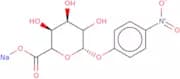
CAS:4-Nitrophenyl b-D-glucuronide sodium salt is a high-quality chromogenic substrate specifically designed for the colorimetric detection and measurement of β-glucuronidase activity. Upon enzymatic cleavage, it releases the yellow 4-nitrophenol, enabling quantitative analysis via spectroscopy. This compound is conveniently provided as a sodium salt to ensure enhanced solubility, stability, and shelf life. It is an ideal choice for biochemical, research, and diagnostic applications requiring a reliable and efficient b-D-glucuronide substrate.Fórmula:C12H12NNaO9Pureza:Min. 95%Peso molecular:337.21 g/molBCM® Histamine-producing bacteria Broth
Histamine (Scombrotoxin) fish poisoning is the most frequent cause of fish poisoning incidents today. Cymit Quimica's BCM®; Histamine-producingbacteria Broth (C-0450) is a growth medium for the detection of histamine-producing bacteria in food and water samples. The medium contains an indicator that turns orange to red due to metabolites released by histidine decarboxylase.4-Nitrophenyl 2,3,4-tri-O-acetyl-6-O-(2,3,4,6-tetra-O-[4-methoxybenzyl]-a-D-glucopyranosyl)-a-D-glucopyranoside
Introducing our 4-Nitrophenyl 2,3,4-tri-O-acetyl-6-O-(2,3,4,6-tetra-O-[4-methoxybenzyl]-a-D-glucopyranosyl)-a-D-glucopyranoside, an advanced chromogenic pNP enzyme substrate designed for high performance and superior results. This cutting-edge substrate ensures excellent outcomes in various enzymatic assays, including glycosidase and glycosyltransferase, due to its unique composition and significant sensitivity. Offering rapid color development and clear visualization, this substrate is perfect for research or industrial applications.Pureza:Min. 95%Peso molecular:1,126.03 g/molAldol® 515 L-proline amide, hydrochloride, Biosynth Patent: EP 2427431 and US 8940909
CAS:Aldol® 515 L-proline amide is a chromogenic and fluorogenic enzyme substrate used for detection of L-proline aminopeptidase activity. The colorless enzyme substrate is cleaved by L-proline aminopeptidase produced by microorganisms grown in liquid or solid media, yielding red-orange color. In addition, red fluorescence signals are generated when a fluorescence enhancer or a suitable matrix is present. Aldol® 515 L-proline amide is suitable for use under aerobic and anaerobic conditions.
Fórmula:C28H29ClN4O2Pureza:Min. 95.0 Area-%Peso molecular:489.02 g/mol4-Bromo-2-nitrophenyl b-D-galactopyranoside
4-Bromo-2-nitrophenyl b-D-galactopyranoside is a chemiluminescent substrate that reacts with an excess of luciferase to produce light. It is used as a reagent in the detection of ATP, NADH, and other compounds in biochemistry and biology. 4-Bromo-2-nitrophenyl b-D-galactopyranoside is also used in diagnostic kits for detecting bacterial or fungal contamination in food.
Fórmula:C12H14BrNO8Pureza:Min. 95%Peso molecular:380.15 g/molp-Nitrophenylphosphorylcholine
CAS:p-Nitrophenylphosphorylcholine is a substrate molecule for enzymes that catalyze phospholipid biosynthesis. It is the most common substrate used to study the enzyme activity of phosphatidylcholine synthase and phospholipase A2 in human serum. The reaction mechanism is not well understood, but it appears to involve autocatalysis and an initial nucleophilic attack by p-nitrophenolate on the carbonyl carbon atom of the choline moiety. p-Nitrophenylphosphorylcholine has been shown to exhibit receptor activity on cells, which may be due to its ability to bind with basic proteins. This compound can also inhibit meiosis in Drosophila melanogaster and increase levels of natriuretic peptides in rats, as well as cause cell lysis and polymerase chain reactions in mammalian cells.Fórmula:C11H17N2O6PPeso molecular:304.24 g/molRef: 3D-N-2740
-Unit-ggA consultar1gA consultar5gA consultar10gA consultar25gA consultar2500mgA consultarBCIP disodium salt sesquihydrate
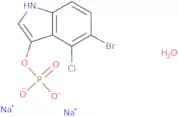
CAS:BCIP is a dye that can be used as a substrate in a fluorometric assay to detect the presence of effector proteins. It is also used in analytical chemistry to detect phosphate, and as a reagent in diagnostic tests for mucin gene expression. BCIP has been shown to have transcriptional regulatory effects on genes encoding for proteins involved in antibody production. BCIP has been shown to act as an effector protein, which influences the amount of mRNA produced by the gene encoding for tissue culture cells. BCIP can also be used as a model system to study the regulation of transcription in vitro.
A hybridization technique using BCIP with DNA-dependent RNA polymerase II has been demonstrated and applied to analyze the mechanism of transcriptional control at the level of individual genes. The use of this technique allows for analysis at a single gene level and may allow for better understanding of transcriptional regulation.Pureza:Min. 95%Peso molecular:388.45 g/mol4-Nitrophenyl 2,3,4-tri-O-acetyl-b-D-glucuronide methyl ester
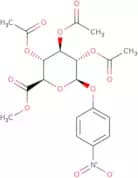
CAS:4-Nitrophenyl 2,3,4-tri-O-acetyl-b-D-glucuronide methyl ester is a fluorescent substrate for the beta-glucuronidase enzyme. It can be used to detect the presence of this enzyme in bacteria and other microorganisms by means of fluorometric or colorimetric assays. It has been shown to have an excellent stability in a variety of culture media and food testing applications. This product is available in high purity and quality, with a CAS number of 18472-49-6.Pureza:Min. 95%Peso molecular:455.37 g/mol2-Methyl-4-nitrophenyl b-D-galactopyranoside
2-Methyl-4-nitrophenyl b-D-galactopyranoside is a chemiluminescent substrate that is used in various applications. It is a ligand that binds to the enzyme beta-galactosidase and is used in diagnostics for detecting the presence of the enzyme. 2-Methyl-4-nitrophenyl b-D-galactopyranoside has been shown to be an appropriate substrate for chemiluminescence reactions, such as those used in diagnostic or research applications. The product also has been tested for potential toxicity and found not to be toxic at concentrations up to 100mg/mL. This product can be used in a variety of applications, including food testing, bacterial culture media, and environmental testing.Pureza:Min. 95%Peso molecular:315.28 g/mol4-Nitrophenyl b-D-cellopentaoside hexadecaacetate
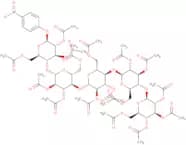
CAS:4-Nitrophenyl b-D-cellopentaoside hexadecaacetate is a fluorogenic substrate that is used to study the activity of various enzymes. It reacts with hydrolytic enzymes in the presence of hydrogen peroxide to produce light, and it can be used for food testing, environmental testing, and diagnostics. 4-Nitrophenyl b-D-cellopentaoside hexadecaacetate is a conjugate of 4-nitrophenol and cellobiose pentaacetate that has a high purity and high quality. The CAS number for this compound is 129411-66-1.Pureza:Min. 95%Peso molecular:1,622.4 g/mol2,4-Dinitrophenyl b-L-arabinofuranoside
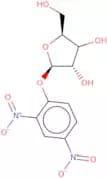
2,4-Dinitrophenyl b-L-arabinofuranoside is a high quality chromogenic substrate for dinitrophenylase. It is a ligand that reacts with an enzyme to form a product that can be detected by various methods, including colorimetry and fluorimetry. 2,4-Dinitrophenyl b-L-arabinofuranoside has shown to be useful for the detection of organic contaminants in water and air. 2,4-Dinitrophenyl b-L-arabinofuranoside is also used as a reagent for the preparation of conjugates for immunoassays.Pureza:Min. 95%Peso molecular:628.54 g/molAldol® 495 phosphate, disodium salt, Biosynth Patent: EP 2427431 and US 8940909
CAS:Aldol® 495 phosphate is a chromogenic and fluorogenic enzyme substrate used for detection of phosphatase activity. The colorless enzyme substrate is cleaved by acid and alkaline phosphatases secreted by bacteria in liquid or solid media, yielding orange color and green fluorescence. Aldol® 495 phosphate can also be used in Western blots and other immunoassay applications with phosphatase-coupled secondary antibodies. Aldol® 495 phosphate can be used under aerobic and anaerobic conditions.Fórmula:C20H14ClN2Na2O5PPureza:Min. 98.0 Area-%Peso molecular:474.74 g/mol4-Nitrophenyl 2,3-di-O-(2,3,4,6-tetra-O-acetyl-b-D-glucopyranosyl)-4,6-benzylidene-b-D-glucopyranoside
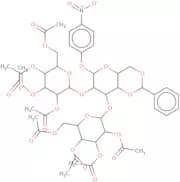
4-Nitrophenyl 2,3-di-O-(2,3,4,6-tetra-O-acetyl-b-D-glucopyranosyl)-4,6-benzylidene-b-D-glucopyranoside is a high purity, high quality 4nitrophenol derivative that is used as a food testing substrate. It is also used for the detection of fluorescence in environmental testing. This product can be conjugated with ligands for use in diagnostic assays.Pureza:Min. 95%Peso molecular:1,049.93 g/molVerapamil
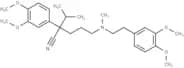
CAS:Verapamil (CP-16533-1), an oral calcium channel blocker, inhibits P-gp and CYP3A4, used for hypertension, arrhythmias, and angina research.Fórmula:C27H38N2O4Pureza:99.61% - 99.93%Forma y color:OilPeso molecular:454.6Ref: TM-T20656
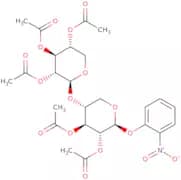
10mg34,00€25mg49,00€1mL*10mM (DMSO)52,00€50mg70,00€100mg90,00€200mg136,00€500mg219,00€2-Nitrophenyl 2,2',3,3',4'-penta-O-acetyl-b-D-xylobioside
CAS:2-Nitrophenyl 2,2',3,3',4'-penta-O-acetyl-b-D-xylobioside is an oligosaccharide that is used as a substrate for the transport of nucleic acid molecules. It can be used to study the function of membrane transport proteins and their homologues. This compound has been shown to inhibit the growth of corynebacterium glutamicum and trisaccharide emissions.Pureza:Min. 95%Peso molecular:613.52 g/mol4-Nitrophenyl 2-acetamido-2-deoxy-3-O-(2,3,4,6-tetra-O-acetyl-β-D-galactopyranosyl)-α-D-galactopyranoside
CAS:4-Nitrophenyl 2-acetamido-2-deoxy-3-O-(2,3,4,6-tetra-O-acetyl-β-D-galactopyranosyl)-α-D-galactopyranoside is a chemiluminescent substrate that has been used in the detection of bacterial activity. It is used in the detection of bacterial activity through chemiluminescence and can be conjugated to an enzyme or protein for increased sensitivity. This product has been shown to have high purity and quality and is suitable for use in diagnostic applications.Fórmula:C28H36N2O17Pureza:Min. 95%Forma y color:PowderPeso molecular:672.59 g/mol4-Nitrophenyl 4,6-benzylidene-2-O-(2,3,4,6-tetra-O-[4-methoxybenzyl]-a-D-glucopyranosyl)-a-D-glucopyranoside
4-Nitrophenyl 4,6-benzylidene-2-O-(2,3,4,6-tetra-O-[4-methoxybenzyl]-a-D-glucopyranosyl)-a-D-glucopyranoside is a fluorogenic substrate that is used in diagnostic assays to measure the activity of enzymes such as β–galactosidase and β–glucuronidase. It is also an enzyme substrate for culture media and chemiluminescence. This product has a CAS number of 57316-92-8.Pureza:Min. 95%Peso molecular:1,088.02 g/mol5-Bromo-6-chloro-3-indolyl b-D-glucuronide
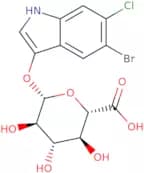
CAS:5-Bromo-6-chloro-3-indolyl b-D-glucuronide (5BCIG) is an antibiotic that inhibits bacterial growth by binding to the DNA gyrase and topoisomerase IV, which are enzymes that maintain the integrity of bacterial DNA. 5BCIG is detectable in tissues, and quantified in blood. It encodes a protein to the cell cytoplasm. The sensitivity of 5BCIG against clostridium perfringens was found to be 10 times higher than that of penicillin G or erythromycin. 5BCIG has optimal activity against clostridium perfringens when expressed functionally as a polypeptide.Fórmula:C14H13BrClNO7Pureza:Min. 95%Peso molecular:422.61 g/mol



![4-Nitrophenyl 2,3,4-tri-O-acetyl-6-O-(2,3,4,6-tetra-O-[4-methoxybenzyl]-a-D-glucopyranosyl)-a-D-gl…](/_next/image/?url=https%3A%2Fstatic.cymitquimica.com%2Fproducts%2F3D%2Fthumb-webp%2FEN04817.webp&w=3840&q=75)






![4-Nitrophenyl 4,6-benzylidene-2-O-(2,3,4,6-tetra-O-[4-methoxybenzyl]-a-D-glucopyranosyl)-a-D-gluco…](/_next/image/?url=https%3A%2Fstatic.cymitquimica.com%2Fproducts%2F3D%2Fthumb-webp%2FEN04828.webp&w=3840&q=75)