Otros
Se han encontrado 6300 productos de "Otros"
4-Nitrophenyl b-D-cellobioside heptacetate
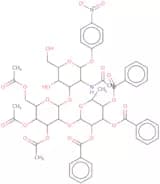
CAS:4-Nitrophenyl b-D-cellobioside heptacetate is a fluorogenic substrate that is used in food testing and environmental testing. The product is an enzyme substrate that can be used as a conjugate to produce chemiluminescence or bioluminescence. 4-Nitrophenyl b-D-cellobioside heptacetate has CAS number 69948-03-4 and is of high purity and quality. It has been shown to have good fluorescence properties, which makes it ideal for use in fluorescence microscopy applications.Pureza:Min. 95%Peso molecular:757.65 g/mol4-Nitrophenyl 2-acetamido-3-O-[2-O-(2,3,4-tri-O-benzoyl-a-L-fucopyranosyl)-3,4,6-tri-O-acetyl-2-deoxy-D-galactopyranosyl]-b-D-glucop yranoside
4-Nitrophenyl 2-acetamido-3-O-[2-O-(2,3,4-tri-O-benzoyl-a-L-fucopyranosyl)-3,4,6-tri-O-acetyl-2 deoxy -D-galactopyranosyl]-b D glucopyranoside is a fluorescent substrate for the enzyme β galactosidase. It can be used to test for β galactosidase activity in food products, environmental samples and diagnostics. 4NPFAPG is a conjugate of 4 nitrophenol and 2 acetamido 3 O-[2 O-(2,3,4 tri O benzoyl a L fucopyranosyl) 3,4 6 tri O acetyl 2 deoxy D galactopyranosyl] b D glucopyranose. 4NPFAPG is water soluble and hasPureza:Min. 95%Peso molecular:1,089.01 g/mol2-Nitrophenyl 2,2',3,3',4'-penta-O-acetyl-b-D-xylobioside
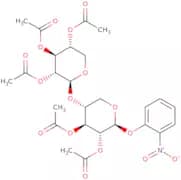
CAS:2-Nitrophenyl 2,2',3,3',4'-penta-O-acetyl-b-D-xylobioside is an oligosaccharide that is used as a substrate for the transport of nucleic acid molecules. It can be used to study the function of membrane transport proteins and their homologues. This compound has been shown to inhibit the growth of corynebacterium glutamicum and trisaccharide emissions.Pureza:Min. 95%Peso molecular:613.52 g/mol2-Methyl-4-nitrophenyl b-D-galactopyranoside
2-Methyl-4-nitrophenyl b-D-galactopyranoside is a chemiluminescent substrate that is used in various applications. It is a ligand that binds to the enzyme beta-galactosidase and is used in diagnostics for detecting the presence of the enzyme. 2-Methyl-4-nitrophenyl b-D-galactopyranoside has been shown to be an appropriate substrate for chemiluminescence reactions, such as those used in diagnostic or research applications. The product also has been tested for potential toxicity and found not to be toxic at concentrations up to 100mg/mL. This product can be used in a variety of applications, including food testing, bacterial culture media, and environmental testing.Pureza:Min. 95%Peso molecular:315.28 g/molTetrabutylphosphonium p-toluenesulfonate
CAS:Tetrabutylphosphonium p-toluenesulfonate is a fluorogenic substrate that is used in the diagnosis of cytochrome P450 enzymes. It is a ligand that binds to metal ions, such as copper and zinc. This compound is also used for the preparation of bioluminescent substrates for use in diagnostics and research.Fórmula:C16H36P•C7H7O3SPureza:Min. 95%Peso molecular:430.63 g/mol4-Nitrophenyl 6-O-trityl-a-D-glucopyranoside
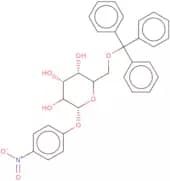
CAS:4-Nitrophenyl 6-O-trityl-a-D-glucopyranoside is a high-quality trityl pNP substrate that performs excellently in various enzymatic assays. Containing a trityl-protected sugar moiety, this substrate is perfect for investigating alpha-D-glucopyranoside-specific enzymes and providing precise data for your experiments.Pureza:Min. 95%Peso molecular:543.56 g/mol5-Bromo-4-chloro-3-indolyl 2-acetamido-2-deoxy-a-D-galactopyranoside
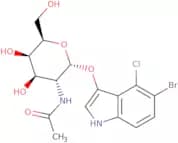
CAS:Substrate for a-N-acetyl-galactosaminidaseFórmula:C16H18BrClN2O6Pureza:Min. 95%Forma y color:White to off-white solid.Peso molecular:449.68 g/mol4-Chloro-2-nitrophenyl b-D-galactopyranoside
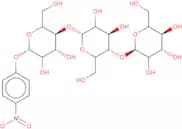
4-Chloro-2-nitrophenyl b-D-galactopyranoside is a fluorogenic substrate that is used in diagnostic testing, such as food and environmental testing. 4-Chloro-2-nitrophenyl b-D-galactopyranoside is an enzyme substrate that can be used to measure the activity of beta galactosidase. This substrate is also chromogenic, which means that it will change color when exposed to the enzyme. 4CNPGalA has been shown to be an excellent ligand for beta galactosidase and can be used in conjugation reactions with other molecules.Pureza:Min. 95%Peso molecular:335.69 g/mol4-Nitrophenyl β-D-maltotrioside
CAS:Chromogenic substrate targeting amylase
Fórmula:C24H35NO18Pureza:Min. 95%Forma y color:PowderPeso molecular:625.53 g/molp-Nitrophenylphosphorylcholine
CAS:p-Nitrophenylphosphorylcholine is a substrate molecule for enzymes that catalyze phospholipid biosynthesis. It is the most common substrate used to study the enzyme activity of phosphatidylcholine synthase and phospholipase A2 in human serum. The reaction mechanism is not well understood, but it appears to involve autocatalysis and an initial nucleophilic attack by p-nitrophenolate on the carbonyl carbon atom of the choline moiety. p-Nitrophenylphosphorylcholine has been shown to exhibit receptor activity on cells, which may be due to its ability to bind with basic proteins. This compound can also inhibit meiosis in Drosophila melanogaster and increase levels of natriuretic peptides in rats, as well as cause cell lysis and polymerase chain reactions in mammalian cells.Fórmula:C11H17N2O6PPeso molecular:304.24 g/molRef: 3D-N-2740
1gA consultar5gA consultar10gA consultar25gA consultar2500mgA consultar-Unit-ggA consultar4-Nitrophenyl b-D-celloheptaoside
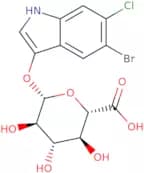
CAS:Chromogenic substrate targeting cellulasePureza:Min. 95%Peso molecular:1,274.09 g/mol5-Bromo-6-chloro-3-indolyl b-D-glucuronide
CAS:5-Bromo-6-chloro-3-indolyl b-D-glucuronide (5BCIG) is an antibiotic that inhibits bacterial growth by binding to the DNA gyrase and topoisomerase IV, which are enzymes that maintain the integrity of bacterial DNA. 5BCIG is detectable in tissues, and quantified in blood. It encodes a protein to the cell cytoplasm. The sensitivity of 5BCIG against clostridium perfringens was found to be 10 times higher than that of penicillin G or erythromycin. 5BCIG has optimal activity against clostridium perfringens when expressed functionally as a polypeptide.Fórmula:C14H13BrClNO7Pureza:Min. 95%Peso molecular:422.61 g/molAldol® 470 L-alanine ester, hydrochloride, Biosynth Patent: EP 2427431 and US 8940909
CAS:Producto controladoAldol® 470 L-alanine ester, hydrochloride is a chromogenic substrate that is used as a food testing reagent and enzyme substrate in diagnostics. It is also used to detect the presence of ligands in an environment. Aldol® 470 L-alanine ester, hydrochloride is used in chemiluminescence and bioluminescence reactions.Fórmula:C26H25ClN2O5Pureza:Min. 95.0 Area-%Peso molecular:480.95 g/mol5-Bromo-6-chloro-3-indolyl b-D-cellobiopyranoside
5-Bromo-6-chloro-3-indolyl b-D-cellobiopyranoside is a fluorogenic substrate for the enzyme β-glucuronidase. It is used in diagnostic applications such as food testing, bacterial culture media and environmental testing. The product has CAS number: 123591-77-0.
Pureza:Min. 95%Abiraterone dimer impurity
CAS:Producto controladoAbiraterone dimer impurity is a drug product that is used as an analytical standard for HPLC, as well as in research and development of drugs. It is also a metabolite of abiraterone and has been detected in the urine of patients receiving the drug. Abiraterone dimer impurity is found in trace amounts in abiraterone acetate but its pharmacological significance is not known. This impurity has been detected in the urine of patients receiving abiraterone acetate therapy.Fórmula:C43H57NO2Pureza:Min. 95%Peso molecular:619.92 g/mol2,4-Dinitrophenyl b-D-cellobioside
CAS:2,4-Dinitrophenyl b-D-cellobioside is a chemiluminescent substrate that is used to detect the activity of enzymes and other proteins. It can be conjugated with an antibody or other ligand for use in diagnostic purposes. 2,4-DNPBC is a pure compound with a high quality that does not contain any other impurities. Its CAS number is 157956-96-2.Pureza:Min. 95%5-Bromo-6-chloro-3-indolyl palmitate
CAS:5-Bromo-6-chloro-3-indolyl palmitate is a magenta enzyme substrate that is widely used in the study of lipase and esterase enzymes. This compound consists of an indole ring with bromine and chlorine atoms at positions 5 and 6, respectively, and a palmitate moiety esterified to the indolyl ring. The palmitate group is a long-chain fatty acid, making this substrate particularly useful for investigating enzymes that hydrolyze ester bonds in lipids. Upon cleavage by lipases or esterases, 5-Bromo-6-chloro-3-indolyl palmitate releases a magenta-colored product, which can be easily detected and quantified to measure enzyme activity.
Pureza:Min. 95%Peso molecular:484.9 g/molAldol® 467 β-D-galactopyranoside, Biosynth Patent: EP 2427431 and US 8940909
CAS:Aldol® 467 beta-D-galactopyranoside is a chromogenic and fluorogenic enzyme substrate used for detection of beta-galactosidase activity. The colorless product is cleaved by lactose-utilizing bacteria grown in liquid or solid media, yielding yellow coloration and green fluorescence. Aldol® 467 beta-D-galactopyranoside can also be used in beta-galactosidase gene reporter assays or immunoassay applications (ELISA). Aldol® 467 beta-D-galactopyranoside can be used under aerobic and anaerobic conditions.
Fórmula:C29H28ClNO9Pureza:Min. 95.0 Area-%Peso molecular:570 g/mol4-Nitrophenyl O-(N-acetyl-a-neuraminosyl)-(2-3)-b-D-galactopyranosyl-(1-4)-2-acetamido-2-deoxy-b-D-glucopyranoside
CAS:4-Nitrophenyl O-(N-acetyl-a-neuraminosyl)-(2-3)-b-D-galactopyranosyl-(1-4)-2-acetamido-2-deoxybDglucopyranoside is a fluorescent compound that has been used as a substrate in enzyme assays. It has been shown to be an effective ligand for the enzyme beta galactosidase, which hydrolyzes the substrate to produce 4nitrophenol and o-(Nacetyl)a-neuraminic acid. This product is CAS No. 501427-92-5 and can be used as a high purity, high quality reagent for conjugation.Pureza:Min. 95%Peso molecular:795.7 g/molAldol® 518 β-D-cellobioside, Biosynth Patent: EP 2427431 and US 8940909
CAS:Aldol® 518 beta-D-cellobioside is a chromogenic substrate for the detection of glycosidases. Aldol® 518 beta-D-cellobioside reacts with enzymes such as alpha-amylase, beta-galactosidase, and alpha-glucosidase to produce a fluorescent product. This product is detected by spectrophotometer, fluorometer, or luminometer. The fluorescence intensity is proportional to the concentration of the enzyme in the sample. It has been shown that Aldol® 518 beta-D-cellobioside can be used as a substitute for conventional substrates in food testing and diagnostics, such as staining and culture media. It also has applications in environmental testing and enzyme substrate assays.Fórmula:C35H39ClN2O12Pureza:Min. 95 Area-%Peso molecular:715.15 g/mol