Derivados de Benzimidazol e Imidazol
El benzimidazol es un compuesto que consta de un anillo bencénico fusionado a un anillo imidazol, una estructura de cinco miembros que contiene dos átomos de nitrógeno. Los derivados de benzimidazol, como el albendazol, son conocidos por su actividad antiparasitaria y antifúngica, utilizados en el tratamiento de infecciones parasitarias y en algunas enfermedades parasitarias en animales y humanos. El imidazol, por su parte, es una estructura de cinco miembros con dos átomos de nitrógeno, que se encuentra en diversos compuestos biológicamente activos. Los derivados de imidazol, como el metronidazol, tienen propiedades antimicrobianas y antiparasitarias. Estos compuestos también se usan en la industria farmacéutica para tratar infecciones bacterianas, enfermedades parasitarias y algunas infecciones fúngicas, además de tener aplicaciones en la química orgánica como catalizadores.
En CymitQuimica ofrecemos benzimidazoles e imidazoles de alta pureza para investigación en química medicinal, farmacología y biotecnología.
Se han encontrado 10355 productos de "Derivados de Benzimidazol e Imidazol"
Ordenar por
Pureza (%)
0
100
|
0
|
50
|
90
|
95
|
100
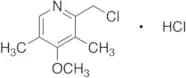
2-(Chloromethyl)-4-methoxy-3,5-dimethylpyridine Hydrochloride
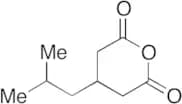
CAS:Producto controlado<p>Impurity Omeprazole EP Impurity XI<br>Applications 2-(Chloromethyl)-4-methoxy-3,5-dimethylpyridine Hydrochloride (Omeprazole EP Impurity XI) is an intermediate in the production of the antiulcer agent Omeprazole.<br>References Roma, G., et al.: J. Med. Chem., 50, 2886 (2007), Hoffmann, S., et al.: Toxicol. Lett., 180, 9 (2008),<br></p>Fórmula:C9H12ClNO·ClHForma y color:WhitePeso molecular:222.113-Isobutylglutaric Anhydride
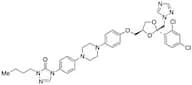
CAS:Producto controladoFórmula:C9H14O3Forma y color:NeatPeso molecular:170.2057Butyl Itraconazole
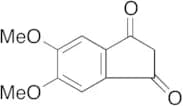
CAS:Producto controladoFórmula:C35H38Cl2N8O4Forma y color:NeatPeso molecular:705.635,6-Dimethoxyindane-1,3-dione
CAS:Producto controladoFórmula:C11H10O4Forma y color:NeatPeso molecular:206.19(2R,3R)-3-(2,4-Difluorophenyl)-3-hydroxy-4-(1H-1,2,4-triazol-1-yl)butan-2-yl methanesulfonate
CAS:Producto controladoFórmula:C13H15F2N3O4SForma y color:NeatPeso molecular:347.342-Chlorobenzotrichloride
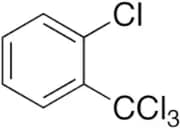
CAS:Producto controlado<p>Applications 2-Chlorobenzotrichloride is a chlorinated toluene with mutagenicity.<br>References Mineki, S. et al.: Mat. technol., 23, 413 (2005); Matsushita, H. et al.: Indust. Health., 17, 199 (1979);<br></p>Fórmula:C7H4Cl4Forma y color:NeatPeso molecular:229.9210,11-Dihydro Carbamazepine
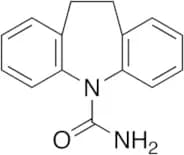
CAS:Producto controladoFórmula:C15H14N2OForma y color:WhitePeso molecular:238.28(Chloromethyl)cyclohexane
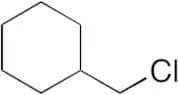
CAS:Producto controlado<p>Applications (Chloromethyl)cyclohexane is a common chemical reagent used in the synthesis of imidazole inhibitors of cytokine release which suppresses the response to tumor necrosis factor.<br> Not a dangerous good if item is equal to or less than 1g/ml and there is less than 100g/ml in the package<br>References Laufer, S. et al., J. Med. Chem., 45, 1695 (2002); Rabinowitz, M. et al.: J. Med. Chem., 44, 4252 (2001);<br></p>Fórmula:C7H13ClForma y color:NeatPeso molecular:132.63Propyl Itraconazole
CAS:Producto controladoFórmula:C34H36Cl2N8O4Forma y color:NeatPeso molecular:691.61N,N-Dimethylaminoethyl-a-(1-Hydroxycyclopentyl)phenylacetate hydrochloride
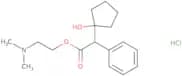
CAS:Producto controlado<p>N,N-Dimethylaminoethyl-a-(1-Hydroxycyclopentyl)phenylacetate hydrochloride (DMAEA) is a drug that is used as an ophthalmic. It has been shown to be safe and effective in patients with chronic open angle glaucoma, and it may also have some efficacy for the treatment of other conditions such as uveitis and retinal detachment. DMAEA is thought to work by binding to the DNA in the eye’s optic nerve cells and blocking the production of leukotrienes. This drug has also been shown to have anti-inflammatory properties.</p>Fórmula:C17H26ClNO3Pureza:Min. 95%Forma y color:PowderPeso molecular:327.85 g/mol2-[(4-Chloro-3-methyl-2-pyridinyl)methylthio]-1H-benzimidazole
CAS:<p>2-[(4-Chloro-3-methyl-2-pyridinyl)methylthio]-1H-benzimidazole is a drug product. It is an impurity standard for the analytical determination of 2-[(4-chloro-3-methylpyridin)-2yl]thiohydantoin in pharmaceuticals and other chemical products. This compound is also used as a research and development (R&D) metabolite and impurity standard for the synthesis of 4-(4,5,6,7-tetrahydrobenzo[b]thiophen-2-yl)pyridine. The CAS number for this compound is 103312-62-5./END></p>Fórmula:C14H12ClN3SPureza:Min. 95%Peso molecular:289.78 g/molAmino albendazole
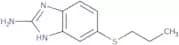
CAS:<p>Albendazole is a sulfoxide anthelmintic drug that is used to treat worm infections in livestock and pets. Albendazole inhibits the synthesis of the parasitic cell membrane, which disrupts the integrity of the cell and leads to death. The analytical method for measuring albendazole includes extraction with hexane followed by analysis using gas chromatography. In humans, albendazole may be used to treat cancer, especially when it occurs in cavities or fatty tissues. It can also be used as a treatment for certain types of parasitic infections, such as toxoplasmosis, amebiasis, and cysticercosis. Albendazole is absorbed well after oral administration and plasma concentrations are proportional to dosage levels. The most common side effects are nausea and headache.</p>Fórmula:C10H13N3SPureza:Min. 95%Peso molecular:207.3 g/molAlbendazole impurity F
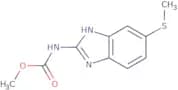
CAS:<p>Albendazole is an anti-helminthic drug that is structurally classified as a benzimidazole. It has been shown to be effective against a variety of helminths, including roundworms, pinworms, hookworms, and tapeworms. Albendazole impurity F is an analytical standard for the determination of albendazole in pharmaceutical products by HPLC. It also serves as a reference substance to establish the purity of drug products containing albendazole and its metabolites. Albendazole impurity F is not considered to be a metabolite of albendazole because it has been shown to be stable under acidic conditions and can be synthesized from other starting materials.</p>Fórmula:C10H11N3O2SPureza:Min. 95%Peso molecular:237.28 g/molSolifenacin impurity C
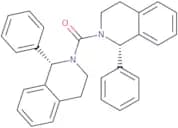
CAS:<p>Solifenacin impurity C is an impurity that is found in the drug product Solifenacin. It has been shown to be a natural metabolite and has been detected in human urine. Solifenacin impurity C is used as an analytical standard for HPLC analyses of solifenacin, and can also be used as a reference material for pharmacopoeia. The purity of this compound is 99%.</p>Fórmula:C31H28N2OPureza:Min. 95 Area-%Forma y color:White PowderPeso molecular:444.57 g/molOxybutynin EP impurity A
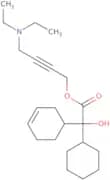
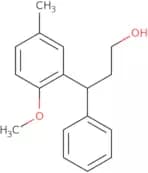
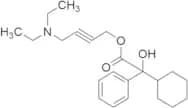
CAS:<p>Oxybutynin EP impurity A is a metabolite of oxybutynin, an antispasmodic drug. It has been shown to have immunomodulatory effects in a rat model of adjuvant arthritis. Oxybutynin EP impurity A is the major metabolite of oxybutynin and has been shown to be pharmacologically active in humans.</p>Pureza:Min. 95%2-Methoxy-5-methyl-γ-phenylbenzenepropanol
CAS:<p>2-Methoxy-5-methyl-gamma-phenylbenzenepropanol is a synthetic compound that is used as an intermediate in the synthesis of coumarin derivatives. Reaction with sulfonating agents produces sulfones, and reaction with borohydride reagents produces boronates. The synthesis of 2-methoxy-5-methyl-gamma-phenylbenzenepropanol can be accomplished by the reduction of diphenyl ethers with lithium aluminum hydride or borohydride. The reduction can also be carried out using lanthanum oxide and potassium borohydride. The reaction proceeds smoothly at room temperature in nonpolar solvents.<br>2-Methoxy-5-methyl-gamma-phenylbenzenepropanol reacts with chloride to produce the corresponding chlorides, which are useful intermediates for the synthesis of tolterodine tartrate, a drug used to treat urinary inc</p>Fórmula:C17H20O2Pureza:Min. 95%Peso molecular:256.34 g/mol(R,R)-Solifenacin succinate
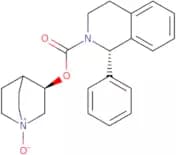
CAS:<p>(R,R)-Solifenacin succinate is a pharmaceutical agent that acts as an antimuscarinic drug. It has been shown to be effective in wastewater treatment, where it was found to reduce the amount of solifenacin and optimised organic chemicals in the water. This drug has also been shown to have antagonist properties against the muscarinic receptor M3.</p>Fórmula:C23H26N2O2•C4H6O4Pureza:Min. 95%Forma y color:PowderPeso molecular:480.55 g/molSolifenacin N-oxide
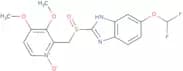
CAS:<p>Solifenacin N-oxide is an anti-cholinergic agent that has been shown to be effective in the treatment of overactive bladder. Solifenacin N-oxide is a prodrug that is hydrolyzed in vivo to solifenacin, its active form. The compound reversibly binds to muscarinic receptors and inhibits the release of acetylcholine. Solifenacin N-oxide has been shown to have low levels of impurities and is highly soluble in water. It was also found to be stable when stored at room temperature for two months. This drug has a high flow rate and moderate retention time, which makes it suitable for reversed-phase liquid chromatography (RPLC). RPLC is a chromatographic technique that separates compounds by size, hydrophobicity, or charge.</p>Fórmula:C23H26N2O3Pureza:Min. 95%Forma y color:White PowderPeso molecular:378.46 g/molPantoprazole N-oxide
CAS:<p>Pantoprazole is a proton pump inhibitor that inhibits the gastric acid secretion by blocking the hydrogen/potassium ATPase enzyme in the stomach. Pantoprazole N-oxide, a prodrug of pantoprazole, is converted to pantoprazole after administration and has been shown to be more stable than pantoprazole. It has been shown to have tissue-specific effects, with high concentrations found in gastrointestinal tissues such as the abomasum, ileum, and colon. Pantoprazole N-oxide is also found in plasma samples at low levels. This drug may be useful for ulceration because it prevents heartburn caused by excess stomach acid.</p>Fórmula:C16H15F2N3O5SPureza:Min. 95%Forma y color:PowderPeso molecular:399.37 g/mol




![2-[(4-Chloro-3-methyl-2-pyridinyl)methylthio]-1H-benzimidazole](/_next/image/?url=https%3A%2Fstatic.cymitquimica.com%2Fproducts%2F3D%2Fthumb-webp%2FIC21227.webp&w=3840&q=75)