Monosacáridos
Los monosacáridos son la forma más simple de los carbohidratos y sirven como bloques fundamentales para azúcares más complejos y polisacáridos. Estas moléculas de azúcar única juegan roles críticos en el metabolismo energético, la comunicación celular y los componentes estructurales de las células. En esta sección, encontrará una amplia variedad de monosacáridos esenciales para la investigación en bioquímica, biología molecular y glicociencia. Estos compuestos son cruciales para estudiar las rutas metabólicas, los procesos de glucosilación y el desarrollo de agentes terapéuticos. En CymitQuimica, ofrecemos monosacáridos de alta calidad para apoyar sus necesidades de investigación, asegurando precisión y fiabilidad en sus investigaciones científicas.
Subcategorías de "Monosacáridos"
- Allosas(11 productos)
- Arabinosas(21 productos)
- Eritrosas(11 productos)
- Fructosas(9 productos)
- Fucosas(36 productos)
- Galactosamina(41 productos)
- Galactosa(261 productos)
- Glucosas(365 productos)
- Ácidos glucurónicos(51 productos)
- Glico-sustratos para enzimas(77 productos)
- Gulosas(6 productos)
- Idosas(4 productos)
- Inositoles(15 productos)
- Lyxosas(4 productos)
- Manosas(65 productos)
- O-glicanos(48 productos)
- Psicosas(3 productos)
- Ramnosas(10 productos)
- Ribosas(61 productos)
- Ácidos siálicos(100 productos)
- Sorbosas(4 productos)
- Azúcares(173 productos)
- Tagatosis(4 productos)
- Taloses(8 productos)
- Xilosas(20 productos)
Mostrar 17 subcategorías más
Se han encontrado 6088 productos de "Monosacáridos"
Ordenar por
Pureza (%)
0
100
|
0
|
50
|
90
|
95
|
100
Hyacinthine crystals
<p>Hyacinthine is a sugar that is synthesized in the laboratory. It is modified with fluorine, methyl, and click chemistry. Hyacinthine has been shown to have antifungal, antiviral, and antitumour properties. It also has been shown to have anti-inflammatory effects. Hyacinthine can be used as a probe for the study of glycosylation reactions or as a model for the synthesis of complex carbohydrates.</p>Pureza:Min. 95%3,4,6-Tri-O-acetyl-L-glucal
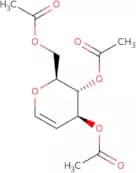
CAS:<p>Resource for the synthesis of 2-azido- and 2-deoxy-L-glucoses and 1,2-epoxides</p>Fórmula:C12H16O7Pureza:Min. 95%Forma y color:White PowderPeso molecular:272.25 g/mol2,3,5-Tri-O-acetyl-L-arabinofuranosyl fluoride
<p>2,3,5-Tri-O-acetyl-L-arabinofuranosyl fluoride is a monosaccharide sugar that has been fluorinated. It is a custom synthesis of methylation and click modification. The CAS number for this product is 565-64-8. This product has been modified to make it more resistant to degradation by enzymes such as alpha amylase and beta amylase. It is also used for polysaccharide synthesis and saccharides with higher purity than other products on the market. This product is synthesized from natural sources, making it high in purity and suitable for use in food production.END></p>Fórmula:C11H15FO7Pureza:Min. 95%Forma y color:Colourless To Yellow LiquidPeso molecular:278.23 g/molL-Mannonic acid-1,4-lactone
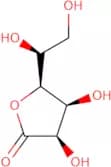
CAS:<p>L-Mannonic acid-1,4-lactone is an acidic compound that has kinetic properties. It is used in the assays of chloride ions and neutral pH. L-Mannonic acid-1,4-lactone also has conjugates with hydrolytic activity and can be used as a synthetic intermediate for other organic compounds. L-Mannonic acid-1,4-lactone can be found in group P2 of the periodic table because it contains a hydroxyl group and an organic group with a methyl ethyl side chain. L-Mannonic acid-1,4-lactone hydrolyzes at high temperatures and may exhibit synergistic effects when combined with other agents. This product is also used to incubate cells such as k562 cells.</p>Fórmula:C6H10O6Pureza:Min. 95%Forma y color:PowderPeso molecular:178.14 g/molD-Apiose - Aqueous solution
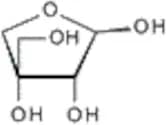
CAS:<p>D-Apiose is a triterpenoid saponin that is isolated from the bark of the Quillaja saponaria tree. It has been shown to inhibit tumor growth and induce cell death in animal models. D-Apiose is also known to be an inhibitor of sugar transport, hydroxylation, and ribitol dehydrogenase, which are all important cellular processes. This compound induces cell lysis by binding to cellular organelles such as the mitochondria and endoplasmic reticulum. Cell lysis leads to the release of intracellular contents into the extracellular environment, which can have potent antitumor activity. The hydroxyl group on D-Apiose allows it to react with ribitol dehydrogenase, which catalyzes a reaction involving the conversion of ribitol into 2-deoxyribose 5-phosphate. The ultimate product of this reaction is galacturonic acid, which may have anti-</p>Fórmula:C5H10O5Pureza:Min. 95%Forma y color:Clear LiquidPeso molecular:150.13 g/mol2,3,4-Tri-O-benzyl-D-glucuronide methyl ester
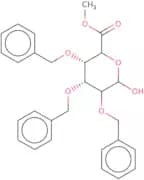
<p>2,3,4-Tri-O-benzyl-D-glucuronide methyl ester is an organic compound that is structurally classified as a saccharide. It can be used as an intermediate in the synthesis of oligosaccharides and glycosylated proteins. This product has been modified with Click chemistry, which is a method for modifying chemical structures with a simple reaction between two groups. The modification is stable in acidic conditions and can be removed by treatment with base. 2,3,4-Tri-O-benzyl-D-glucuronide methyl ester also contains fluorine atoms that have been introduced during the synthetic process.</p>Fórmula:C28H30O7Pureza:Min. 95%Forma y color:White PowderPeso molecular:478.53 g/mol5-O-tert-Butyldimethylsilyl-2,3-O-isopropylidene-D-ribofuranose
CAS:<p>5-O-tert-Butyldimethylsilyl-2,3-O-isopropylidene-D-ribofuranose is a stereoselective, unsubstituted aryl group. It is used in the synthesis of deodorants and antiperspirants. This compound has been shown to have an effect on perspiration by reducing the amount of sweat produced by the apocrine glands. The mechanism of action may be related to its ability to inhibit c1-c4 esters that are involved in the synthesis of odoriferous substances. 5-O-tert-Butyldimethylsilyl-2,3-O-isopropylidene-D-ribofuranose also inhibits bacterial growth by binding to DNA gyrase and topoisomerase IV, which are enzymes that maintain the integrity of bacterial DNA.</p>Fórmula:C14H28O5SiPureza:Min. 95%Forma y color:White PowderPeso molecular:304.45 g/molEthyl 3-deoxy-2,5-di-O-toluoyl-L-threo-pentofuranoside
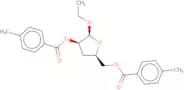
<p>Ethyl 3-deoxy-2,5-di-O-toluoyl-L-threo-pentofuranoside is a custom synthesis that can be modified to fluorinate and methylate the sugar. It is an oligosaccharide that is synthesized from a monosaccharide. The saccharide has been glycosylated to form a complex carbohydrate.</p>Fórmula:C23H26O6Pureza:Min. 95%Peso molecular:398.45 g/mol1,6-Anhydro-3,4-O-isopropylidene-b-D-galactopyranose
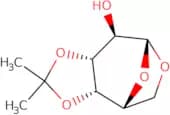
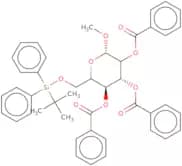
CAS:<p>1,6-Anhydro-3,4-O-isopropylidene-b-D-galactopyranose is a custom synthesis of a complex carbohydrate that has been modified with methylation and glycosylation. It is a saccharide with the CAS number 52579-97-2. This product is highly pure and can be fluorinated for synthesizing other sugars or carbohydrates. The purity of this product is greater than 98%.</p>Fórmula:C9H14O5Pureza:Min. 95%Forma y color:White PowderPeso molecular:202.2 g/molMethyl 2,3,4-tri-O-benzoyl-6-O-tert-butyldiphenylsilyl-a-D-galactopyranoside
<p>Methyl 2,3,4-tri-O-benzoyl-6-O-tert-butyldiphenylsilyl-a-D-galactopyranoside is a custom synthesis of an oligosaccharide with a CAS number. It is an Oligosaccharide that is modified with Methylation and Glycosylation. The chemical modification of the saccharide moiety was achieved through Click chemistry using a triarylphosphine and methyl iodide followed by protection with tert butyl diphosphate. The chemical modification was done to the hydroxyl group at the C2 position on the glycosidic bond. This product has been fluorinated to give a high purity product.<br>Methyl 2,3,4-tri-O-benzoyl-6-O-(tert butyldiphenylsilyl)-a D galactopyranoside is</p>Fórmula:C44H44O9SiPureza:Min. 95%Peso molecular:744.92 g/mol2,3-O-Isopropylidene-5-O-triphenylmethyl-D- ribonic acid γ-lactone
<p>2,3-O-Isopropylidene-5-O-triphenylmethyl-D-ribonic acid gamma-lactone is a modified and synthetic oligosaccharide. It is also known as 2,3:5,6:7,8:5',6'-O-isopropylidene-D-riboaldonic acid gamma lactone or 2,3:5,6:7,8:5',6'-0-(2,2,2,-trimethyl)propane. It is an important precursor for the synthesis of complex carbohydrates such as polysaccharides and glycosylation reactions. This product can be used in research on carbohydrate chemistry and in pharmaceuticals.<br>1. <br>2. <br>3.<br>4. <br>5. <br>6. <br>7.</p>Pureza:Min. 95%L-Arabinose - Syrup
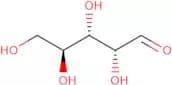
CAS:<p>L-arabinose is a monosaccharide that is found in many plants, but not in humans. It is metabolized by the liver to produce L-arabinose-1-phosphate and L-ribulose-1,5-bisphosphate. L-Arabinose syrup is used for the treatment of bacterial infections such as escherichia coli or listeria monocytogenes.</p>Fórmula:C5H10O5Pureza:Min. 95%Peso molecular:150.13 g/mol3-Deoxy-D-glycero-D-galacto-2-nonulosonic acid
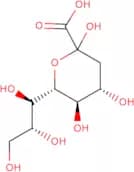
CAS:<p>3-Deoxy-D-glycero-D-galacto-2-nonulosonic acid (3DG) is a monosaccharide that is present in many biological molecules, such as glycoproteins and glycoconjugates. 3DG is found in the sialic acid residues of glycoproteins and has been shown to have anticancer properties through its ability to inhibit cell growth. This compound also inhibits the synthesis of DNA and RNA by binding to bacterial 16S ribosomal RNA, inhibiting protein synthesis and cell division. 3DG has been used in biocompatible polymers for medical applications, such as drug delivery systems.</p>Fórmula:C9H16O9Pureza:Min. 98 Area-%Forma y color:White Yellow PowderPeso molecular:268.22 g/molα-D-Galactopyranosyl phenylisothiocyanate
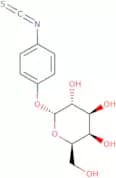
CAS:<p>a-D-Galactopyranosyl phenylisothiocyanate is a compound that is used in the synthesis of saccharides and oligosaccharides. It reacts with a variety of sugars, including glucose, sucrose, maltose and lactose, to produce methylated derivatives. This reagent is also useful for the synthesis of glycosides. The product can be used in custom synthesis or as a fluorinated carbohydrate.</p>Fórmula:C13H15NO6SPureza:Min. 95%Forma y color:Off-White SolidPeso molecular:313.33 g/mol3-O-Benzyl-1,2:5,6-di-O-isopropylidene-α-D-allofuranose
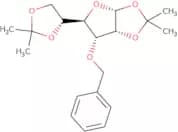
CAS:<p>3-O-Benzyl-1,2:5,6-di-O-isopropylidene-α-D-allofuranose is a carbohydrate that belongs to the group of saccharides. It is an oligosaccharide with a molecular weight of 607.3 g/mol and a CAS number of 22331-21-1. 3OBAF is used in the synthesis of complex carbohydrates or as a sugar substitute and can be custom synthesized to meet your specifications. This product is available for sale and can be shipped internationally.</p>Fórmula:C19H26O6Pureza:Min. 95%Forma y color:White Off-White PowderPeso molecular:350.41 g/mol2-Azido-((R)-3,5-O-benzylidene)-2,6-dideoxy-L-glucono-1.4-lactone
<p>2-Azido-((R)-3,5-O-benzylidene)-2,6-dideoxy-L-glucono-1.4-lactone is a sugar and sugar derivative. It is a synthetic product that has been modified with methylation, fluorination and click chemistry. 2-Azido-(R)-3,5-O-benzylidene)-2,6-dideoxy--L--glucono--1.4--lactone is a carbohydrate with a saccharide at the end of its chain. This product is synthesized in high purity and without any contaminants, as it has been custom synthesized for your company's needs.</p>Pureza:Min. 95%Ethyl 3-O-allyl-4,6-O-benzylidene-b-D-thiogalactopyranoside
<p>Ethyl 3-O-allyl-4,6-O-benzylidene-b-D-thiogalactopyranoside is an oligosaccharide that has been synthesized by a modified Click reaction. It is a white powder with a melting point of 116°C and a molecular weight of 554. The purity of this compound is greater than 98%. Ethyl 3-O-allyl-4,6-O-benzylidene-b-D-thiogalactopyranoside can be used for glycosylation reactions. This product can be custom synthesized to meet your specific needs.</p>Pureza:Min. 95%1,2,3,4,6-Penta-O-(3,4,5-tri-O-benzylgalloyl)-b-D-glucopyranose
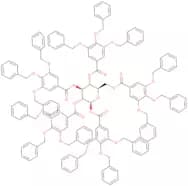
CAS:<p>1,2,3,4,6-Penta-O-(3,4,5-tri-O-benzylgalloyl)-b-D-glucopyranose is a custom synthesis, complex carbohydrate that has been modified with methylation and glycosylation. It is also a saccharide that can be found in the form of an Oligosaccharide or Polysaccharide. The CAS No. for this compound is 122625-60-9. This compound has a purity level of 99% and is 100% synthetic. It has been fluorinated to make it more stable.<br>1,2,3,4,6-Penta-O-(3,4,5-tri-O-benzylgalloyl)-b-D-glucopyranose can be used in pharmaceuticals as a sugar or carbohydrate. It can also be used as a food additive for flavoring purposes</p>Fórmula:C146H122O26Pureza:Min. 95%Peso molecular:2,292.52 g/mol1-O-Methyl-β-D-xylopyranoside
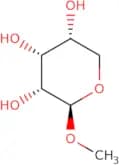
CAS:<p>1-O-Methyl-beta-D-xylopyranoside is a glycoside that consists of a glucose molecule linked to the hydroxyl group of p-hydroxybenzoic acid through an alpha glycosidic bond. It is found in many plants, such as in the leaves of the common bay tree (Laurus nobilis) and in the bark of the cinnamon tree (Cinnamomum verum). 1-O-Methyl-beta-D-xylopyranoside is used as a sweetener and flavoring agent. It is also used in some pharmaceutical drugs, including antiulcer agents and antidiarrheal agents. This compound has been shown to have an effective dose of 5 mg/kg when given orally to humans.</p>Fórmula:C6H12O5Pureza:Min. 98.0 Area-%Peso molecular:164.16 g/mol3-O-Benzyl-4-(hydroxymethyl)-1,2-O-isopropylidene-α-D-ribofuranose
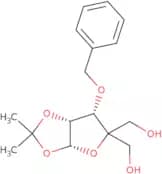
CAS:<p>Synthetic building block for nucleic acid research</p>Fórmula:C16H22O6Pureza:Min. 98 Area-%Forma y color:White PowderPeso molecular:310.34 g/mol