Monosacáridos
Los monosacáridos son la forma más simple de los carbohidratos y sirven como bloques fundamentales para azúcares más complejos y polisacáridos. Estas moléculas de azúcar única juegan roles críticos en el metabolismo energético, la comunicación celular y los componentes estructurales de las células. En esta sección, encontrará una amplia variedad de monosacáridos esenciales para la investigación en bioquímica, biología molecular y glicociencia. Estos compuestos son cruciales para estudiar las rutas metabólicas, los procesos de glucosilación y el desarrollo de agentes terapéuticos. En CymitQuimica, ofrecemos monosacáridos de alta calidad para apoyar sus necesidades de investigación, asegurando precisión y fiabilidad en sus investigaciones científicas.
Subcategorías de "Monosacáridos"
- Allosas(11 productos)
- Arabinosas(21 productos)
- Eritrosas(11 productos)
- Fructosas(9 productos)
- Fucosas(36 productos)
- Galactosamina(41 productos)
- Galactosa(260 productos)
- Glucosas(365 productos)
- Ácidos glucurónicos(51 productos)
- Glico-sustratos para enzimas(77 productos)
- Gulosas(6 productos)
- Idosas(4 productos)
- Inositoles(15 productos)
- Lyxosas(4 productos)
- Manosas(65 productos)
- O-glicanos(48 productos)
- Psicosas(3 productos)
- Ramnosas(10 productos)
- Ribosas(61 productos)
- Ácidos siálicos(100 productos)
- Sorbosas(4 productos)
- Azúcares(173 productos)
- Tagatosis(4 productos)
- Taloses(8 productos)
- Xilosas(20 productos)
Mostrar 17 subcategorías más
Se han encontrado 6088 productos de "Monosacáridos"
Ordenar por
Pureza (%)
0
100
|
0
|
50
|
90
|
95
|
100
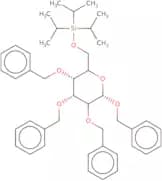
1,2,3,4-Tetra-O-benzyl-6-O-triisopropylsilyl-a-D-mannopyranose
<p>1,2,3,4-Tetra-O-benzyl-6-O-triisopropylsilyl-a-D-mannopyranose is a methylated saccharide. It has the CAS number of 43471-92-5 and is a synthetic modification of mannopyranose. This product can be modified with other functional groups to create customized synthesis for glycosylation and fluorination. It has high purity and is free from contaminants such as proteins, lipids, or carbohydrates.</p>Fórmula:C43H56O6SiPureza:Min. 95%Peso molecular:697.01 g/molL-Xylose
CAS:<p>L-Xylose is a monosaccharide that is found in many plants. It is used as a sweetener, and also has been shown to be beneficial in the treatment of diabetic neuropathy. L-Xylose can be metabolized by the enzyme xylitol dehydrogenase to produce energy for the cell. The enzyme catalyzes the conversion of xylitol to D-xylulose and then D-xylulose 1-phosphate, which can be converted into ATP for use by cells. L-Xylose is not metabolized by bacterial enzymes and does not affect blood sugar levels. L-Xylose has been shown to have an effect on taste perception, with a sweet taste at concentrations of 10 milligrams per liter (mg/L). This sweet taste is due to its hydroxymethyl group on the C2 position, which reacts with sodium ions in the mouth. The optimum pH for L-xylose</p>Fórmula:C5H10O5Pureza:Min. 99.0 Area-%Peso molecular:150.13 g/molD-Apiose - Aqueous solution
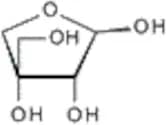
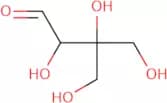
CAS:<p>D-Apiose is a triterpenoid saponin that is isolated from the bark of the Quillaja saponaria tree. It has been shown to inhibit tumor growth and induce cell death in animal models. D-Apiose is also known to be an inhibitor of sugar transport, hydroxylation, and ribitol dehydrogenase, which are all important cellular processes. This compound induces cell lysis by binding to cellular organelles such as the mitochondria and endoplasmic reticulum. Cell lysis leads to the release of intracellular contents into the extracellular environment, which can have potent antitumor activity. The hydroxyl group on D-Apiose allows it to react with ribitol dehydrogenase, which catalyzes a reaction involving the conversion of ribitol into 2-deoxyribose 5-phosphate. The ultimate product of this reaction is galacturonic acid, which may have anti-</p>Fórmula:C5H10O5Pureza:Min. 95%Forma y color:Clear LiquidPeso molecular:150.13 g/mol5-O-tert-Butyldimethylsilyl-2,3-O-isopropylidene-D-ribofuranose
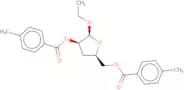
CAS:<p>5-O-tert-Butyldimethylsilyl-2,3-O-isopropylidene-D-ribofuranose is a stereoselective, unsubstituted aryl group. It is used in the synthesis of deodorants and antiperspirants. This compound has been shown to have an effect on perspiration by reducing the amount of sweat produced by the apocrine glands. The mechanism of action may be related to its ability to inhibit c1-c4 esters that are involved in the synthesis of odoriferous substances. 5-O-tert-Butyldimethylsilyl-2,3-O-isopropylidene-D-ribofuranose also inhibits bacterial growth by binding to DNA gyrase and topoisomerase IV, which are enzymes that maintain the integrity of bacterial DNA.</p>Fórmula:C14H28O5SiPureza:Min. 95%Forma y color:White PowderPeso molecular:304.45 g/molEthyl 3-deoxy-2,5-di-O-toluoyl-L-threo-pentofuranoside
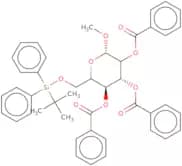
<p>Ethyl 3-deoxy-2,5-di-O-toluoyl-L-threo-pentofuranoside is a custom synthesis that can be modified to fluorinate and methylate the sugar. It is an oligosaccharide that is synthesized from a monosaccharide. The saccharide has been glycosylated to form a complex carbohydrate.</p>Fórmula:C23H26O6Pureza:Min. 95%Peso molecular:398.45 g/molMethyl 2,3,4-tri-O-benzoyl-6-O-tert-butyldiphenylsilyl-a-D-galactopyranoside
<p>Methyl 2,3,4-tri-O-benzoyl-6-O-tert-butyldiphenylsilyl-a-D-galactopyranoside is a custom synthesis of an oligosaccharide with a CAS number. It is an Oligosaccharide that is modified with Methylation and Glycosylation. The chemical modification of the saccharide moiety was achieved through Click chemistry using a triarylphosphine and methyl iodide followed by protection with tert butyl diphosphate. The chemical modification was done to the hydroxyl group at the C2 position on the glycosidic bond. This product has been fluorinated to give a high purity product.<br>Methyl 2,3,4-tri-O-benzoyl-6-O-(tert butyldiphenylsilyl)-a D galactopyranoside is</p>Fórmula:C44H44O9SiPureza:Min. 95%Peso molecular:744.92 g/molDL-Apiose - Aqueous solution
CAS:<p>DL-Apiose, also known as D-apiose, is a carbohydrate that is found in the bark of the tree Dolichandrone. It can be synthesized from verbascoside, a product of the thermally and irradiation degradation of verbascoside. This compound has been shown to have anti-inflammatory properties. DL-Apiose has two stereoisomers: alpha and beta. Alpha-DL-apiose is an intramolecular hydrogen bond donor while beta-DL-apiose is an intramolecular hydrogen bond acceptor. The alpha form can be converted to the beta form by ring opening. The alpha form of this compound has a hydroxyl group at carbon 2 and the beta form does not have this group. The alpha form of DL-apiose is more soluble than the beta form and may be more biologically active than its counterpart.</p>Fórmula:C5H10O5Pureza:Min. 95%Forma y color:Clear LiquidPeso molecular:150.13 g/mol4,6-O-Benzylidene-1-O-(N-Cbz-3-aminopropyl)-b-D-galactopyranose
CAS:<p>4,6-O-Benzylidene-1-O-(N-Cbz-3-aminopropyl)-b-D-galactopyranose is a methylated saccharide. It can be modified with click chemistry to produce a wide variety of compounds. 4,6-O-Benzylidene-1-O-(N-Cbz 3 -aminopropyl)-b D galactopyranose is a synthetic sugar that can be used for glycosylation and polysaccharide synthesis. This product is available in various purities and CAS number 189819 33 8.</p>Fórmula:C24H29NO8Pureza:Min. 95%Peso molecular:459.49 g/molD-Fructose-1,6-diphosphate
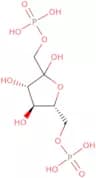
CAS:<p>D-Fructose-1,6-diphosphate is a chemical that is found in the cytosol of cells. It is an intermediate in the metabolism of fructose and also has an important role in the synthesis of fatty acids and phospholipids. D-Fructose-1,6-diphosphate is an effective inhibitor of sodium succinate dehydrogenase, which converts succinate to fumarate. D-Fructose-1,6-diphosphate has a neutral pH profile and is not affected by changes in pH levels. The optimum pH for this compound is between 6.5 and 7.5. D-Fructose-1,6-diphosphate binds to proteins with unsaturated alkyl chains such as creatine kinase and glutamate dehydrogenase. It has been shown to have hemolytic effects on erythrocytes (red blood cells) at high concentrations, which may be due to its ability to bind</p>Fórmula:C6H14O12P2Pureza:(¹H-Nmr) Min. 95 Area-%Forma y color:White PowderPeso molecular:340.12 g/mol5-Bromo-5,6-dideoxy-3-O-benzoyl-D-gulono-1.4-lactone
<p>5-Bromo-5,6-dideoxy-3-O-benzoyl-D-gulono-1.4-lactone is a Carbohydrate with the molecular formula C8H12Br2O7 and a molecular weight of 338. The CAS number for this compound is 9061-52-8. This compound is an Oligosaccharide with a molecular weight of 334. The structure of this compound is related to the structure of the natural sugar, glucose. 5-Bromo-5,6-dideoxy-3-O-(benzoyl)-D--gulono--1.4--lactone has been synthesized from 5,6 dideoxy erythrose in which one hydroxyl group has been replaced by bromine and one hydroxyl group has been replaced by benzoyl chloride. It has also been methylated and glycosylated.</p>Pureza:Min. 95%2-Propynyl-2,3,4,6-tetra-O-acetyl-b-D-glucopyranoside
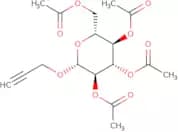
CAS:<p>2-Propynyl-2,3,4,6-tetra-O-acetyl-b-D-glucopyranoside is a carbohydrate. It is an oligosaccharide that contains a glucose molecule with four acetyl groups at the 2 position. This type of modification can be used to create high purity compounds for research purposes. 2-Propynyl-2,3,4,6-tetra-O-acetyl-b-D-glucopyranoside also has methylation and glycosylation sites available for custom synthesis.</p>Fórmula:C17H22O10Pureza:Min. 95%Forma y color:White PowderPeso molecular:386.35 g/mol1,2-Di-O-tert.butyldimethylsilyl-3,4:5,6-di-O-isopropylidene-D-glycero-a-D-talopyranoside
<p>This compound is a high purity, custom synthesis. It is a sugar that can be fluorinated and glycosylated. It also has the ability to be modified with methylation and modification. The CAS Number is 1213-78-3. This carbohydrate has many functions: it can act as an oligosaccharide or monosaccharide and can also be used as a complex carbohydrate.</p>Pureza:Min. 95%Tri-O-acetyl-4-pentulosonic acid methyl ester
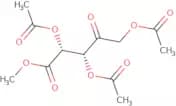
CAS:<p>Tri-O-acetyl-4-pentulosonic acid methyl ester is a high purity, custom synthesis sugar that has been modified by click chemistry. It is fluorinated, glycosylated and synthetically modified. The chemical name for this product is 3'-O-Acetyl-4'-O-(2,3,5,6-tetrafluoro)pentylosonic acid methyl ester. Tri-O-acetyl-4-pentulosonic acid methyl ester is a saccharide that has the CAS No. 108595-14-8 and has been shown to be useful in the synthesis of oligosaccharides and monosaccharides.</p>Fórmula:C12H16O9Pureza:Min. 95%Peso molecular:304.25 g/mol2-Azido-((R)-3,5-O-benzylidene)-2,6-dideoxy-L-glucono-1.4-lactone
<p>2-Azido-((R)-3,5-O-benzylidene)-2,6-dideoxy-L-glucono-1.4-lactone is a sugar and sugar derivative. It is a synthetic product that has been modified with methylation, fluorination and click chemistry. 2-Azido-(R)-3,5-O-benzylidene)-2,6-dideoxy--L--glucono--1.4--lactone is a carbohydrate with a saccharide at the end of its chain. This product is synthesized in high purity and without any contaminants, as it has been custom synthesized for your company's needs.</p>Pureza:Min. 95%Ethyl 3-O-allyl-4,6-O-benzylidene-b-D-thiogalactopyranoside
<p>Ethyl 3-O-allyl-4,6-O-benzylidene-b-D-thiogalactopyranoside is an oligosaccharide that has been synthesized by a modified Click reaction. It is a white powder with a melting point of 116°C and a molecular weight of 554. The purity of this compound is greater than 98%. Ethyl 3-O-allyl-4,6-O-benzylidene-b-D-thiogalactopyranoside can be used for glycosylation reactions. This product can be custom synthesized to meet your specific needs.</p>Pureza:Min. 95%1-O-Methyl-β-D-xylopyranoside
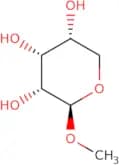
CAS:<p>1-O-Methyl-beta-D-xylopyranoside is a glycoside that consists of a glucose molecule linked to the hydroxyl group of p-hydroxybenzoic acid through an alpha glycosidic bond. It is found in many plants, such as in the leaves of the common bay tree (Laurus nobilis) and in the bark of the cinnamon tree (Cinnamomum verum). 1-O-Methyl-beta-D-xylopyranoside is used as a sweetener and flavoring agent. It is also used in some pharmaceutical drugs, including antiulcer agents and antidiarrheal agents. This compound has been shown to have an effective dose of 5 mg/kg when given orally to humans.</p>Fórmula:C6H12O5Pureza:Min. 98.0 Area-%Peso molecular:164.16 g/mol3-O-Benzyl-4-(hydroxymethyl)-1,2-O-isopropylidene-α-D-ribofuranose
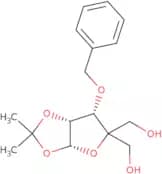
CAS:<p>Synthetic building block for nucleic acid research</p>Fórmula:C16H22O6Pureza:Min. 98 Area-%Forma y color:White PowderPeso molecular:310.34 g/mol(2R, 3S, 4S) -N-Benzyl-3- fluoro- 4- (hydroxymethyl) - 2- azetidinecarboxylic acid
<p>(2R, 3S, 4S)-N-Benzyl-3-fluoro-4-(hydroxymethyl)-2-azetidinecarboxylic acid is a synthetic sugar that is custom synthesized for pharmaceutical applications. It has a purity of 98% and is available in different quantities. The drug can be modified with fluorination, glycosylation, methylation, and modification. (2R, 3S, 4S)-N-Benzyl-3-fluoro-4-(hydroxymethyl)-2-azetidinecarboxylic acid can be used as a sugar or carbohydrate in the synthesis of oligosaccharide or monosaccharide. It has an CAS number of 58614-82-1 and can be found in the Glycosylations and Synthetic sections of the catalog.</p>Pureza:Min. 95%6-Azido-6-deoxy-D-galactose
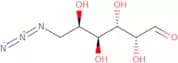
CAS:<p>6-Azido-6-deoxy-D-galactose is a mutagenic compound that is used as a carbon source in the synthesis of other compounds. It has been shown to have mutagenicity in TA100 cells and to be active against Staudinger's naphthol. The compound is synthesised by chemoenzymatic methods, which involve the use of alcohols and an acetyl group. 6-Azido-6-deoxy-D-galactose can be used as a mutagenic agent for the production of mutants with desired properties.</p>Fórmula:C6H11N3O5Pureza:Min. 95%Forma y color:White PowderPeso molecular:205.17 g/molD-Glucose-6-phosphate barium
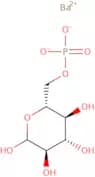
CAS:<p>D-Glucose-6-phosphate barium salt is a custom synthesis of the saccharide, which is a component of the carbohydrates. It has been modified by fluorination, methylation, and monosaccharide modification. The synthesis of this compound can be done in a single reaction, and it is an example of glycosylation. This product has been shown to have high purity.</p>Fórmula:C6H13O9P•BaxPureza:Min. 95%Forma y color:PowderPeso molecular:395.45