Monosacáridos
Los monosacáridos son la forma más simple de los carbohidratos y sirven como bloques fundamentales para azúcares más complejos y polisacáridos. Estas moléculas de azúcar única juegan roles críticos en el metabolismo energético, la comunicación celular y los componentes estructurales de las células. En esta sección, encontrará una amplia variedad de monosacáridos esenciales para la investigación en bioquímica, biología molecular y glicociencia. Estos compuestos son cruciales para estudiar las rutas metabólicas, los procesos de glucosilación y el desarrollo de agentes terapéuticos. En CymitQuimica, ofrecemos monosacáridos de alta calidad para apoyar sus necesidades de investigación, asegurando precisión y fiabilidad en sus investigaciones científicas.
Subcategorías de "Monosacáridos"
- Allosas(11 productos)
- Arabinosas(21 productos)
- Eritrosas(11 productos)
- Fructosas(9 productos)
- Fucosas(36 productos)
- Galactosamina(41 productos)
- Galactosa(261 productos)
- Glucosas(365 productos)
- Ácidos glucurónicos(52 productos)
- Glico-sustratos para enzimas(78 productos)
- Gulosas(6 productos)
- Idosas(4 productos)
- Inositoles(15 productos)
- Lyxosas(4 productos)
- Manosas(65 productos)
- O-glicanos(48 productos)
- Psicosas(3 productos)
- Ramnosas(10 productos)
- Ribosas(61 productos)
- Ácidos siálicos(100 productos)
- Sorbosas(4 productos)
- Azúcares(173 productos)
- Tagatosis(4 productos)
- Taloses(8 productos)
- Xilosas(20 productos)
Mostrar 17 subcategorías más
Se han encontrado 6088 productos de "Monosacáridos"
Ordenar por
Pureza (%)
0
100
|
0
|
50
|
90
|
95
|
100
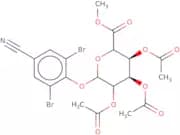
Bromoxynil 2,3,4-tri-O-acetyl-D-glucuronide methyl ester
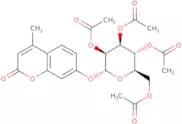
Bromoxynil 2,3,4-tri-O-acetyl-D-glucuronide methyl ester is a custom synthesis of a polysaccharide. It is a modification of the natural saccharides with an acetyl group at the 3’ position on glucose and a methyl group at the 4’ position. Bromoxynil 2,3,4-tri-O-acetyl-D-glucuronide methyl ester is synthesized by glycosylation and then fluorination to form the desired product. The compound has high purity and is stable in water solution.Fórmula:C20H19Br2NO10Pureza:Min. 95%Peso molecular:593.17 g/mol4-Methylumbelliferyl 2,3,4,6-tetra-O-acetyl-a-D-mannopyranoside
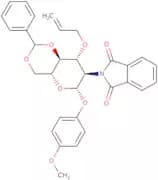
CAS:The expression profile of 4-methylumbelliferyl 2,3,4,6-tetra-O-acetyl-a-D-mannopyranoside was analyzed in human cells. The gene expression levels were analyzed and compared to the profiles from other cell types. Analysis showed that this compound is expressed at high levels in the zingiberaceae family of plants.Fórmula:C24H26O12Pureza:Min. 95%Peso molecular:506.46 g/mol4-Methoxyphenyl 3-O-allyl-4,6-O-benzylidene-2-deoxy-2-phthalimido-b-D-glucopyranoside
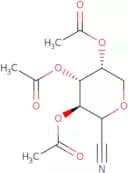
CAS:4-Methoxyphenyl 3-O-allyl-4,6-O-benzylidene-2-deoxy-2-phthalimido-b-D-glucopyranoside (BAP) is a phosphatase inhibitor. It binds to the active site of the enzyme phosphatase and prevents it from hydrolyzing phosphate esters. BAP is used to prevent the release of calcium ions from bone, which can lead to osteitis fibrosa cystica in patients with esophagectomy or those who have undergone abdominal surgery. Thermodynamic studies indicate that BAP binds to phosphatases with a 1:1 stoichiometry and that this binding is irreversible.Fórmula:C31H29NO8Pureza:Min. 95%Peso molecular:543.56 g/mol2,3,4-Tri-O-acetyl-b-D-arabinopyranosyl cyanide
CAS:2,3,4-Tri-O-acetyl-b-D-arabinopyranosyl cyanide is a synthetic sugar used in the synthesis of complex carbohydrates. It is a white to light yellow powder that is soluble in water and alcohol. This compound can be used to modify saccharides, such as monosaccharides and oligosaccharides. It has been shown that 2,3,4-tri-O-acetyl-b-D-arabinopyranosyl cyanide can be used for the fluorination of saccharides with high purity and modification.Fórmula:C11H15N3O7Pureza:Min. 95%Peso molecular:301.3 g/mol1,2,3,4,6-Penta-O-pivaloyl-b-D-galactopyranoside
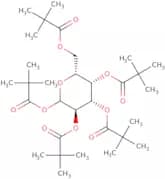
CAS:1,2,3,4,6-Penta-O-pivaloyl-b-D-galactopyranoside is a high purity custom synthesis sugar. It is the product of a click modification, fluorination, glycosylation and carbamylation. This compound is also methylated and modified with an oligosaccharide and monosaccharide. The CAS number for 1,2,3,4,6-Penta-O-pivaloyl-b-D-galactopyranoside is 108342-85-4.Fórmula:C31H52O11Pureza:Min. 95%Peso molecular:600.74 g/molEthyl 2-O-benzoyl-3-O-benzyl-4-O-levulinoyl-b-D-thioglucopyranoside
Ethyl 2-O-benzoyl-3-O-benzyl-4-O-levulinoyl-b-D-thioglucopyranoside is a glycosylation product of ethyl levulinate and 3,4,6,7,8,9,10,11,12-hexahydroxybenzoate. This compound has undergone methylation at the C2 position of the benzoic acid moiety and click modification at the C1 position of the benzoyl group. It is a polysaccharide that is used as a fluorinating agent in organic synthesis. Ethyl 2-O-benzoyl-3-O-benzyl-4-O-levulinoyl b -D--thioglucopyranoside is an oligosaccharide with six monosaccharides attached to each other by glycosidic bonds. The CAS NoPureza:Min. 95%1,3,6-Tri-O-acetyl-2,4-di-O-benzyl-a-D-glucopyranose
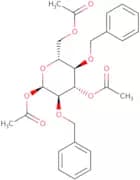
CAS:Glycosylation is a process by which glucose molecules are covalently attached to other molecules, such as proteins or lipids. This process can be accomplished through the addition of a phosphate group to the glucose molecule. The Methylation, Click modification, and Polysaccharide reactions are all methods of modifying glycosides. Glycosylation is an important part of many biological processes such as cell growth and repair, the immune response, and blood clotting. Fluorination is a chemical reaction between fluorine and another element or compound in which one or more atoms of fluorine replace hydrogen atoms on the other element or compound. This process has been used for the synthesis of carbohydrates with specific properties that may not be found in nature. The CAS number for 1,3,6-Tri-O-acetyl-2,4-di-O-benzyl-a-D-glucopyranose is 79414-66-7. This productFórmula:C26H30O9Pureza:Min. 95%Peso molecular:486.51 g/mol1,2,5-Tri-O-acetyl-3-deoxy-3-fluoro-D-ribofuranose
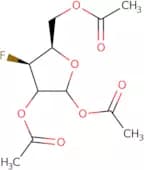
CAS:1,2,5-Tri-O-acetyl-3-deoxy-3-fluoro-D-ribofuranose is a custom synthesis. It is a complex carbohydrate that can be modified with methylation and glycosylation to produce an Oligosaccharide or Polysaccharide. This molecule has been used in click chemistry to modify the sugar moiety and fluorinate the ribose group. 1,2,5-Tri-O-acetyl-3-deoxy--D--ribofuranose has CAS number 1556020-32-6 and has a purity of 99%.Fórmula:C11H15FO7Pureza:Min. 95%Peso molecular:278.23 g/mol3-Cyclohexylpropyl-b-D-glucopyranoside
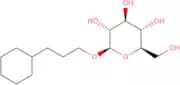
CAS:3-Cyclohexylpropyl-b-D-glucopyranoside is a synthetic glycoside that is used as an intermediate in the production of complex carbohydrates. This product is custom synthesized and available at a purity of 99%. It can be modified with methylation, glycosylation, or click chemistry. The saccharide can also be fluorinated for use in the synthesis of other products. 3-Cyclohexylpropyl-b-D-glucopyranoside has been shown to be stable during storage at room temperature for up to three months.Fórmula:C15H28O6Pureza:Min. 95%Peso molecular:304.38 g/mol4-Thio-1-acetyl-2,3,5-tri-O-benzoyl-b-L-ribofuranose
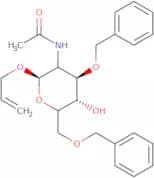
4-Thio-1-acetyl-2,3,5-tri-O-benzoyl-b-L-ribofuranose is a modified carbohydrate that is used in the synthesis of oligosaccharides. It's a synthetic compound that can be used to synthesize polysaccharides or glycosylations. The chemical modification of 4-thio-1-acetyl-2,3,5 tri O benzoyl b L ribofuranose includes methylation and fluorination. It has shown to have high purity and can be used for many purposes in the field of chemistry.Pureza:Min. 95%Allyl 2-acetamido-3,6-di-O-benzyl-2-deoxy-b-D-glucopyranoside
CAS:Allyl 2-acetamido-3,6-di-O-benzyl-2-deoxy-b-D-glucopyranoside is a synthetic sugar that is used in the modification of complex carbohydrates. It is an Oligosaccharide that has a Glycosylation and fluorination. Allyl 2-acetamido-3,6-di-O-benzyl-2-deoxy-b--D--glucopyranoside contains a methyl group on the C1 position, which can be modified at the C1 position to produce various derivatives. Click chemistry reactions are also possible with this compound. The chemical name for this compound is 65730–02–1 and it has CAS number 65730–02–1.Fórmula:C25H31NO6Pureza:Min. 95%Peso molecular:441.53 g/molmyo-Inositol 1,2,3,4,6-pentakisphosphate
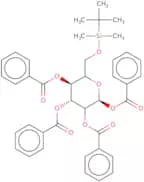
CAS:Myo-inositol 1,2,3,4,6-pentakisphosphate is a compound that belongs to the group of myo-inositols. It can be isolated from rice bran or synthesized by reacting inositol with phosphoric acid. Myo-Inositol 1,2,3,4,6-pentakisphosphate has been shown to be an analog of myo-inositol and has a similar chromatographic profile. This compound also has the ability to dephosphorylate diacylglycerol (DAG) and reduce its levels in cells. Myo-inositol 1,2,3,4,6-pentakisphosphate can be quantified by reversed phase high performance liquid chromatography (RP-HPLC). The result can then be used to calculate the concentration of DAG in cells based on the standard curve obtained from the quantification of DAG inFórmula:C6H17O21P5Pureza:Min. 95%Peso molecular:580.06 g/mol1,2,3,4-Tetra-O-benzoyl-6-O-tert-butyldimethylsilyl-b-D-galactopyranose
Tetra-O-benzoyl-6-O-tert-butyldimethylsilyl-b-D-galactopyranose is a tetrasaccharide that has been modified with the fluoride ion. This compound is synthesized from 1,2,3,4-tetraacetyl bromoacetone and 2,3,4,6-tetraacetyl bromoethanol by an acetalization reaction followed by a silylation reaction. Tetra-O-benzoyl-6-O-tert butyldimethylsilyl b D galactopyranose may be used in glycosylation reactions. The product is soluble in water or ethanol and can be stored for up to 2 weeks at 4°C.Fórmula:C40H42O10SiPureza:Min. 95%Peso molecular:710.86 g/mol1,3-O-Benzylidene-L-erythritol
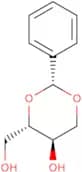
CAS:1,3-O-Benzylidene-L-erythritol is a potent inhibitor of the intestinal maltase. It has two diastereomers, one of which is more potent than the other. The more potent diastereomer inhibits both the maltase and L-arabinose isomerase enzymes in the intestine. This inhibition prevents digestion of complex carbohydrates such as starch and sucrose into simple sugars that can be absorbed by the body. 1,3-O-Benzylidene-L-erythritol also inhibits salacinol synthase and thiosugar synthetases from bacteria and plants, preventing synthesis of these important compounds.
Pureza:Min. 95%(2-Pirydyl) 2,3,4,6-tetra-O-acetyl-1-deoxy-a-D-manno-1-C-pyranoside
2-Pyridyl-2,3,4,6-tetra-O-acetyl-1-deoxy-a-D-manno-1Cpyranoside is a glycosylated pyranoside that can be used as a building block to synthesize complex carbohydrate. It has been modified with fluorination and acetylation. The purity of this compound is greater than 98% and it is available for custom synthesis.Pureza:Min. 95%Peso molecular:409.39 g/mol6-O-Acetyl-1,2:3,4-di-O-isopropylidene-α-D-galactopyranose
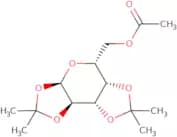
CAS:Glycosylation is the chemical process of adding sugars to other molecules. It often occurs in the cell, but can also be done in a lab. The process of glycosylation is called O-glycosylation when it attaches a carbohydrate molecule to an amino acid or protein, and it's called N-glycosylation when it attaches a carbohydrate molecule to nitrogen-containing compounds such as proteins or nucleic acids. 6-O-Acetyl-1,2:3,4-di-O-isopropylidene-a-D-galactopyranose is a synthetic compound that is used as an intermediate in the synthesis of glycoproteins and other complex carbohydrates. This product has been modified by fluorination and acetylation. It has been shown to inhibit cancer cell proliferation, induce apoptosis (cell death), and increase chemosensitivity in cancer cells.Fórmula:C14H22O7Pureza:Min. 95%Peso molecular:302.32 g/molPhenyl 2,3,4,6-tetra-O-benzyl-b-D-thiogalactopyranoside
CAS:The chemical name for Phenyl 2,3,4,6-tetra-O-benzyl-b-D-thiogalactopyranoside is Phenyl 2,3,4,6-tetra-O-benzyl-b-D-thiogalactopyranoside. This chemical is a Carbohydrate that is Modification and saccharide. It has the molecular formula of C12H14O8S2. Phenyl 2,3,4,6-tetra-O-benzyl-b-D-thiogalactopyranoside is an Oligosaccharide with a sugar type of Monosaccharide. The Chemical Abstracts Service (CAS) registry number for this chemical is 577861 - 19 - 1. Phenyl 2,3,4,6 tetra O benzyl b D thiogalactopFórmula:C40H40O5SPureza:Min. 95%Forma y color:PowderPeso molecular:632.81 g/mol2-O-b-D-Glucopyranosyl-L-ascorbic acid
CAS:L-Ascorbic acid is a white crystalline solid that can be obtained from the tissues of many fruits and vegetables. L-Ascorbic acid is soluble in water, but insoluble in alcohol. It can be found in two forms: an oxidized form (dehydroascorbic acid) and a reduced form (L-ascorbic acid). The conversion between the two forms is catalyzed by ascorbate oxidase. L-Ascorbic acid has antioxidant properties, which scavenge free radicals, and prevent the oxidation of LDL cholesterol to its more atherogenic form. This compound also helps to alkalize bodily fluids and neutralizes pollution, making it useful for treating or preventing cervical cancer or diabetes. L-Ascorbic acid also acts as a preservative by inhibiting bacterial growth.Fórmula:C12H18O11Pureza:Min. 95%Peso molecular:338.26 g/mol1-O-Propargyl 2, 3, 4, 6- tetra-O-acetyl- D- fructofuranose
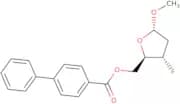
1-O-Propargyl 2, 3, 4, 6- tetra-O-acetyl-D-fructofuranose is a monosaccharide that is modified with an acetyl, propargyl and fluorine. It can be used as a glycosylation agent, as well as a methylating and click modification agent. 1-O-Propargyl 2, 3, 4, 6- tetra-O-acetyl -D -fructofuranose has been shown to have antiinflammatory properties in addition to its ability to inhibit the growth of bacteria and fungi. This compound can also be used for the synthesis of polysaccharides and oligosaccharides.Pureza:Min. 95%Methyl-2,3-dideoxy-3-fluoro-5-O-(4-phenylbenzoyl)-a-D-erythro-pentofuranoside
CAS:A mutant is a modified form of a gene that can be either natural or artificial. This gene has been modified by the introduction of an additional chemical group, such as methyl, at a specific position in the DNA sequence. The new compound is not found in nature and may have beneficial effects on the organism. The control system for this experiment is programmable and allows for the introduction of multiple mutations to be introduced simultaneously into a single gene. This technique has been shown to create mutants with neurological disorders, including protein overload, which occurs when there are too many proteins made by one particular gene.Pureza:Min. 95%