Monosacáridos
Los monosacáridos son la forma más simple de los carbohidratos y sirven como bloques fundamentales para azúcares más complejos y polisacáridos. Estas moléculas de azúcar única juegan roles críticos en el metabolismo energético, la comunicación celular y los componentes estructurales de las células. En esta sección, encontrará una amplia variedad de monosacáridos esenciales para la investigación en bioquímica, biología molecular y glicociencia. Estos compuestos son cruciales para estudiar las rutas metabólicas, los procesos de glucosilación y el desarrollo de agentes terapéuticos. En CymitQuimica, ofrecemos monosacáridos de alta calidad para apoyar sus necesidades de investigación, asegurando precisión y fiabilidad en sus investigaciones científicas.
Subcategorías de "Monosacáridos"
- Allosas(11 productos)
- Arabinosas(21 productos)
- Eritrosas(11 productos)
- Fructosas(9 productos)
- Fucosas(36 productos)
- Galactosamina(41 productos)
- Galactosa(261 productos)
- Glucosas(365 productos)
- Ácidos glucurónicos(51 productos)
- Glico-sustratos para enzimas(77 productos)
- Gulosas(6 productos)
- Idosas(4 productos)
- Inositoles(15 productos)
- Lyxosas(4 productos)
- Manosas(65 productos)
- O-glicanos(48 productos)
- Psicosas(3 productos)
- Ramnosas(10 productos)
- Ribosas(61 productos)
- Ácidos siálicos(100 productos)
- Sorbosas(4 productos)
- Azúcares(173 productos)
- Tagatosis(4 productos)
- Taloses(8 productos)
- Xilosas(20 productos)
Mostrar 17 subcategorías más
Se han encontrado 6090 productos de "Monosacáridos"
Ordenar por
Pureza (%)
0
100
|
0
|
50
|
90
|
95
|
100
O-Butanoyl-2,3-O-isopropylidene-a-D-mannofuranoside
CAS:<p>O-Butanoyl-2,3-O-isopropylidene-a-D-mannofuranoside is a high purity sugar with CAS No. 177562-15-1. It is synthesized by the modification of saccharides with methyl groups, glycosylation, and click chemistry. This chemical has a complex structure and can be used as a raw material for the production of complex carbohydrates.</p>Fórmula:C14H26O7Pureza:Min. 95%Peso molecular:304.38 g/mol2,6-Anhydro-1-deoxy-1-nitro-3,4,5-tri-O-acetyl-D-gulitol
CAS:<p>2,6-Anhydro-1-deoxy-1-nitro-3,4,5-tri-O-acetyl-D-gulitol is a custom synthesized sugar that is manufactured by Click modification with the fluorination and glycosylation of the 2,6 anhydro sugar. The CAS No. 20204-84-6 belongs to the category of high purity and is a synthetic carbohydrate. This complex carbohydrate can be modified for its methylation and oligosaccharide content.</p>Pureza:Min. 95%2,3,4-Tri-O-acetyl-b-L-fucopyranosyl dibenzyl phosphate
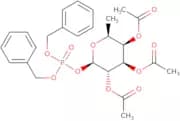
CAS:<p>2,3,4-Tri-O-acetyl-b-L-fucopyranosyl dibenzyl phosphate is a fluorinated carbohydrate that can be custom synthesized to order. The compound is a modification of the pentose sugar, D-ribose and contains an acetyl group at C2' position of the sugar. The compound has been shown to have anti-inflammatory activities in rats.</p>Fórmula:C26H31O11PPureza:Min. 95%Peso molecular:550.49 g/mol2-Acetamido-3-O-benzoyl-4,6-O-benzylidene-2-deoxy-D-glucopyranose
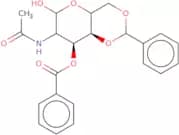
CAS:<p>This is a custom synthesized oligosaccharide that is a complex carbohydrate. This is an Oligosaccharide, Polysaccharide, and CAS No. 1486465-81-9. It has been modified by methylation, glycosylation, and carbamylation. This product has high purity and has been fluorinated. It is a saccharide and a sugar with Click modification.</p>Fórmula:C22H23NO7Pureza:Min. 95%Peso molecular:413.42 g/molQuinovic acid 3-O-(3',4'-O-isopropylidene)-b-D-fucopyranoside
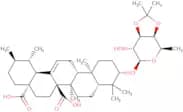
CAS:<p>Quinovic acid 3-O-(3',4'-O-isopropylidene)-b-D-fucopyranoside is a monocyclic aromatic hydrocarbon that belongs to the class of phthalic acids. It is a white or light yellow crystalline solid that has been used as an absorber for rubber, polyester, and other organic solvents. This compound has been shown to be carcinogenic in animal studies with leukemia cells in mice and rats. Quinovic acid 3-O-(3',4'-O-isopropylidene)-b-D-fucopyranoside also induces bone resorption in animals.</p>Pureza:Min. 95%1,3,4-Tri-O-benzoyl-2-deoxy-b-D-ribopyranose
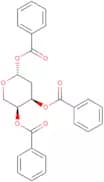
CAS:<p>1,3,4-Tri-O-benzoyl-2-deoxy-b-D-ribopyranose is a synthetic sugar that is used as a methylation substrate for the synthesis of polysaccharides. It is a white solid that can be dissolved in water and organic solvents. This product has been shown to have good reactivity with various polysaccharide templates, including glycosylation and glycosyltransferase.</p>Fórmula:C26H22O7Pureza:Min. 95%Peso molecular:446.45 g/mol1,2:5,6-Di-O-isopropylidene-3-O-tosyl-a-D-gulofuranose
CAS:<p>1,2:5,6-Di-O-isopropylidene-3-O-tosyl-a-D-gulofuranose is an oligosaccharide modification. The compound is a complex carbohydrate that can be synthesized with high purity and monosaccharide methylation. It can be used as a glycosylation or saccharide fluorination agent for the synthesis of polysaccharides. 1,2:5,6-Di-O-isopropylidene-3-O-tosyl-a-D-gulofuranose is also known by its CAS number 19131–06–7.</p>Fórmula:C19H26O8SPureza:Min. 95%Peso molecular:414.47 g/molAcetylsalicylic acid-acyl-β-D-glucuronide
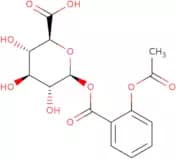
CAS:<p>Acetylsalicylic acid-acyl-b-D-glucuronide is a glycosylation product of acetylsalicylic acid. It is a complex carbohydrate that can be methylated, fluorinated, or modified by click chemistry. Acetylsalicylic acid-acyl-b-D-glucuronide has been shown to be an effective inhibitor of the MMPs metalloproteinases and collagenase in vitro. It also inhibits the growth of Staphylococcus aureus, Streptococcus agalactiae, and Group A Streptococcus. Acetylsalicylic acid-acyl-b-D-glucuronide can be synthesized using monosaccharides, oligosaccharides, or custom synthesis. This product is available in high purity (99%) and CAS No. 24719-72-0.</p>Fórmula:C15H16O10Pureza:Min. 95%Forma y color:White PowderPeso molecular:356.28 g/molMethyl 2-O-(methyl 4-O-methyl-α-D-glucopyranosyluronate)-β-D-xylopyranoside
CAS:<p>Methyl 2-O-(methyl 4-O-methyl-α-D-glucopyranosyluronate)-β-D-xylopyranoside is a methyl glycoside disaccharide</p>Fórmula:C14H24O11Pureza:Min. 95%Forma y color:PowderPeso molecular:368.33 g/molD-Mannose-6-phosphate barium salt hydrate
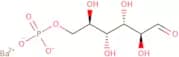
CAS:<p>D-Mannose-6-phosphate barium salt hydrate is a glycosylation agent, which can be used in the synthesis of complex carbohydrates and other saccharides. It is also a methylation agent and can be used to modify polysaccharides. D-Mannose-6-phosphate barium salt hydrate is fluorinated with trifluoromethanesulfonic acid to introduce Fluorination groups, which can then be modified with other reagents. The compound has been shown to have Click modification activity. D-Mannose-6-phosphate barium salt hydrate is a synthetic sugar that can be custom synthesized according to the customer’s requirements. This compound has CAS number 104872-94-8 and is available in high purity, which makes it suitable for use in pharmaceutical applications.</p>Fórmula:C6H11BaO9P·2H2OPureza:Min. 95%Forma y color:SolidPeso molecular:395.45 g/molSinapaldehyde glucoside
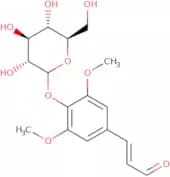
CAS:Sinapaldehyde glucoside is a phenolic compound found in the leaves of Sinapis alba. This compound has been shown to have antiviral and antibacterial properties. It has been shown to inhibit staphylococcal growth, with the most effective concentration being 0.5-2% w/v. The chemical structure of sinapaldehyde glucoside is similar to that of pomolic acid, which was also found to have anti-staphylococcal effects. Syringaresinol, a constituent of S. alba, may be responsible for the anti-staphylococcal activity due to its ability to inhibit bacterial protein synthesis. Sinapaldehyde glucoside can also be extracted from S. alba using ethanol or water as solvents and is soluble in both water and alcohols. Sinapaldehyde glucoside can also be extracted from eleutherococcus (Eleutherococcus senticosus) usingPureza:Min. 95%Mannose pentasulfate pentapotassium salt - technical grade
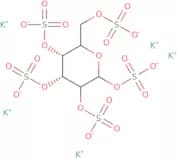
CAS:<p>Mannose pentasulfate pentapotassium salt - technical grade is a white crystalline powder that is soluble in water. This product is a synthetic, high purity, custom synthesis, and glycosylation reagent for the preparation of oligosaccharides and carbohydrates. The CAS number for this product is 359436-63-8.</p>Fórmula:C6H7K5O21S5Pureza:Min. 95%Peso molecular:770.93 g/molR,S-Equol 7-b-D-glucuronide sodium salt
CAS:<p>R,S-equol 7-b-D-glucuronide sodium salt is a Methylated, Custom synthesis, Click modification, CAS No. 38482-82-5, Oligosaccharide, Polysaccharide, saccharide, Carbohydrate with high purity and modifiction.</p>Fórmula:C21H21NaO9Pureza:Min. 95%Forma y color:PowderPeso molecular:440.38 g/molMethyl 1-C-[4-chloro-3-[[4-[[(3S)-tetrahydro-3-furanyl]oxy]phenyl]methyl]phenyl]-a-D-glucopyranoside
CAS:<p>Intermediate in the synthesis of empagliflozin</p>Fórmula:C24H29ClO8Pureza:Min. 95%Peso molecular:480.94 g/mol2-Aminophenyl β-D-glucuronide hydrochloride
CAS:<p>2-Aminophenyl b-D-glucuronide HCl is a custom synthesis chemical. It is a white to pale yellow crystalline powder. This compound has a molecular weight of 363.2 and it's chemical formula is C8H10N2O7Glucuronic acid. 2-Aminophenyl b-D-glucuronide HCl is used in the modification of oligosaccharides, polysaccharides, saccharides, carbohydrates, fluorination and complex carbohydrate. The purity of this chemical is high and it can be modified with monosaccharide or sugar.</p>Fórmula:C12H15NO7•HClPureza:Min. 95%Peso molecular:321.71 g/mol1,2,3-Tri-O-methyl-D-glucopyranoside
CAS:<p>1,2,3-Tri-O-methyl-D-glucopyranoside is a custom synthesis and modification of the natural product 1,2,3-tri-O-methyl-D-mannopyranoside. The compound was synthesized by fluorination of the 3' hydroxyl group followed by methylation of the 2', 3' hydroxyl groups to form a triol. This sugar was then glycosylated with D-glucose to produce an oligosaccharide. 1,2,3 - Tri -O - methyl - D - glucopyranoside is a natural product that can be found in plants such as barley and wheat. It has been shown to have antiinflammatory properties.</p>Fórmula:C9H18O6Pureza:Min. 95%Peso molecular:222.24 g/molN-Benzoyl-D-glucosamine
CAS:<p>Lectins are carbohydrate-binding proteins that can be classified into different types based on their specificities for glycan structures. One of the most common types is the N-acetyl-D-glucosamine (NAG) lectin, which binds to oligomers of NAG and related sugars. Lectins are used to activate cells and induce cell death. The dodecyl NAG lectin has been shown to bind to glucocerebrosides in a reductively irreversible manner and has been used as a model for such interactions. This lectin is also inexpensively produced from a synthetic benzylidene acetal, which can be made from commercially available materials. It has been shown that this lectin binds to polyacrylamide gels in an SDS-polyacrylamide gel electrophoresis, with a pH optimum at 7.0 and an amino acid composition that includes glutamic acid, glutamine, asparagine, ser</p>Fórmula:C13H17NO6Pureza:Min. 95%Forma y color:White PowderPeso molecular:283.28 g/molCorchoionoside C
CAS:<p>Corchoionoside C is a natural compound classified as an iridoid glycoside. This compound is isolated from various plant species, particularly those within the Boraginaceae family. The mode of action of Corchoionoside C involves modulation of biological pathways, likely through its interaction with cellular enzymes and receptors, contributing to its potential therapeutic effects.</p>Pureza:Min. 98%D-Arabinose-5-phosphate
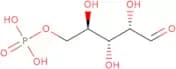
CAS:<p>D-Arabinose-5-phosphate is an intermediate in the pentose phosphate pathway. It is synthesized from D-xylulose-5-phosphate by xylitol dehydrogenase. D-Arabinose-5-phosphate inhibits the enzyme xylitol dehydrogenase, which converts xylulose to d-xylulose, and thus prevents the formation of 5-hydroxyisoxazole phosphate, a precursor to the synthesis of NADPH. In this way, it blocks the synthesis of NADPH, which is essential for aerobic metabolism. This inhibition leads to a decrease in ATP production and consequently cell death.</p>Fórmula:C5H11O8PPureza:Min. 95%Peso molecular:230.11 g/molD-Gluconic acid potassium salt
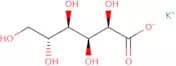
CAS:<p>D-Gluconic acid potassium salt is a glycol ether with biochemical properties that can be used to synthesize covalent linkages. It has been shown to have antimicrobial properties in wild-type strains of Escherichia coli and Salmonella typhimurium. D-Gluconic acid potassium salt has been shown to exhibit inhibitory effects on the synthesis of DNA, RNA, and protein, as well as enzyme activities. The matrix effect is an analytical method that measures the inhibition of bacterial growth in agar plates. Electrochemical impedance spectroscopy (EIS) is a technique that measures changes in electrical resistance when bacteria are placed on an electrode surface. This technique has been used to show that D-gluconic acid potassium salt exhibits inhibitory effects against group P2 enzymes, such as polymerase chain reaction (PCR), which is used for DNA replication and amplification.</p>Fórmula:C6H11KO7Pureza:Min. 95%Peso molecular:234.25 g/mol





![Methyl 1-C-[4-chloro-3-[[4-[[(3S)-tetrahydro-3-furanyl]oxy]phenyl]methyl]phenyl]-a-D-glucopyranosi…](/_next/image/?url=https%3A%2Fstatic.cymitquimica.com%2Fproducts%2F3D%2Fthumb-webp%2FMM137435.webp&w=3840&q=75)