Sustratos de enzimas
Los sustratos enzimáticos son moléculas sobre las cuales actúan las enzimas para catalizar reacciones químicas. El sustrato se une al sitio activo de la enzima, donde sufre una transformación específica para formar el producto de la reacción. Los sustratos enzimáticos son herramientas esenciales en la investigación para estudiar la cinética enzimática, la especificidad y el mecanismo de acción. También se utilizan en ensayos diagnósticos y estudios bioquímicos. En CymitQuimica, ofrecemos una selección diversa de sustratos enzimáticos de alta calidad para apoyar su investigación en enzimología y bioquímica.
Subcategorías de "Sustratos de enzimas"
Se han encontrado 1529 productos de "Sustratos de enzimas"
Ordenar por
Pureza (%)
0
100
|
0
|
50
|
90
|
95
|
100
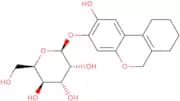
3,4-Cyclohexenoesculetin β-D-galactopyranoside
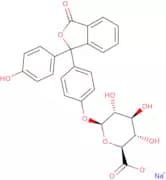
CAS:Chromogenic substrate for beta-galactosidaseFórmula:C19H22O9Pureza:Min. 95 Area-%Forma y color:PowderPeso molecular:394.37 g/molPhenolphthalein b-D-glucuronide sodium salt monohydrate
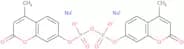
CAS:Monohydrate; beta-glucuronidase substrate; yellow/pink color Beta-glucuronidase activity can be measured in a colorimetric assay with phenolphthalein beta-D-glucuronide as substrate. Starting assay conditions can include 30 µg of enzyme-containing material, 0.6 mM phenolphthalein beta-D-glucuronide in 100 mM sodium phosphate buffer in a total volume of 100 µL and monitoring absorbance changes at 540 nm. Temperature incubation can be used to promote the enzymatic activity (Galindo, 2012).Fórmula:C26H23NaO11Pureza:Min. 95%Forma y color:Off-White PowderPeso molecular:534.45 g/mol4-Methylumbelliferyl pyrophosphate diester disodium salt
CAS:4-Methylumbelliferyl pyrophosphate diester disodium salt is a fluorogenic substrate for pyrophosphatases or diphosphatases. After enzymatic cleaveage, free 4-methylumbelliferone (also known as hymecromone) is released, exhibiting blue fluorescence upon excitation with UV light. The strongest fluorescence of 4-methylumbelliferone requires deprotonation of the hydroxyl group (thus requires alkaline pH), with a maximal fluorescence intensity obtained with excitation at 350 to 370 nm and emission at 440 to 470 nm. The use of 4-methylumbelliferyl pyrophosphate diester disodium saltas a substrate for measuring the pyrophosphatases or diphosphatases activity is used for monitoring and diagnosis of pyrophosphatase deficiency and bone metabolism disorder.Fórmula:C20H14Na2O11P2Pureza:Min. 95%Forma y color:White PowderPeso molecular:538.25 g/molAldol® 470 nonanoate, Biosynth Patent: EP 2427431 and US 8940909
CAS:Producto controladoAldol® 470 nonanoate is a chemiluminescent substrate that can be used as a ligand for the detection of C8/C9-esterases, lipases activity, to result in an orange/green color. Aldol® 470 nonanoate has been shown to be active with horseradish peroxidase in a number of different assay systems. The purity and quality of Aldol® 470 nonanoate has been tested with culture media, environmental testing, bioluminescence, staining, fluorogenic substrate, chromogenic substrate, enzyme substrate, food testing and conjugates.Fórmula:C32H35NO5Pureza:Min. 95%Forma y color:PowderPeso molecular:513.62 g/mol4-Methylumbelliferyl b-D-cellotetraoside
CAS:A fluorogenic MOSCERDAM® substrate targeting cellulasesFórmula:C34H48O23Pureza:Min. 95%Forma y color:PowderPeso molecular:824.73 g/mol6,8-Difluoro-4-methylumbelliferyl 2-acetamido-3-O-(b-D-galactopyranosyl)-a-D-galactopyranoside
<p>6,8-Difluoro-4-methylumbelliferyl 2-acetamido-3-O-(b-D-galactopyranosyl)-a-D-galactopyranoside is a chemiluminescent substrate that reacts with oxygen in the presence of luciferase to produce light. This product is an excellent replacement for luminol, especially in applications where aqueous solvents are not suitable. 6,8-Difluoro-4-methylumbelliferyl 2-acetamido-3-O-(b-D-galactopyranosyl)-a-D-galactopyranoside has been extensively tested and shown to be nonhazardous in a variety of different culture media. It is also nonhazardous to the environment, as it can be easily degraded by microorganisms.</p>Pureza:Min. 95%Aldol® 470 β-D-galactopyranoside, Biosynth Patent: EP 2427431 and US 8940909
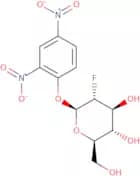
CAS:Aldol® 470 beta-D-galactopyranoside is a chromogenic and fluorogenic enzyme substrate used for detection of beta-galactosidase activity. The colorless enzyme substrate is cleaved by lactose-utilizing bacteria grown in liquid or solid media, yielding yellow coloration and green fluorescence. Aldol® 470 beta-D-galactopyranoside can also be used in beta-galactosidase gene reporter assays or immunoassay applications (ELISA). Aldol® 470 beta-D-galactopyranoside can be used under aerobic and anaerobic conditions.Fórmula:C29H29NO9Pureza:Min. 95 Area-%Forma y color:PowderPeso molecular:535.54 g/mol2,4-Dinitrophenyl 2-deoxy-2-fluoro-b-D-glucopyranoside
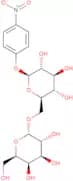
CAS:2,4-Dinitrophenyl 2-deoxy-2-fluoro-β-D-glucopyranoside, sometimes referred as 2F-DNPG, is an enzyme substrate for measuring beta-glucosidase activity. It is a mechanism-based inactivator of glycosidases, including beta-glucocerebrosidase (Gcase), a lysosomal enzyme encoded by the GBA1 gene responsible for breaking down glucosylceramide into ceramide and glucose. The use of 2,4-dinitrophenyl 2-deoxy-2-fluoro-β-D-glucopyranoside as an enzyme substrate permits the study of the catalytic mechanism and reaction intermediate of these enzymes.Fórmula:C12H13FN2O9Pureza:Min. 98 Area-%Forma y color:PowderPeso molecular:348.24 g/mol4-Nitrophenyl 6-O-(a-D-glucopyranosyl)-b-D-glucopyranoside
CAS:4-Nitrophenyl 6-O-(alpha-D-glucopyranosyl)-beta-D-glucopyranoside is a chromogenic substrate for beta-glucosidase. Upon hydrolysis, para-nitrophenol is released yielding a yellowish colour. 4-Nitrophenyl 6-O-(alpha-D-glucopyranosyl)-beta-D-glucopyranoside is used in different applications such as the Cellulose metabolism research, biofuel productionPureza:Min. 95%Forma y color:PowderPeso molecular:463.39 g/mol4-Methylumbelliferyl β-D-lactoside
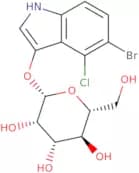
CAS:Fluorogenic substrate for beta-galactosidaseFórmula:C22H28O13Pureza:Min. 98 Area-%Forma y color:White PowderPeso molecular:500.45 g/mol5-Bromo-4-chloro-3-indolyl b-D-mannopyranoside
CAS:5-Bromo-4-Chloro-3-Indolyl b-D-Mannopyranoside, also known as X-Man, is an enzyme substrate commonly used for detecting mannosidase enzymes. Upon hydrolysis by the enzyme, it produces a blue-green colored compound that can be detected visually or measured spectrophotometrically. This substrate is useful in characterizing the activity of mannosidases involved in glycoprotein processing and quality control.Fórmula:C14H15BrClNO6Forma y color:White Off-White PowderPeso molecular:408.63 g/mol4-Methylumbelliferyl 2-acetamido-2-deoxy-b-D-galactopyranoside-4-sulfate sodium salt
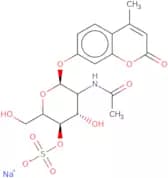
4-Methylumbelliferyl 2-acetamido-2-deoxy-beta-D-galactopyranoside-4-sulfate sodium salt is a fluorogenic substrate for N-acetylgalactosamine-4-sulfatase. After enzymatic cleaveage, free 4-methylumbelliferone (also known as hymecromone) is released, exhibiting blue fluorescence upon excitation with UV light. The strongest fluorescence of 4-methylumbelliferone requires deprotonation of the hydroxyl group (thus requires alkaline pH), with a maximal fluorescence intensity obtained with excitation at 350 to 370 nm and emission at 440 to 470 nm. The use of 4-methylumbelliferyl 2-acetamido-2-deoxy-beta-D-galactopyranoside-4-sulfate sodium saltas a substrate for measuring the N-acetylgalactosamine-4-sulfatase activity is used for diagnosis of Mucopolysaccharidosis VI (MPS VI) (a rare lysosomal storage disorder) and Maroteaux-Lamy syndrome screening.Pureza:Min. 95%Forma y color:White PowderPeso molecular:481.41 g/mol5-Bromo-3-indolyl phosphate disodium salt
CAS:<p>5-Bromo-3-indolyl phosphate disodium salt is a chemiluminescent substrate that is used for the detection of bacterial activity. It reacts with oxygen to produce light, which can be measured using a luminometer. It is also used as a chromogenic substrate for detection of bacterial activity in culture media. The enzyme reaction produces an intense blue fluorescence and is used for diagnostic purposes in food testing and medical diagnostics. 5-Bromo-3-indolyl phosphate disodium salt has been shown to be effective against many bacteria and fungi, including Staphylococcus aureus, Streptococcus pyogenes, Escherichia coli, Pseudomonas aeruginosa, Candida albicans and Aspergillus niger. This product is chemically stable at room temperature but should be stored at 4°C or below.</p>Fórmula:C8H5BrNO4PNa2Pureza:Min. 95%Forma y color:PowderPeso molecular:335.99 g/mol4-Methylumbelliferyl-β-D-GlcNAc-6-phosphocholine
4-Methylumbelliferyl-beta-D-GlcNAc-6-phosphocholine is a fluorogenic substrate for phosphodiesterase. After enzymatic cleaveage, free 4-methylumbelliferone (also known as hymecromone) is released, exhibiting blue fluorescence upon excitation with UV light. The strongest fluorescence of 4-methylumbelliferone requires deprotonation of the hydroxyl group (thus requires alkaline pH), with a maximal fluorescence intensity obtained with excitation at 350 to 370 nm and emission at 440 to 470 nm. The use of 4-methylumbelliferyl-beta-D-GlcNAc-6-phosphocholineas a substrate for measuring the phosphodiesterase activity is used for Niemann-Pick disease diagnostic assays. It is also used for sphingomyelin metabolism disorder screening.Pureza:Min. 95%Peso molecular:544.49 g/molFluorescein mono-b-D-galactopyranoside
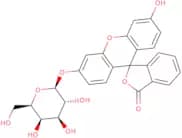
CAS:Fluorescein mono-b-D-galactopyranoside or FMG is a fluorogenic substrate for beta-galactosidase. The fluorophore fluorescein is released after enzymatic cleavage, exhibiting a greenish fluorescent. This substrate is particularly valuable in gene expression studies (e.g., lacZ reporter assays) and as a probe for cell-based assays for real-time monitoring.Pureza:Min. 95%Forma y color:PowderPeso molecular:494.45 g/molIsopropyl-β-D-thiogalactopyranoside, approx. 15.0% dioxane
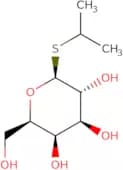
CAS:A non-metabolizable allolactose analogue, widely used in molecular biology for overexpression of recombinant proteins from inducible systems under the control of lac promoter. IPTG binds to the LacI repressor and causes its release from the lac operator, allowing gene expression to take place. Present in vectors of pGEX, pGEM-T, pET, pRSET, pMAL class and others.Fórmula:C9H18O5SPureza:Min. 95%Forma y color:PowderPeso molecular:238.30 g/mol4-Nitrophenyl 2-O-(β-D-glucopyranosyl)-β-D-glucopyranoside
CAS:4-Nitrophenyl 2-O-(beta-D-glucopyranosyl)-beta-D-glucopyranoside is a chromogenic substrate for beta-glucosidase. Upon hydrolysis, para-nitrophenol is released yielding a yellowish colour. 4-Nitrophenyl 2-O-(beta-D-glucopyranosyl)-beta-D-glucopyranoside is used in different applications such as the Cellulose degradation studies, biofuel researchFórmula:C18H25NO13Pureza:Min. 95%Forma y color:White solid.Peso molecular:463.39 g/mol4-Methylumbelliferyl a-D-mannopyranoside 6-sulfate sodium salt
<p>4-Methylumbelliferyl alpha-D-mannopyranoside 6-sulfate sodium salt is a fluorogenic substrate for sulfatase. After enzymatic cleaveage, free 4-methylumbelliferone (also known as hymecromone) is released, exhibiting blue fluorescence upon excitation with UV light. The strongest fluorescence of 4-methylumbelliferone requires deprotonation of the hydroxyl group (thus requires alkaline pH), with a maximal fluorescence intensity obtained with excitation at 350 to 370 nm and emission at 440 to 470 nm. The use of 4-methylumbelliferyl alpha-D-mannopyranoside 6-sulfate sodium saltas a substrate for measuring the sulfatase activity is used for Mucopolysaccharidosis (MPS) screening and other lysosomal storage disorder diagnosis.</p>Fórmula:C16H17O11SNaPureza:Min. 98 Area-%Forma y color:White PowderPeso molecular:440.36 g/molResorufin b-D-glucuronide sodium salt
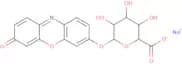
CAS:Resorufin b-D-glucuronide sodium salt is used as a fluorogenic substrate for beta-glucuronidase (GUS) to study drug metabolism.Pureza:Min. 95%Forma y color:Brown Orange Red PowderPeso molecular:411.29 g/mol4-Nitrophenyl 4,6-benzylidene-α-D-glucopyranoside
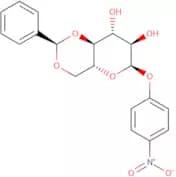
CAS:4-Nitrophenyl 4,6-benzylidene-alpha-D-glucopyranoside is a chromogenic substrate for alpha-glucosidase. Upon hydrolysis, para-nitrophenol is released yielding a yellowish colour. 4-Nitrophenyl 4,6-benzylidene-alpha-D-glucopyranoside is used in different applications such as the Pompe disease diagnosis, glycogen metabolism researchFórmula:C19H19NO8Pureza:Min. 95%Forma y color:PowderPeso molecular:389.36 g/mol