Sustratos de enzimas
Los sustratos enzimáticos son moléculas sobre las cuales actúan las enzimas para catalizar reacciones químicas. El sustrato se une al sitio activo de la enzima, donde sufre una transformación específica para formar el producto de la reacción. Los sustratos enzimáticos son herramientas esenciales en la investigación para estudiar la cinética enzimática, la especificidad y el mecanismo de acción. También se utilizan en ensayos diagnósticos y estudios bioquímicos. En CymitQuimica, ofrecemos una selección diversa de sustratos enzimáticos de alta calidad para apoyar su investigación en enzimología y bioquímica.
Subcategorías de "Sustratos de enzimas"
Se han encontrado 1529 productos de "Sustratos de enzimas"
Ordenar por
Pureza (%)
0
100
|
0
|
50
|
90
|
95
|
100
Salmon-pal
CAS:6-Chloro-1H-indol-3-yl hexadecanoate is a chromogenic substrate for an enzyme that oxidizes it to produce a blue color. It can be used in the diagnosis of bacterial infections, such as tuberculosis and leprosy. 6CHIH is a ligand for various enzymes, including lactate dehydrogenase, which catalyzes the conversion of pyruvate to lactic acid. This compound reacts with oxygen to produce light in the presence of a catalyst. 6CHIH is also used as a fluorescent tag for protein labeling and detection. 6CHIH has been shown to be effective in detecting bacteria in food products and water samples using bioluminescence techniques. The high purity and quality of this compound make it suitable for use in diagnostics, culture media, and environmental testing.Pureza:Min. 95%Peso molecular:406 g/molAc-Abu-Tle-Leu-Gln-AMC TFA salt
<p>A fluorogenic substrate for detection of enzymatic activity of the SARS-CoV-2 Mpro protease. The fluorophore 7-Amino-4-methylcoumarin (AMC) is linked to the tetrapeptide via a peptide bond at the C-terminal of the glutamine residue. Following the hydrolytic activity of the Mpro protease, the fluorogenic AMC group get released from the substrate, generating a fluorescent signal (Ex 380 nm / Em 455 nm).</p>Fórmula:C33H48N6O8(freebase)Pureza:Min. 95.0 Area-%Peso molecular:656.77 g/mol1-Naphthyl β-D-mannopyranoside
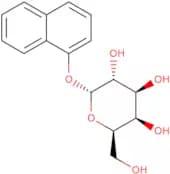
CAS:1-Naphthyl β-D-mannopyranoside is a chromogenic (also fluorogenic) substrate. After cleavage, 1-naphthol is released and is used to quantify beta-mannosidase activity.Fórmula:C16H18O6Pureza:Min. 95%Forma y color:PowderPeso molecular:306.31 g/mol4-Methylumbelliferyl 2-deoxy-2-sulfamino-b-D-glucopyranoside sodium salt
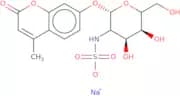
4-Methylumbelliferyl 2-deoxy-2-sulfamino-beta-D-glucopyranoside sodium salt is a fluorogenic substrate for N-sulfoglucosamine sulfohydrolase. After enzymatic cleaveage, free 4-methylumbelliferone (also known as hymecromone) is released, exhibiting blue fluorescence upon excitation with UV light. The strongest fluorescence of 4-methylumbelliferone requires deprotonation of the hydroxyl group (thus requires alkaline pH), with a maximal fluorescence intensity obtained with excitation at 350 to 370 nm and emission at 440 to 470 nm. The use of 4-methylumbelliferyl 2-deoxy-2-sulfamino-beta-D-glucopyranoside sodium saltas a substrate for measuring the N-sulfoglucosamine sulfohydrolase activity is used for screening of Mucopolysaccharidosis IIIA (MPS IIIA) and diagnosis of Sanfilippo A syndrome.Fórmula:C16H19NO10SNaPureza:Min. 95%Forma y color:PowderPeso molecular:439.37 g/mol1-Naphthyl a-D-galactopyranoside
CAS:<p>1-Naphthyl a-D-galactopyranoside is a chromogenic substrate use to detect alpha-galactosidase activity.</p>Fórmula:C16H18O6Pureza:Min. 95%Forma y color:PowderPeso molecular:306.31 g/mol4-Methylumbelliferyl-α-L-fucopyranoside
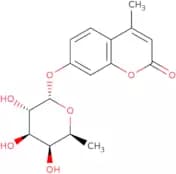
CAS:<p>Fluorogenic substrate for α-L-Fucosidase yielding a blue fluorescent solution upon cleavage.</p>Fórmula:C16H18O7Peso molecular:322.32 g/molβ-Alanine 7-amido-4-methylcoumarin trifluoroacetate
CAS:<p>Beta-Alanine 7-amido-4-methylcoumarin trifluoroacetate is a fluorogenic substrate for aminopeptidase yielding a blue fluorescent solution.</p>Fórmula:C13H14N2O3•C2HF3O2Pureza:Min. 95%Forma y color:PowderPeso molecular:360.29 g/molNaphthol AS-BI β-L-fucopyranoside
CAS:Substrate for the detection of beta-D-fucosidaseFórmula:C24H24BrNO7Pureza:Min. 95%Peso molecular:518.35 g/mol2-Chloro-4-nitrophenyl β-D-maltotrioside
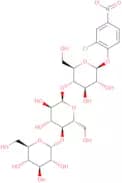
CAS:2-Chloro-4-nitrophenyl beta-D-maltotrioside, often abbreviated as CNP-G3, is a chromogenic substrate to detect and mesaure alpha-amylase activity. Evaluation and monitoring of alpha-amylase activity is important to help diagnose certain diseases such as pancreatitis.Fórmula:C24H34ClNO18Pureza:Min. 95%Forma y color:PowderPeso molecular:659.98 g/mol2-Nitrophenyl b-D-arabinopyranoside
<p>2-Nitrophenyl b-D-arabinopyranoside is a chemical compound that is used in the detection of ATP by chemiluminescence. It acts as a substrate for enzymes such as luciferase and catalase, which catalyze the oxidation of 2-nitrophenyl b-D-arabinopyranoside to phenol and carbon dioxide with the release of light. This reaction can be used in diagnostic applications such as detecting bacteria in culture media or diagnosing food spoilage. 2-Nitrophenyl b-D-arabinopyranoside can also be used as a conjugate to detect proteins or nucleic acids by fluorescence spectroscopy. The CAS number for this compound is 107772-06-1.</p>Pureza:Min. 95%Peso molecular:271.22 g/molLuciferin-β-D-galactoside
CAS:Luciferin-beta-D-galactoside is an acceptor in immunoassays. It is used as a label for specific antibodies and antigens, and the light emitted by this compound can be measured with a luminometer. Luciferin-beta-D-galactoside binds to the bacterial enzyme β-galactosidase, which catalyzes the hydrolysis of lactose to form glucose and galactose. Mammalian cells have been used as a source of β-galactosidase in order to measure luciferin-beta-D-galactoside activity. The substrate specificity of this enzyme has also been studied using mammalian tissue extracts.Fórmula:C17H18N2O8S2Pureza:Min. 95 Area-%Peso molecular:442.46 g/molRef: 3D-L-8121
5mgA consultar10mgA consultar25mgA consultar50mgA consultar100mgA consultar-Unit-ggA consultarAldol® 470 acetate, Biosynth Patent: EP 2427431 and US 8940909
CAS:Producto controlado<p>Aldol® 470 acetate is a Fluorogenic substrate that is used in enzymatic reactions to produce a fluorescent product. Aldol® 470 acetate can be used as a ligand or a chromogenic substrate. This product is also used in diagnostic tests, such as conjugates and chemiluminescence, to detect the presence of certain enzymes or microorganisms. It can be used in culture media to measure the amount of certain enzymes, such as phosphatases or proteases, and has been shown to have high purity and quality. This product has CAS No. 1318785-37-3, 1318785-38-4, 1318785-39-5, 1318785-40-6 and 1318785-41-7.</p>Fórmula:C25H21NO5Pureza:Min. 95%Forma y color:PowderPeso molecular:415.44 g/molAldol® 484 alpha-D-glucopyranoside, Biosynth Patent: EP 2427431 and US 8940909
CAS:<p>Aldol® 484 alpha-D-glucopyranoside is a chromogenic and fluorogenic enzyme substrate for alpha-glucosidase activity (EC 3.2.1.20, alpha-1,4-glucosidase, also known as maltase). The colorless enzyme substrate is cleaved by bacteria producing this enzyme in liquid or solid media, yielding orange color. Green fluorescence is also generated if a suitable matrix is present such as: cellulose acetate filters, polypropylene tubes or microplates and polyethylene vials. Aldol® 484 alpha-D-glucopyranoside can be used under aerobic and anaerobic conditions.</p>Fórmula:C26H24ClFN2O7Pureza:Min. 95%Forma y color:PowderPeso molecular:530.93 g/molN,N,N',N'-Tetramethyl-p-phenylenediamine dihydrochloride
CAS:Reducing co-substrate for heme peroxidases; test reagent in microbiologyFórmula:C10H16N2·2HClPureza:Min. 95%Forma y color:White PowderPeso molecular:237.17 g/mol4-Nitrophenyl-α-D-galactopyranoside
CAS:Chromogenic substrate yielding a soluble chromophore for the colorimetric assay of α-D-galactosidase upon cleavage. Used for the detection of hydrolases in tissues and membranes.Fórmula:C12H15NO8Pureza:Min. 99.0 Area-%Peso molecular:301.26 g/mol(+)-Biotin 4-amidobenzoic acid sodium salt
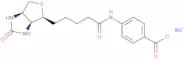
CAS:<p>(+)-Biotin 4-amidobenzoic acid sodium salt, often referred as (+)-biotin PABA, is a fluorogenic substrate used to measure biotinidase activity, especially in newborn screening programs.</p>Fórmula:C17H20N3NaO4SPureza:Min. 95%Forma y color:White Slightly Yellow PowderPeso molecular:385.41 g/molGlycyl-glycine 7-amido-4-methylcoumarin hydrochloride
CAS:Glycyl-glycine 7-amido-4-methylcoumarin hydrochloride (Gly-Gly-AMC) is a fluorescent compound that can be used as a probe for the transfer of glycine in the brain. Gly-Gly-AMC binds to Langerhans cells and is transferred by an anterograde axonal transport mechanism from the peripheral nervous system to the central nervous system. The binding of Gly-Gly-AMC to Langerhans cells has been shown to activate them, which induces the release of inflammatory mediators into the surrounding tissue. This activity may be due to increased levels of calcium ions, which are known to induce exocytosis in these cells. Glycine is also involved in depression and other mental disorders, as well as muscle and brain activity.Fórmula:C14H16ClN3O4Peso molecular:325.75 g/molRef: 3D-G-6100
1gA consultar5gA consultar10gA consultar500mgA consultar2500mgA consultar-Unit-ggA consultar2-Naphthyl b-D-glucopyranoside monohydrate
CAS:<p>2-Naphthyl-lpha-D-glucopyranoside is a substrate for α-glucosidase. 2-Naphthol is released upon hydrolyzation. By simultaneous coupling with a suitable staining reagent, such as hexazonium p-rosaniline, the corresponding reddish-brown azo-dye is formed. Naphthols can also be detected by fluorescence analysis.</p>Pureza:Min. 95%Forma y color:PowderPeso molecular:324.33 g/molNucleic Acid Dye Green I, 10,000X in DMSO
CAS:Green I is a nucleic acid dye that has been shown to have antioxidative properties. It inhibits protein synthesis in mammalian cells by binding to the DNA and blocking transcription. Green I has also been shown to inhibit the growth of tumor cells and to cause cell death by oxidative damage. Green I is not genotoxic, but it can cause false positive results in genotoxicity tests. Green I has also been shown to be a potential biomarker for renal cell cancer, as well as a prognostic marker for this cancer. This dye enhances polymerase chain reaction (PCR) and is used in biological research because of its ability to bind with proteins and form complexes with DNA.Fórmula:C32H37N4SPeso molecular:509.27 g/molLuc-coliforms Na
CAS:Luc-coliforms Na is a high quality, chromogenic substrate for the detection of coliforms. It is used widely in the food industry to detect whether coliforms are present in milk, cheese, and other dairy products. Luc-coliforms Na provides a color change from yellow to blue when it reacts with coliforms and has a high pH range of 4.0-8.0. Luc-coliforms Na has a CAS number of 93824-43-4.Pureza:Min. 95%