Sustratos de enzimas
Los sustratos enzimáticos son moléculas sobre las cuales actúan las enzimas para catalizar reacciones químicas. El sustrato se une al sitio activo de la enzima, donde sufre una transformación específica para formar el producto de la reacción. Los sustratos enzimáticos son herramientas esenciales en la investigación para estudiar la cinética enzimática, la especificidad y el mecanismo de acción. También se utilizan en ensayos diagnósticos y estudios bioquímicos. En CymitQuimica, ofrecemos una selección diversa de sustratos enzimáticos de alta calidad para apoyar su investigación en enzimología y bioquímica.
Subcategorías de "Sustratos de enzimas"
Se han encontrado 1529 productos de "Sustratos de enzimas"
Ordenar por
Pureza (%)
0
100
|
0
|
50
|
90
|
95
|
100
7-((4'-L-Alaninamido)-rac-3'-hydroxybutyloxy) coumarin hydrochloride
This Clips-O substrate 7-((4'-L-Alaninamido)-rac-3'-hydroxybutyloxy) coumarin allows the detection of single and dual enzymatic activity (L-alanine aminopetidase and oxidation of 4-amino-3-hydroxybutyloxy spacer either enzymatically or by exposure to sodium periodate) with a single substrate resulting in a fluorescent signal. The main virtues of Clips-O substrates are an increased stability towards non-enzymatic hydrolysis that results in a reduced background and high sensitivity.Fórmula:C16H21ClN2O5Peso molecular:356.8 g/mol5-Bromo-6-chloro-3-indoxyl-β-D-glucopyranoside
CAS:Chromogenic substrate for β-D-glucosidase yielding a magenta precipitate. Differentiation of Salmonella spp. (negative) from other Enterobacteriaceae.Fórmula:C14H15BrClNO6Pureza:Min. 99 Area-%Peso molecular:408.64 g/mol3-Indoxyl phosphate disodium salt
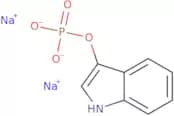
CAS:Producto controlado<p>Histochemical substrate for alkaline phosphatase; Dark-blue color</p>Pureza:Min. 98 Area-%Forma y color:PowderPeso molecular:257.09 g/mol4-Methylumbelliferyl-α-L-arabinofuranoside
CAS:4-Methylumbelliferyl-alpha-L-arabinofuranoside is a nucleic acid molecule that has an average diameter of 10 nm. It is used as a tracer in electron microscopy to detect the presence of nucleic acid molecules in cells. This compound is also used to study the interactions between DNA and RNA molecules by labeling the DNA strand with 4-methylumbelliferyl-alpha-L-arabinofuranoside, which contains an alpha-(2,4,6) arabinofuranosyl group. The recombinant expression of this compound can be carried out in corynebacterium glutamicum, and it has a bulk density that ranges from 1.7 to 2.1 g/cm3 and an average particle diameter ranging from 0.5 to 1 micron. It is not soluble in water or alcohol but is soluble in acetone or chloroform.Fórmula:C15H16O7Pureza:Min. 98 Area-%Peso molecular:308.29 g/molRef: 3D-M-5509
1gA consultar100mgA consultar250mgA consultar500mgA consultar2500mgA consultar-Unit-ggA consultar5-Bromo-3-indoxyl-β-D-galactopyranoside
CAS:Chromogenic substrate for beta-D-galactosidase yielding a lapis colored precipitate. 5-Bromo-3-indoxyl-beta-D-galactopyranoside can be used in conjunction with isopropyl-beta-D-thiogalactopyranoside as an alternative to 5-bromo-4-chloro-3-indolyl-beta-D-galactopyranoside (X-gal), producing a darker blue color for detection of beta-galactosidase activity in bacterial colonies in a colorimetric assay to detect recombinants (white) from non-recombinants (blue). 5-Bromo-3-indoxyl-beta-D-galactopyranoside is also used in histochemistry to demonstrate beta-galactosidase activity in tissues.Fórmula:C14H16BrNO6Pureza:Min. 99.0 Area-%Peso molecular:374.20 g/molIsopropyl-β-D-thiogalactopyranoside, approx. 15.0% dioxane
CAS:A non-metabolizable allolactose analogue, widely used in molecular biology for overexpression of recombinant proteins from inducible systems under the control of lac promoter. IPTG binds to the LacI repressor and causes its release from the lac operator, allowing gene expression to take place. Present in vectors of pGEX, pGEM-T, pET, pRSET, pMAL class and others.Fórmula:C9H18O5SPeso molecular:238.30 g/molRef: 3D-I-8050
1kgA consultar100gA consultar250gA consultar500gA consultar2500gA consultar-Unit-ggA consultarChlorophenol red-b-D-galactopyranoside sodium salt
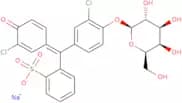
CAS:Chlorophenol red-b-D-galactopyranoside sodium salt is the salt from of CPRG (chlorophenol red-b-D-galactopyranoside), that has a higher solubility. It is a chromogenic substrate for beta-galactosidases that, after enzymatic cleavage, releases chlorophenol red, a dark red compound quantified by absorbance at 570 nm.Fórmula:C25H21Cl2O10SNaPureza:Min. 96 Area-%Forma y color:PowderPeso molecular:607.4 g/mol4-Nitrophenyl-N-acetyl-β-D-glucosaminide
CAS:Chromogenic β-glucosaminidase substrate yielding a yellow solution upon cleavage, used particularly in yeasts and molds.Fórmula:C14H18N2O8Pureza:Min. 99.0 Area-%Peso molecular:342.31 g/molD-Luciferin 1-(4,5-dimethoxy-2-nitrophenyl)ethyl ester
CAS:DMNPE-caged Luciferin is a photoactivatable probe that can easily penetrate the cell membrane, and by exposure to UV light it undergoes a photochemical decomposition liberating a Luciferin molecule. Once exposed to Luciferase enzyme expressed by the cells, Luciferin emits visible (and measurable) light. Using_x000D_this technique, imaging of luciferase activity was performed both in living cells and in mouse tumor xenograft, by intraperitoneal injection of the caged DMNPE luciferin (Chem. Commun., 2009, 0, 4028-4030).Fórmula:C21H19N3O7S2Pureza:Min. 98 Area-%Peso molecular:489.53 g/mol4-Nitrophenyl-N-acetyl-β-D-galactosaminide
CAS:4-Nitrophenyl-N-acetyl-beta-D-galactosaminide is a synthetic substrate that is used in enzyme kinetics. It is a beta-galactosidase substrate that reacts with the enzyme to form a product. The rate of reaction can be measured by following the change in absorbance over time. This product will react with an acceptor, such as chondroitin sulfate, to produce an observable reaction product. 4NPBGA has been shown to be an effective carbon source for plant physiology studies and has been shown to have optimal activity at pH 6.5.Fórmula:C14H18N2O8Pureza:Min. 98 Area-%Peso molecular:342.31 g/mol5-Nitro-3-indoxyl-β-D-galactopyranoside
<p>Please enquire for more information about 5-Nitro-3-indoxyl-β-D-galactopyranoside including the price, delivery time and more detailed product information at the technical inquiry form on this page</p>Fórmula:C14H16N2O8Pureza:Min. 95%Peso molecular:340.29 g/molAldol® 515 L-pyroglutamic acid amide, Biosynth Patent: EP 2427431 and US 8940909
<p>A chromogenic and fluorogenic substrate, used for detection of esterase activity.</p>Fórmula:C28H26N4O3Pureza:Min. 95.0 Area-%Peso molecular:466.54 g/molAquaSpark® alpha-D-galactoside, lyophilized, Patent WO 2017/130191
<p>Chemiluminescence beta-galactosidase substrate</p>Fórmula:C34H39ClO12Pureza:Min. 90 Area-%Peso molecular:675.12 g/mol5-Bromo-4-chloro-3-indoxyl-alpha-L-fucopyranoside
CAS:<p>Chromogenic substrate for α-D-Fucosidase yielding a blue precipitate.</p>Fórmula:C14H15BrClNO5Pureza:Min. 98.0 Area-%Peso molecular:392.64 g/mol4-Methylumbelliferyl-α-L-arabinopyranoside
CAS:Fluorogenic substrate for α-L-arabinosidase yielding a blue fluorescent solution upon cleavage.Fórmula:C15H16O7Pureza:Min. 98.0 Area-%Peso molecular:308.29 g/mol4-Nitrophenyl-α-D-mannopyranoside
CAS:Chromogenic α-mannosidase substrate yielding a absorbent solution upon cleavage. Also used for studies of the crystal structure of the complexes of concanavalin A and binding studies with concanavalin A.Fórmula:C12H15NO8Pureza:Min. 99 Area-%Peso molecular:301.26 g/mol6-Fluoro-3-indoxyl-β-D-galactopyranoside
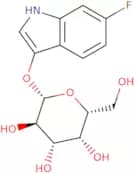
CAS:6-Fluoro-3-indoxyl-beta-D-galactopyranoside is a fluorescent chromogenic substrate that is commonly used for the detection and quantification of beta-galactosidase activity. When this substrate is hydrolyzed by beta-galactosidase, it produces a fluorescent blue product that can be easily detected and measured using a fluorometer or spectrophotometer. This substrate is often used in microbiology and molecular biology research to study gene expression and enzyme kinetics, and is also used in medical diagnostics as a marker for specific diseases and conditions.Fórmula:C14H16FNO6Pureza:Min. 98.0 Area-%Peso molecular:313.29 g/mol3-Indoxyl phosphate, p-toluidine salt
CAS:Producto controlado<p>3-Indoxyl phosphate, p-toluidine salt is a fluorogenic substrate that can be used for the detection of β-galactosidase. 3-Indoxyl phosphate, p-toluidine salt is a highly active chromogenic substrate that can be used as a diagnostic tool in the food industry to determine whether or not milk has been adulterated with animal milk. This product is also used in environmental testing to detect bacteria and fungi. 3-Indoxyl phosphate, p-toluidine salt is a high purity, high quality conjugate that can be used for the detection of β-galactosidase.</p>Fórmula:C8H8NO4P·C7H9NPureza:Min. 98 Area-%Peso molecular:320.28 g/molAldol® 470 choline phosphate, Biosynth Patent: EP 2427431 and US 8940909
CAS:Aldol® 470 choline phosphate is a chromogenic and fluorogenic enzyme substrate used for detection of phosphatidyl-choline specific phospholipase C (PC-PLC, EC 3.1.4.3) activity. The colorless product is cleaved by PC-PLC positive microorganisms in liquid or solid media, yielding a yellow color and green fluorescence. Aldol® 470 choline phosphate therefore, enables the detection and identification of PC-PLC positive pathogenic bacteria, such as, Clostridium perfringens, Pseudomonas aeruginosa, Helicobacter pylori, Legionella pneumophila, Bacillus cereus, Bacillus anthracis, Listeria monocytogenes, and others. Aldol® 470 choline phosphate can be used under aerobic and anaerobic conditions.Fórmula:C28H31N2O7PPureza:Min. 95 Area-%Peso molecular:538.53 g/mol4-Nitrophenyl-α-L-arabinofuranoside
CAS:Chromogenic substrate for α-L-arabinofuranosidase yielding a yellow solution upon cleavage.Fórmula:C11H13NO7Pureza:Min. 99.0 Area-%Peso molecular:271.22 g/mol