Sustratos de enzimas
Los sustratos enzimáticos son moléculas sobre las cuales actúan las enzimas para catalizar reacciones químicas. El sustrato se une al sitio activo de la enzima, donde sufre una transformación específica para formar el producto de la reacción. Los sustratos enzimáticos son herramientas esenciales en la investigación para estudiar la cinética enzimática, la especificidad y el mecanismo de acción. También se utilizan en ensayos diagnósticos y estudios bioquímicos. En CymitQuimica, ofrecemos una selección diversa de sustratos enzimáticos de alta calidad para apoyar su investigación en enzimología y bioquímica.
Subcategorías de "Sustratos de enzimas"
Se han encontrado 1529 productos de "Sustratos de enzimas"
Ordenar por
Pureza (%)
0
100
|
0
|
50
|
90
|
95
|
100
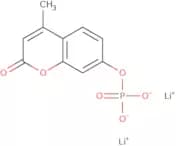
4-Methylumbelliferyl phosphate dilithium
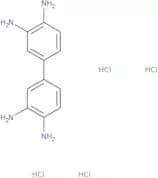
CAS:<p>4-Methylumbelliferyl phosphate dilithium is a fluorogenic substrate for alkaline phosphatase. After enzymatic cleaveage, free 4-methylumbelliferone (also known as hymecromone) is released, exhibiting blue fluorescence upon excitation with UV light. The strongest fluorescence of 4-methylumbelliferone requires deprotonation of the hydroxyl group (thus requires alkaline pH), with a maximal fluorescence intensity obtained with excitation at 350 to 370 nm and emission at 440 to 470 nm. The use of 4-methylumbelliferyl phosphate dilithiumas a substrate for measuring the alkaline phosphatase activity is used for bone metabolism disorder studies and hypophosphatasia diagnosis.</p>Fórmula:C10H7O6P•Li2Pureza:Min. 95%Forma y color:PowderPeso molecular:268.01 g/mol3,3'-Diaminobenzidine tetrahydrochloride
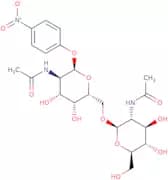
CAS:<p>3,3'-Diaminobenzidine tetrahydrochloride or DAB hydrochloride is the hydrochloride salt of biphenyl tetra-aniline. DAB hydrochloride is a water-soluble formulation of DAB and is used in immunohistochemical staining of nucleic acids and proteins. DAB hydrochloride is used in Alzheimer's disease research, Aβ protein amyloid plaques are targeted by a primary antibody, and subsequently by a secondary antibody, which is conjugated with a peroxidase enzyme. This will bind DAB as a substrate and oxidize causing a colour change. 3,3’-Diaminobenzidine tetrahydrochloride is also available as the tetrahydrochloride hydrate and as the free base.</p>Fórmula:C12H14N4•4HClPureza:Min. 95%Forma y color:Off-White PowderPeso molecular:360.12 g/mol4-Nitrophenyl 2-acetamido-6-O-(2-acetamido-2-deoxy-b-D-glucopyranosyl)-2-deoxy-a-D-galactopyranoside
CAS:<p>4-Nitrophenyl 2-acetamido-6-O-(2-acetamido-2-deoxy-b-D-glucopyranosyl)-2-deoxy-a-D-galactopyranoside is a chromogenic pNP glycoside substrate designed for the detection and assay of specific enzymes, particularly glycosidases. Upon enzymatic hydrolysis, this substrate releases a quantifiable 4-nitrophenol moiety enabling straightforward colorimetric measurement. This pNP-linked substrate is versatile and can be efficiently employed in enzyme activity assays, screening enzyme inhibitors, and assessing enzyme mechanisms, enhancing research and development processes in the field of glycobiology.</p>Pureza:Min. 95%Forma y color:White PowderPeso molecular:545.49 g/mol5-Chloro-N-(2-chloro-4-nitrophenyl)-2-(β-D-glucopyranosyloxy)benzamide
CAS:<p>Please enquire for more information about 5-Chloro-N-(2-chloro-4-nitrophenyl)-2-(β-D-glucopyranosyloxy)benzamide including the price, delivery time and more detailed product information at the technical inquiry form on this page</p>Fórmula:C19H18Cl2N2O9Pureza:Min. 99 Area-%Peso molecular:489.26 g/molAldol® 467 N-acetyl-beta-D-glucosaminide, Biosynth Patent: EP 2427431 and US 8940909
CAS:<p>Aldol® 467 N-acetyl-beta-D-glucosaminide is a chromogenic and fluorogenic enzyme substrate used for detection of ?-N-acetyl-glucosaminidase activity. The colorless enzyme substrate is cleaved in the presence of ?-N-acetyl-glucosaminidase yielding development of a yellow product. In addition, green fluorescence is generated when a suitable matrix or Aldol® 355 fluorescence enhancer is present. Aldol® 467 N-acetyl-beta-D-glucosaminide amide can be used in enzymatic assays or in live bacterial cultures. Aldol® 467 N-acetyl-beta-D-glucosaminide is suitable for use in liquid and solid media, under aerobic as well as anaerobic conditions.</p>Fórmula:C31H31ClN2O9Pureza:Min. 92.0 Area-%Peso molecular:611.04 g/molAldol® 515 choline phosphate, Biosynth Patent: EP 2427431 and US 8940909
<p>A useful substrate for the study of enzyme activities</p>Fórmula:C28H32N3O5PPureza:Min. 95 Area-%Peso molecular:521.55 g/molAquaSpark® beta-D-galactoside, 10 mM in DMSO, Ramot at Tel-Aviv University Ltd. Patent family WO 2017/130191
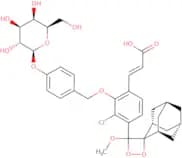
CAS:<p>AquaSpark® beta-D-galactoside, 10 mM in DMSO is a fluorogenic substrate for beta-galactosidase. This is typically used at 10 – 50 µM final concentration. Cymit Quimica provides AquaSpark® beta-D-galactoside as a 10 mM stock solution in dimethyl sulfoxide (DMSO) for convenience and improved storage stability.</p>Fórmula:C34H39ClO12Pureza:Min. 95%Peso molecular:675.12 g/molAquaSpark® 510 Peroxide Probe, 10 mM in DMSO, Ramot at Tel-Aviv University Ltd. Patent family WO 2017/130191
CAS:AquaSpark® Peroxide Probe is a dioxetane-based substrate for the luminescence detection of hydrogen peroxide and other peroxides in biological samples. AquaSpark® Peroxide Probe is the most sensitive probe for H2O2 detection available. It is also an extremely versatile probe for oxidase detection applicable in a wide range of biocompatible buffers. For example it can be used for glucose oxidase detection andfor the quantitation of glucose levels (when coupled to the glucoseoxidase activity in an assay). In addition, AquaSpark® Peroxide Probe is used for the quantification of other biologically relevant compounds(e.g. amino acids) using the corresponding peroxide releasing oxidases.Fórmula:C34H40BClO8Peso molecular:622.95 g/molResorufin acetate
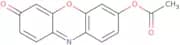
CAS:<p>Resorufin acetate is a fluorogenic substrate for esterase activity measurments in lipid metabolism studies. It is also used as a substrate for chymotrypsin, a digestive enzyme produced by the pancreas that aids in protein digestion in the small intestine.</p>Fórmula:C14H9NO4Pureza:Min. 95%Forma y color:PowderPeso molecular:255.23 g/mol8-Hydroxyquinoline b-D-galactopyranoside
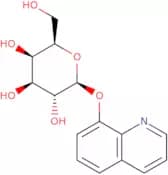
CAS:<p>Chromogenic substrate targeting the beta-galactosidase enzyme</p>Fórmula:C15H17NO6Pureza:Min. 98 Area-%Forma y color:PowderPeso molecular:307.3 g/molAcetyl coenzyme A trilithium salt trihydrate
CAS:Acetyl coenzyme A trilithium salt trihydrate (ATC) is a glutathione-dependent enzyme that catalyzes the acetylation of compounds with a thiol group. Acetyl coenzyme A trilithium salt trihydrate has been shown to acetylate recombinant human and hek293 cells as well as xenobiotic compounds such as acetaminophen, chlorzoxazone, and phenacetin. The rate of acetylation depends on the concentration of glutathione and the availability of the substrate. There is no evidence that ATC conjugates or transfers acetyllysine to other proteins. It is excreted in the urine after being expressed by recombinant human and hek293 cells.END>Fórmula:C23H35N7O17P3S·3Li·3H2OPureza:Min. 95%Forma y color:White PowderPeso molecular:881.42 g/molDisodium 1-Naphthyl Phosphate Hydrate [Substrate for Phosphatase]
CAS:Fórmula:C10H7Na2O4P·xH2OPureza:97.0 to 103.0 %(calcd.on anh.substance)Forma y color:White to Light yellow to Light red powder to crystalPeso molecular:268.12 (as Anhydrous)Azoic Diazo Component 24 (Salt) [for Biochemical Research]
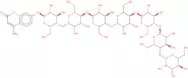
CAS:Fórmula:C30H28Cl2N6O6·ZnCl2Pureza:>95.0%(T)Forma y color:Yellow to Brown to Dark green powder to crystalPeso molecular:775.774-Methylumbelliferyl b-D-celloheptaoside
CAS:<p>A fluorogenic MOSCERDAM® substrate targeting cellulases</p>Pureza:Min. 95%Peso molecular:1,311.15 g/molAc-D-Cha-GR-aminoluciferin
<p>Ac-D-Cha-GR-aminoluciferin is a modified form of D-luciferin used as a luminescent enzyme substrate for protease. This modified substrate provides a longer light emission than normal luciferins, allowing their use in cell-based bioluminescence assays.</p>Fórmula:C30H41N9O6S2Peso molecular:687.83 g/molN-Benzoyl-DL-arginine 4-nitroanilide hydrochloride
CAS:<p>N-α-benzoyl-DL-arginine-4-nitroanilide hydrochloride is commonly used as a substrate in various enzymatic assays, particularly for studying proteases like trypsin and chymotrypsin. It serves as a synthetic substrate to measure the activity of these enzymes. For instance, it has been used to determine trypsin activity in different organisms and tissues. The substrate has also been employed in studying the enzymatic properties of various proteases, including those found in latex, snake venoms, and plant seeds. Additionally, it has been utilized to assess the effects of different compounds on trypsin activity, such as condensed tannins and wine.</p>Fórmula:C19H22N6O4•HClPureza:Min. 95%Forma y color:PowderPeso molecular:434.88 g/mol4-Methylumbelliferyl a-D-arabinopyranoside
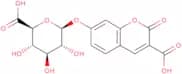
<p>A fluorogenic MOSCERDAM® substrate targeting alpha-arabinofuranosidase</p>Pureza:Min. 95%Peso molecular:308.28 g/mol3-Carboxyumbelliferyl b-D-glucuronide
CAS:<p>3-Carboxyumbelliferyl b-D-glucuronide serves as a highly sensitive fluorogenic substrate for detecting b-glucuronidase activity. Upon enzymatic cleavage, it generates a fluorescent product enabling easy and accurate monitoring of enzyme activity in various applications, such as diagnostics, drug discovery, and research.</p>Pureza:Min. 95%Forma y color:White to off-white solid.Peso molecular:382.28 g/molMethyl 4-methylumbelliferyl hexyl phosphonate
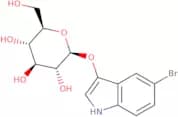
CAS:<p>Methyl 4-methylumbelliferyl hexyl phosphonate is a lipase suicide inhibitor that is a fluorogenic substrate for lipases which upon enzymatic action, binds irreversibly to the lipase and inactivates it. The substrate can be used for the determination of active sites in lipases and the fluorescent signal can be detected at Ex 363 nm and Em 465 nm.</p>Pureza:Min. 95%Peso molecular:338.345-Bromo-3-indolyl b-D-glucopyranoside
CAS:5-bromo-3-indolyl-b-d-glucopyranoside, also known as 5BIG, is an enzyme substrate for beta-glucosidase. It is used in bacterial assays for the identifcation of Gram-positive bacteria such as Staphylococcus aureus and Bacillus subtilis. After cleavege, it gives an intense blue color.Fórmula:C14H16BrNO6Pureza:Min. 98 Area-%Forma y color:PowderPeso molecular:374.18 g/mol





![Disodium 1-Naphthyl Phosphate Hydrate [Substrate for Phosphatase]](/_next/image/?url=https%3A%2Fstatic.cymitquimica.com%2Fproducts%2F3B%2Fthumb-webp%2FP0263.webp&w=3840&q=75)

![Azoic Diazo Component 24 (Salt) [for Biochemical Research]](/_next/image/?url=https%3A%2Fstatic.cymitquimica.com%2Fproducts%2F3B%2Fthumb-webp%2FB0785.webp&w=3840&q=75)