


Sustratos de enzimas
Los sustratos enzimáticos son moléculas sobre las cuales actúan las enzimas para catalizar reacciones químicas. El sustrato se une al sitio activo de la enzima, donde sufre una transformación específica para formar el producto de la reacción. Los sustratos enzimáticos son herramientas esenciales en la investigación para estudiar la cinética enzimática, la especificidad y el mecanismo de acción. También se utilizan en ensayos diagnósticos y estudios bioquímicos. En CymitQuimica, ofrecemos una selección diversa de sustratos enzimáticos de alta calidad para apoyar su investigación en enzimología y bioquímica.
Subcategorías de "Sustratos de enzimas"
Se han encontrado 1529 productos de "Sustratos de enzimas"
Ordenar por
Pureza (%)
0
100
|
0
|
50
|
90
|
95
|
100
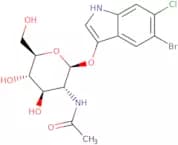
5-Bromo-6-chloro-3-indolyl 2-acetamido-2-deoxy-b-D-glucopyranoside
CAS:<p>5-Bromo-6-chloro-3-indolyl 2-acetamido-2-deoxy-b-D-glucopyranoside is a chromogenic substrate that yields a magenta-colored product after cleavage. The chromophore 5-bromo-6-chloro-indoxyl is released, generating the observable color. It is used in mucopolysaccharidosis screening.</p>Fórmula:C16H18BrClN2O6Pureza:Min. 97 Area-%Forma y color:PowderPeso molecular:449.68 g/mol4-Nitrophenyl 4,6-ethylidene-a-D-maltoheptaoside
CAS:<p>4-Nitrophenyl 4,6-ethylidene-?-D-maltoheptaoside is a substrate used in a reference measurement method for ?-amylase activity in the diagnosis of acute pancreatitis, approved by the International Federation of Clinical Chemistry (IFCC). The substrate is hydrolysed by serum ?-amylase into shorter 4-nitrophenylated oligosaccharides and their free counterparts. These reaction products are channeled into an indicator reaction with ?-glucosidase and are degraded into glucose and the chromophore, 4-nitrophenol.</p>Fórmula:C50H77NO38Pureza:Min. 90%Forma y color:Off-White Yellow PowderPeso molecular:1,300.13 g/mol3-Indolyl 2-acetamido-2-deoxy-b-D-galactopyranoside
<p>3-Indolyl 2-acetamido-2-deoxy-b-D-galactopyranoside is a fluorogenic substrate that reacts with the enzyme β-galactosidase to produce a blue product. This product can be used to diagnose the presence of β-galactosidase in culture media, as well as in food and environmental testing. 3IAG is also a chromogenic substrate that can be used for detection of β-galactosidase activity.</p>Pureza:Min. 95%Peso molecular:336.34 g/mol5-Bromo-4-chloro-3-indolyl myristate
CAS:5-Bromo-4-chloro-3-indolyl myristate is a chromogenic substrate used to detect the specific enzymatic activity of lipase or esterase. After cleavage, 5-bromo-4-chloro-indoxyl is released, resulting in a blue to blue-green color change in bacterial colonies or media. 5-Bromo-4-chloro-3-indolyl myristate is used in screening assays for pancreatic lipase deficiency and lipid metabolism studies.Fórmula:C22H31BrClNO2Pureza:Min. 95%Forma y color:PowderPeso molecular:456.84 g/mol5-Bromo-4-chloro-3-indoxyl-1,3-diacetate
CAS:<p>5-Bromo-4-chloro-3-indoxyl-1,3-diacetate (BCID) is a potent and selective inhibitor of the tyrosine kinase enzyme. BCID has been shown to inhibit the growth of various cell cultures in vitro including murine and human cells. BCID has been shown to be an effective inhibitor of TNF-α production in murine models for asthma and allergic rhinitis. The drug has also been shown to reversibly inhibit the activity of the enzyme without affecting its ability to bind substrate or to regenerate active enzyme form inactive enzyme, indicating that it does not act as a suicide inhibitor.</p>Fórmula:C12H9BrClNO3Pureza:Min. 98.0 Area-%Peso molecular:330.56 g/molRef: 3D-B-7120
5gA consultar10gA consultar25gA consultar100gA consultar250gA consultar-Unit-ggA consultar6-Chloro-3-indoxyl phosphate, p-toluidine salt
CAS:<p>A substrate for visualising alkaline phosphatase activity. Produces a red colored insoluble end product that is detected visually, when used together with nitroblue tetrazolium. The substrate system is versatile and functions in a variety of applications, including Northern, Southern, and Western blotting, in situ hybridization, ELISAs and immunohistochemistry. DMF soluble.</p>Fórmula:C15H16ClN2O4PPureza:Min. 98.0 Area-%Peso molecular:354.73 g/molAldol® 495 nonanoate solution, 0.75 M in DMSO, Biosynth Patent: EP 2427431 and US 8940909
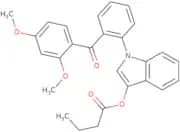
CAS:Producto controladoAldol® 495 nonanoate is a chromogenic and fluorogenic enzyme substrate used for detection of lipase activity. The colorless enzyme substrate is cleaved by C9 esterases, yielding development of an orange coloration. In addition, green fluorescence is generated when Aldol® 355 fluorescence enhancer or a suitable matrix is present. Aldol® 495 nonanoate can be used in enzyme assays and live bacterial cultures. Aldol® 495 nonanoate is suitable for use in liquid and solid media, under aerobic as well as anaerobic conditions.Fórmula:C29H31ClN2O3Pureza:Of Solute (Hplc) 95.0 To 100.0 Area-%Peso molecular:491.02 g/molAldol® 470 butyrate, Biosynth Patent: EP 2427431 and US 8940909
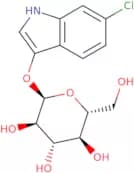
CAS:Producto controladoAldol 470 butyrate is a chromogenic substrate for the enzyme aldolase. It can be used in diagnostics, food testing and culture media. Aldol 470 butyrate has been shown to be useful in detecting the presence of a number of different substances, including alcohols, organic acids, ketones, amines and amino acids. Aldol 470 butyrate is also an excellent ligand for determination of protein-ligand interactions. The conjugation of this product with other molecules provides an excellent tool for chemiluminescence assays. This product is also used as a fluorogenic substrate in environmental testing.Fórmula:C27H25NO5Pureza:Min. 95.0 Area-%Peso molecular:443.5 g/mol6-Chloro-3-indoxyl-α-D-glucopyranoside
CAS:Chromogenic substrate for α-glucosidase yielding a salmon-colored precipitate.Fórmula:C14H16ClNO6Pureza:Min. 98 Area-%Peso molecular:329.74 g/molAldol® 458 nonanoate solution, 0.75 M in DMSO, Biosynth Patent: EP 2427431 and US 8940909
CAS:Producto controladoAldol 458 nonanoate solution is a high quality, enzyme substrate that can be used for a number of applications. It has been shown to be an excellent chromogenic substrate, bioluminescence, ligand and chemiluminescence. Aldol 458 nonanoate solution has also been used for the detection of staining and diagnostics. The compound is a conjugate with an excellent binding affinity to proteins. This product can be used in food testing, culture media, fluorogenic substrate and environmental testing. CAS No. 2484873-15-4Fórmula:C25H29NO4Pureza:Of Solute (Hplc) 98.0 To 100.0 Area-%Peso molecular:407.51 g/molAldol® 470 phosphate, disodium salt, Biosynth Patent: EP 2427431 and US 8940909
CAS:Aldol 470 phosphate is a chromogenic substrate for phosphatases yielding a yellow precipitate. Furthermore it shows some fluorescence (excitationat 320 nm to 490 nm). In contrast to classical indoxyl substrates, Aldolsubstrates work not only under aerobic but also under anaerobic conditions.Fórmula:C23H18NNa2O7PPureza:Min. 95.0 Area-%Peso molecular:497.34 g/molbeta-Mannachrome
<p>Beta-mannachrome is a chemical compound with the formula of CHN(CH)CO. It is a colorless solid that has been used for staining, as a ligand in coordination chemistry and as a biological substrate for chemiluminescence. Beta-mannachrome is used in diagnostics and as an enzyme substrate in various biochemical reactions.<br><br>Beta-Mannachrome is an organic compound that can be synthesized from benzaldehyde and mannitol. It is also found in nature, where it is produced by the fungus Cladosporium cladosporioides. Beta-Mannachrome reacts with hydrogen peroxide to produce light through chemiluminescence. The light produced by this reaction can be measured using a luminometer or other optical instruments to determine the concentration of beta-Mannachrome present.<br><br>The CAS number of beta-Mannachrome is 619-96-8 and its molecular weight is 134.17</p>Pureza:Min. 95%Tyramine
CAS:<p>Tyramine targets peroxidase to form a brown color</p>Fórmula:C8H11NOForma y color:Off-White Slightly Brown PowderPeso molecular:137.18 g/mol2-(2-Thiazolylazo)-p-cresol
CAS:2-(2-Thiazolylazo)-p-cresol structure enables it to form complexes with certain metal ions, changing color in the process. This color change is highly useful in titrimetric analyses (quantitative chemical analysis method) to determine the concentration of metal ions in a solution. The substrates are colored orange-yellow (absorbance maximum= 375 nm). After the enzymatic conversion, the resulting TAC shows an intense, soluble red-violet color (544 nm) in an alkaline medium (pH = 10.3).Fórmula:C10H9N3OSPureza:Min. 96 Area-%Forma y color:Yellow To Orange Brown SolidPeso molecular:219.26 g/mol2,2'-Azino-bis(3-ethylbenzothiazoline-6-sulfonic acid) diammonium salt
CAS:ABTS can be used as a peroxidase substrate that gives a metastable cation when in the presence of H2O2. 2,2'-Azino-bis (3-ethylbenzothiazoline-6-sulfonic acid) or ABTS is commonly used in the enzyme-linked immunosorbent assay (ELISA). ABTS is chosen because the enzyme facilitates the reaction to give a green end-product with an absorbance maximum of 420nm and can therefore be detected with a spectrophotometer.Fórmula:C18H24N6O6S4Pureza:Min. 98.0 Area-%Forma y color:PowderPeso molecular:548.68 g/molResorufin N-acetyl-b-D-galactosamine
<p>Resorufin N-acetyl-b-D-galactosamine is a fluorogenic substrate used as a probe to detect and quantify the activity of N-acetyl-beta-D-galactosaminidase (also known as beta-hexosaminidase or HEX(NAG)). Particularly useful in biomedical research, clinical chemistry, and diagnostics, when the substrate is cleaved, the highly fluorescent resorufin dye is produced that can be detected at approximately 598 nm.</p>Pureza:Min. 95%Forma y color:PowderPeso molecular:416.38 g/molFast blue B salt
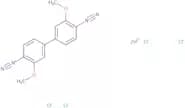
CAS:<p>For visualizing enzymatic activity</p>Fórmula:C14H12N4O2Cl2·ZnCl2Forma y color:PowderPeso molecular:475.46 g/mol3-(2'-Spiroadamantane)-4-methoxy-4-(3''-phosphoryloxy)phenyl-1,2-dioxetane
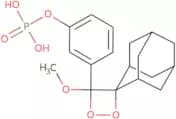
CAS:<p>As an alternative to commonly used colorimetric and fluorescent substrates, 3-(2'-Spiroadamantane)-4-methoxy-4-(3''-phosphoryloxy)phenyl-1,2-dioxetane, abbreviated AMPPD, is a chemiluminescent substrate for alkaline phosphatase (ALP). It allows detection of alkaline phosphatase at a high sensitivity. Literature reports that the co-presence of 0.1% bovine serum albumin (BSA) leads to a signal increase of 10-folds under selected conditions.</p>Fórmula:C18H23O7PPureza:Min. 95%Forma y color:PowderPeso molecular:382.34 g/mol[2-(2-Thiazolylazo)-4-cresyl]phosphate, p-toluidine sal
<p>2-(2-Thiazolylazo)-4-cresyl]phosphate, p-toluidine salt is a chromogenic substrate for alkaline phosphatase resulting in a dark red color.</p>Pureza:Min. 95%[2-(2-Thiazolylazo)-4-cresyl]-β-D-galactopyranoside
CAS:<p>Please enquire for more information about [2-(2-Thiazolylazo)-4-cresyl]-β-D-galactopyranoside including the price, delivery time and more detailed product information at the technical inquiry form on this page</p>Fórmula:C16H19N3SO6Pureza:Min. 95%Forma y color:PowderPeso molecular:381.41 g/mol






![[2-(2-Thiazolylazo)-4-cresyl]phosphate, p-toluidine sal](/_next/image/?url=https%3A%2Fstatic.cymitquimica.com%2Fproducts%2F3D%2Fthumb-webp%2FFT172196.webp&w=3840&q=75)
![[2-(2-Thiazolylazo)-4-cresyl]-β-D-galactopyranoside](/_next/image/?url=https%3A%2Fstatic.cymitquimica.com%2Fproducts%2F3D%2Fthumb-webp%2FFT172198.webp&w=3840&q=75)