Sustratos de enzimas
Los sustratos enzimáticos son moléculas sobre las cuales actúan las enzimas para catalizar reacciones químicas. El sustrato se une al sitio activo de la enzima, donde sufre una transformación específica para formar el producto de la reacción. Los sustratos enzimáticos son herramientas esenciales en la investigación para estudiar la cinética enzimática, la especificidad y el mecanismo de acción. También se utilizan en ensayos diagnósticos y estudios bioquímicos. En CymitQuimica, ofrecemos una selección diversa de sustratos enzimáticos de alta calidad para apoyar su investigación en enzimología y bioquímica.
Subcategorías de "Sustratos de enzimas"
Se han encontrado 1528 productos de "Sustratos de enzimas"
Ordenar por
Pureza (%)
0
100
|
0
|
50
|
90
|
95
|
100
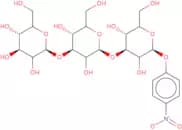
4-Nitrophenyl b-laminaritrioside
CAS:4-Nitrophenyl b-laminaritrioside is a chemiluminescent substrate that reacts with hydrogen peroxide to produce light. It is used in the detection of bacteria and other microorganisms in culture media, food testing, and diagnostics. 4-Nitrophenyl b-laminaritrioside is also used as a chromogenic or fluorogenic substrate in enzyme assays.Pureza:Min. 95%Peso molecular:625.53 g/molAldol® 484 β-D-galactopyranoside, Biosynth Patent: EP 2427431 and US 8940909
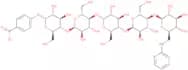
CAS:Aldol® 484 beta-D-galactopyranoside is a chromogenic enzyme substrate for beta-galactosidase activity. The colorless product is cleaved by lactose-utilizing bacteria in liquid or solid media, yielding intense red color. Aldol® 484 beta-D-galacto-pyranoside can also be used in beta-gal reporter gene assays or for identification of beta-gal positive transformants on agar. Aldol® 484 beta-D-galactopyranoside can be used under aerobic and anaerobic conditions.Fórmula:C26H24ClFN2O7Pureza:Min. 95.0 Area-%Peso molecular:530.93 g/mol4-Nitrophenyl 6'-deoxy-6'-(2-pyridylamino)-a-D-penta-(1-4)-glucopyranoside
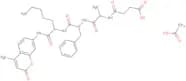
CAS:<p>4-Nitrophenyl 6'-deoxy-6'-(2-pyridylamino)-a-D-penta-(1-4)-glucopyranoside is a fluorescent substrate for the enzyme beta glucosidase. It is a chemiluminescent reagent that can be used to measure beta glucosidase activity. The substrate is an excellent high quality chemical and has been tested for environmental safety, heavy metal content and staining. 4-Nitrophenyl 6'-deoxy-6'-(2-pyridylamino)-a-D-penta-(1-4)-glucopyranoside is a chromogenic substrate that can be used in diagnostic testing, such as bioluminescence or fluorogenic assay. This product can also be used as a culture media additive or food testing agent.</p>Pureza:Min. 95%Peso molecular:1,025.91 g/molN-Succinyl-Ala-Phe-Lys 7-amido-4-methylcumarin acetate (salt)
CAS:Producto controlado<p>Fluorogenic substrate targeting plasmin</p>Fórmula:C34H43N5O10Pureza:Min. 95%Peso molecular:681.7 g/mol2-Chloro-4-nitrophenyl 2,3,4,6-tetra-O-acetyl-b-D-glucopyranoside
CAS:<p>2-Chloro-4-nitrophenyl 2,3,4,6-tetra-O-acetyl-b-D-glucopyranoside is a chromogenic enzyme substrate used in the biochemical characterization of various enzymes. It produces a yellow color when cleaved by enzymes and is commonly used in assays to study enzyme kinetics and activity. It is commonly used is used to study the biochemical and physiological effects of glycosylation and acts as a substrate for glycosylation-dependent enzymes involved in carbohydrate metabolism. Glycosidases hydrolyse 2-Chloro-4-nitrophenyl-2,3,4,6-tetra-O-acetyl-beta-D-glucopyranoside, releasing 2-chloro-4-nitrophenyl moiety, and the substrate can then be further metabolized by other enzymes. It is also used in the investigate the effects and activity on glycoproteins and glycolipids.</p>Pureza:Min. 95%Peso molecular:503.84 g/molBoc-Val-Pro-Arg-AquaSpark®, Ramot at Tel-Aviv University Ltd. Patent family WO 2017/130191
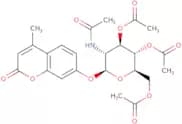
CAS:<p>Targets Factor C substrate and peptidase</p>Fórmula:C49H66ClN7O11Pureza:Min. 85 Area-%Peso molecular:964.56 g/mol4-Methylumbelliferyl 2-acetamido-3,4,6-tri-O-acetyl-2-deoxy-b-D-glucopyranoside
CAS:<p>4-Methylumbelliferyl 2-acetamido-3,4,6-tri-O-acetyl-2-deoxy--bDglucopyranoside is a compound that has been shown to interact with glutamicum and casein kinase. It is also a test compound for corynebacterium glutamicum and interacts with it by functional theory. The compound has been shown to inhibit inflammatory diseases and may be used as a potential treatment for these diseases.</p>Pureza:Min. 95%Peso molecular:505.47 g/mol4-Methylumbelliferyl 2-acetamido-2-deoxy-3,6-di-O-pivaloyl-b-D-galactopyranoside
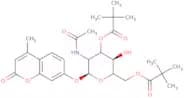
CAS:4-Methylumbelliferyl 2-acetamido-2-deoxy-3,6-di-O-pivaloyl-b-D-galactopyranoside is a chemiluminescent substrate that reacts with an enzyme to produce light. It is used in the detection of ATPase activity and in the diagnosis of diseases. This product has been tested for quality and environmental safety, and it does not contain any hazardous substances. It is highly pure and can be used for testing food, diagnosing diseases, or staining cells.Pureza:Min. 95%Peso molecular:547.59 g/mol4-Methylumbelliferyl b-D-chitobiose heptaacetate
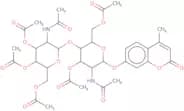
CAS:<p>4-Methylumbelliferyl b-D-chitobiose heptaacetate is a fluorogenic substrate that is widely used in diagnostic and research applications. It can be used as a substrate for enzymes such as alkaline phosphatase, β-glucuronidase, β-galactosidase, β-glucosidase, α-amylase, α-glucosidase, α-mannosidase, and α-fucosidase. 4MUBH can also be used in the detection of bacterial growth. 4MUBH reacts with NADPH to produce light through chemiluminescence. This product has been shown to have a high purity and quality and should not be stored in UV light or strong acids. CAS No. 55900-34-0</p>Pureza:Min. 95%Peso molecular:792.74 g/mol4-Methylumbelliferyl 2-acetamido-3,4,6-tri-O-acetyl-2-deoxy-b-D-galactopyranoside
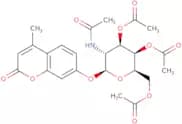
CAS:<p>4-Methylumbelliferyl 2-acetamido-3,4,6-tri-O-acetyl-2-deoxy-b-D-galactopyranoside is a fluorescent marker that is used to measure the enzymatic activity of corynebacterium glutamicum. The enzyme catalyzes the conversion of 4-methylumbelliferyl glucopyranoside to 4-methylumbelliferone glucuronide. The production of 4 methylumbelliferone glucuronide can be quantified using fluorescence spectroscopy. This product can be used in research involving chronic inflammatory diseases and cancer.</p>Pureza:Min. 95%Peso molecular:505.47 g/molOstazin brilliant red H-3B hydroxyethylcellulose
<p>Ostazin brilliant red H-3B hydroxyethylcellulose is a chromogenic enzyme substrate that produces a bright red color upon reaction with specific enzymes. This substrate is particularly useful for the detection and visualization of enzyme activity in histochemical and cytochemical staining techniques. The vibrant red color produced by the reaction allows for easy observation and analysis of enzyme distribution and localization in cells and tissues. Ostazin brilliant red H-3B hydroxyethylcellulose is often used in combination with other substrates to study the presence and activity of multiple enzymes simultaneously, providing valuable insights into the complex interactions and functions of enzymes in biological systems.</p>Pureza:Min. 95%Aldol® 467 β-D-galactopyranoside, Biosynth Patent: EP 2427431 and US 8940909
CAS:<p>Aldol® 467 beta-D-galactopyranoside is a chromogenic and fluorogenic enzyme substrate used for detection of beta-galactosidase activity. The colorless product is cleaved by lactose-utilizing bacteria grown in liquid or solid media, yielding yellow coloration and green fluorescence. Aldol® 467 beta-D-galactopyranoside can also be used in beta-galactosidase gene reporter assays or immunoassay applications (ELISA). Aldol® 467 beta-D-galactopyranoside can be used under aerobic and anaerobic conditions.</p>Fórmula:C29H28ClNO9Pureza:Min. 95.0 Area-%Peso molecular:570 g/mol4-Nitrophenyl b-D-celloheptaoside
CAS:Chromogenic substrate targeting cellulasePureza:Min. 95%Peso molecular:1,274.09 g/mol4-Nitrophenyl 2-O-(2,3,4,6-tetra-O-acetyl-b-D-glucopyranosyl)-4,6-O-benzylidene-b-D-glucopyranoside
CAS:<p>4-Nitrophenyl 2-O-(2,3,4,6-tetra-O-acetyl-b-D-glucopyranosyl)-4,6-O-benzylidene-b-D-glucopyranoside is a compound that is used in gene expression profiling. It has been shown to be an effective inhibitor of glutamicum and corynebacterium glutamicum. 4NPBG can inhibit the production of acid molecules by blocking the activity of cytochrome P450 enzymes in the cells of these bacteria. The compound also inhibits cellular transport and membrane transport genes in these species. This inhibition prevents the synthesis of nucleic acid molecules such as RNA and DNA.</p>Pureza:Min. 95%Peso molecular:719.64 g/mol4-Nitrophenyl 2-acetamido-2-deoxy-3-O-(2,3,4,6-tetra-O-acetyl-β-D-galactopyranosyl)-α-D-galactopyranoside
CAS:4-Nitrophenyl 2-acetamido-2-deoxy-3-O-(2,3,4,6-tetra-O-acetyl-β-D-galactopyranosyl)-α-D-galactopyranoside is a chemiluminescent substrate that has been used in the detection of bacterial activity. It is used in the detection of bacterial activity through chemiluminescence and can be conjugated to an enzyme or protein for increased sensitivity. This product has been shown to have high purity and quality and is suitable for use in diagnostic applications.Fórmula:C28H36N2O17Pureza:Min. 95%Forma y color:PowderPeso molecular:672.59 g/mol4-Methylumbelliferyl b-D-gentiotrioside
CAS:<p>4-Methylumbelliferyl beta-D-gentiotrioside is a fluorogenic substrate for beta-glucosidase. After enzymatic cleaveage, free 4-methylumbelliferone (also known as hymecromone) is released, exhibiting blue fluorescence upon excitation with UV light. The strongest fluorescence of 4-methylumbelliferone requires deprotonation of the hydroxyl group (thus requires alkaline pH), with a maximal fluorescence intensity obtained with excitation at 350 to 370 nm and emission at 440 to 470 nm. The use of 4-methylumbelliferyl beta-D-gentiotriosideas a substrate for measuring the beta-glucosidase activity is used for Gaucher disease screening.</p>Fórmula:C28H38O18Pureza:Min. 98 Area-%Forma y color:PowderPeso molecular:662.59 g/mol5-Bromo-4-chloro-3-indoxyl sulfate p-toluidine salt
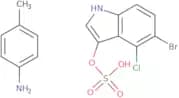
CAS:<p>5-Bromo-4-chloro-3-indoxyl sulfate p-toluidine salt is a staining agent used for the detection of glucose in urine and tissues. It is also an enzyme substrate that can be used to detect the presence of lipases, amylases, esterases, phosphatases, and proteases. This product has a CAS number of 6581-23-3 and comes in high quality.</p>Pureza:Min. 95%Peso molecular:433.71 g/mol4-Nitrophenyl 2-azido-2-deoxy-a-D-galactopyranoside
CAS:<p>4-Nitrophenyl 2-azido-2-deoxy-a-D-galactopyranoside is a superior chromogenic substrate for the precise determination of alpha-D-galactosidase enzyme activity. This substrate features a unique 2-azido moiety providing enhanced sensitivity and specificity in biochemical assays. Upon enzymatic cleavage, it releases the highly fluorescent compound 4-nitrophenol, which simplifies quantification and tracking of enzyme activity in applications such as drug discovery, genetic studies, and enzyme inhibition assays.</p>Pureza:Min. 95%Forma y color:White PowderPeso molecular:326.26 g/molLuc-phosphate Na enhanced
<p>Luc-phosphate Na enhanced is a chemiluminescent substrate for enzyme-linked immunosorbent assay (ELISA) and other immunoassays. It has been shown to have high purity, high quality, and good stability. Luc-phosphate Na enhanced has not been tested for toxicity in animals or humans. Luc-phosphate Na enhanced is a conjugated substrate that can be used in ELISA, where the enzyme substrate will react with the antigen in a sample to produce light. This product can also be used in diagnostic tests and in food testing.</p>Pureza:Min. 95%4-Methylumbelliferyl-phosphoethanolamine
<p>4-Methylumbelliferyl-phosphoethanolamine is a phosphorylated substrate that can be used in the detection of enzymes such as alkaline phosphatase, esterase, and lipase. This compound has been shown to be a fluorescent and chromogenic substrate for many diagnostic purposes. 4-Methylumbelliferyl-phosphoethanolamine is also used as a fluorogenic substrate for chemiluminescent reactions that are found in culture media and environmental testing.</p>Pureza:Min. 95%