Sustratos de enzimas
Los sustratos enzimáticos son moléculas sobre las cuales actúan las enzimas para catalizar reacciones químicas. El sustrato se une al sitio activo de la enzima, donde sufre una transformación específica para formar el producto de la reacción. Los sustratos enzimáticos son herramientas esenciales en la investigación para estudiar la cinética enzimática, la especificidad y el mecanismo de acción. También se utilizan en ensayos diagnósticos y estudios bioquímicos. En CymitQuimica, ofrecemos una selección diversa de sustratos enzimáticos de alta calidad para apoyar su investigación en enzimología y bioquímica.
Subcategorías de "Sustratos de enzimas"
Se han encontrado 1527 productos de "Sustratos de enzimas"
Ordenar por
Pureza (%)
0
100
|
0
|
50
|
90
|
95
|
100
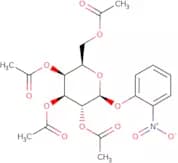
2-Nitrophenyl 2,3,4,6-tetra-O-acetyl-b-D-galactopyranoside
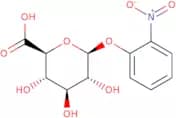
CAS:<p>2-Nitrophenyl 2,3,4,6-tetra-O-acetyl-b-D-galactopyranoside is a fluorescent substrate for β-galactosidase. It is used in food testing, environmental testing and diagnostics. This substrate is also used to detect the presence of β-galactosidase activity in cells and tissues.<br>2NPTABG provides a fluorescence signal that can be detected with an ultraviolet light or a luminometer. The luminescence intensity decreases when it reacts with β-galactosidase enzyme.<br>This product has a CAS number of 3053-17-6 and is available at high purity levels.</p>Pureza:Min. 95%Peso molecular:469.4 g/mol2-Nitrophenyl b-D-glucuronide
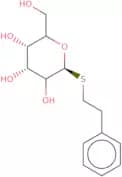
CAS:<p>2-Nitrophenyl-b-D-glucuronide is a chromogenic substrate used to detect the activity of beta-glucuronidase in various biological samples. Upon hydrolysis by the enzyme, the substrate releases 2-nitrophenol, which can be spectrophotometrically measured at 405 nm. The substrate is commonly used in clinical assays to evaluate liver and kidney function, as well as in drug metabolism studies. It is also used in environmental monitoring to assess the presence of microbial activity in soil and water samples. Overall, 2-Nitrophenyl-b-D-glucuronide is a widely used substrate with excellent sensitivity and specificity, making it a valuable tool in enzymology research and diagnostic testing.</p>Pureza:Min. 95%Forma y color:Off-white solid.Peso molecular:315.23 g/molPhenylethyl b-D-thioglucopyranoside
<p>Phenylethyl b-D-thioglucopyranoside is a modification of the sugar molecule. It is an oligosaccharide that can be synthesized from a complex carbohydrate. Phenylethyl b-D-thioglucopyranoside is a high purity product that can be custom synthesized with high purity and CAS No. It also has methylation, glycosylation, and polysaccharide properties. The product's chemical structure can be modified in order to change the properties of this substance. This product is fluorinated or saccharified.</p>Pureza:Min. 95%Forma y color:Light (Or Pale) Yellow SolidPeso molecular:300.37 g/molResorufin maltotriose
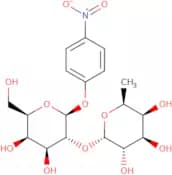
<p>Resorufin maltotriose is an alpha-amylase substrate that releases the dye resorufin with red emission (lmax=585 nm) after enzyme reaction.</p>Fórmula:C30H47NO18Pureza:Min. 95%Peso molecular:709.69 g/mol4-Nitrophenyl 2-O-(α-L-fucopyranosyl)-β-D-galactopyranoside
CAS:<p>4-Nitrophenyl 2-O-(α-L-fucopyranosyl)-β-D-galactopyranoside is a chromogenic enzymatic substrate for the detection and quantification of glycosidases, such as fucosidases and galactosidases. Upon enzymatic cleavage, the substrate releases the p-nitrophenol chromophore, which can be quantified via colorimetric analysis. This pNP-conjugated compound enables the rapid, sensitive, and high-throughput detection of enzyme activity in various applications, including enzymatic assays, inhibitor screening, and mechanistic studies. Its precise specificity for α-L-fucopyranosyl and β-D-galactopyranoside moieties makes it an excellent tool for advancing research in glycobiology and related fields.</p>Fórmula:C18H25NO12Pureza:Min. 95%Forma y color:White Off-White PowderPeso molecular:447.39 g/molD-Luciferin-6-O b-D-glucopyranoside
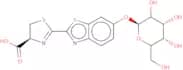
<p>Chemiluminescent substrate for beta-D-glucosidase</p>Pureza:Min. 95%Peso molecular:442.47 g/mol(2-Aminophthalylhydrazido) 2-acetamido-2-deoxy-b-D-glucopyranoside
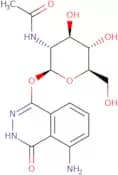
CAS:<p>2-Aminophthalylhydrazido 2-acetamido-2-deoxy-b-D-glucopyranoside is a chromogenic substrate that is used as a diagnostic in biological research. It reacts with enzymes to form fluorescent products, and can be used to detect the presence of bacteria and fungi. This product has a CAS number of 128879-80-1 and can be used for food testing, environmental testing, or bioluminescence. It is an important component in the development of new antibiotics.</p>Fórmula:C16H20N4O7Pureza:Min. 95%Peso molecular:380.35 g/mol4-Methylumbelliferyl-b-D-cellobiose heptaacetate
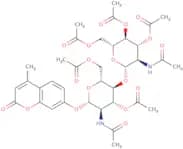
CAS:<p>4-Methylumbelliferyl-beta-D-cellobioside heptaacetate is a fluorogenic substrate for beta-D-glucosidase and can be used to detect this enzyme in the presence of other glycosidases. It is also used as a chromogenic substrate for beta-galactosidase, alpha-mannosidase, alpha-fucosidase, and alpha-N-acetylgalactosaminidase. 4MMB Cellobiose Haptaacetate is a conjugate that can be used to measure the activity of beta-glucuronidase and beta-xylosidase. This product is suitable for use in diagnostics, ligands, food testing, environmental testing, and culture media.</p>Pureza:Min. 95%Peso molecular:794.71 g/mol5-Octanoylaminofluoroscein di-b-D-glactopyranoside
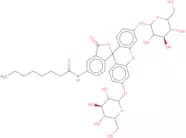
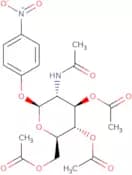
<p>5-Octanoylaminofluoroscein di-b-D-glactopyranoside is a chemiluminescent substrate that can be used for the detection of peroxidase activity. It is a bifunctional substrate, which means it has two reactive groups: one at the 5 position and one at the 8 position. The 5-octanoylaminofluorescein reacts with hydrogen peroxide in a 1:1 ratio, emitting light at 490 nm. The 8-position amine reacts with 2,2'-azino-bis(3-ethylbenzthiazoline)6 sulphonic acid (ABTS) to produce an orange color product that acts as a chromogen. The substrate can be used in diagnostics, food testing, and enzyme substrates.</p>Pureza:Min. 95%Peso molecular:797.8 g/mol4-Nitrophenyl 2-acetamido-3,4,6-tri-O-acetyl-2-deoxy-b-D-glucopyranoside
CAS:<p>4-Nitrophenyl 2-acetamido-3,4,6-tri-O-acetyl-2-deoxy-b-D-glucopyranoside is an extracellular nucleic acid molecule that is produced by the bacterium Corynebacterium glutamicum. This compound has been shown to inhibit cancer cells by blocking the transport of glucose through the cell membrane and may be a potential drug target for cancer treatment. 4NPTAPG has also been shown to have diagnostic properties and can identify corynebacterium glutamicum strains. It is a fluorescent molecule that can be used to detect the presence of this bacterium in culture media.</p>Pureza:Min. 95%Peso molecular:468.41 g/molH-Pro-Arg-4mbna
CAS:<p>H-Pro-Arg-4mbna is a chromogenic substrate that is specifically cleaved by trypsin, a serine protease involved in protein digestion, and thrombin, that cleave peptide bonds. Upon hydrolysis, the bond between the proline and arginine is cleaved, releasing 4MβNA. This leads to a colorimetric change that can be detected spectrophotometrically. This substrate is commonly used in the study of trypsin activity, as well as in the development of assays for the diagnosis and monitoring of pancreatic diseases, such as pancreatitis and cystic fibrosis, which are associated with trypsin dysfunction.</p>Fórmula:C22H30N6O3Pureza:Min. 95%Peso molecular:426.5 g/mol4-Methylumbelliferyl a-L-idopyranoside
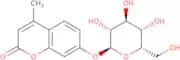
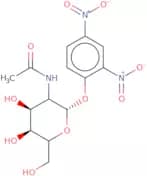
CAS:<p>4-Methylumbelliferyl alpha-L-idopyranoside is a fluorogenic substrate for alpha-L-iduronidase. After enzymatic cleaveage, free 4-methylumbelliferone (also known as hymecromone) is released, exhibiting blue fluorescence upon excitation with UV light. The strongest fluorescence of 4-methylumbelliferone requires deprotonation of the hydroxyl group (thus requires alkaline pH), with a maximal fluorescence intensity obtained with excitation at 350 to 370 nm and emission at 440 to 470 nm. The use of 4-methylumbelliferyl alpha-L-idopyranosideas a substrate for measuring the alpha-L-iduronidase activity is used for Mucopolysaccharidosis I diagnosis and Hurler syndrome screening.</p>Fórmula:C16H18O8Pureza:Min. 98 Area-%Forma y color:White PowderPeso molecular:338.31 g/mol2,4-Dinitrophenyl 2-acetamido-2-deoxy-b-D-glucopyranoside
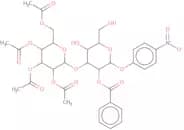
<p>2,4-Dinitrophenyl 2-acetamido-2-deoxy-b-D-glucopyranoside is a fluorogenic substrate for use in diagnostic testing. It reacts with the enzyme β -galactosidase to produce a blue color. This product is used as an indicator of β -galactosidase activity in bacterial cultures or as an indicator of the presence of this enzyme in food or other materials. It can be used to detect and measure the level of β -galactosidase in a sample. The reaction can be monitored by measuring light emission at 450 nm.<br>2,4-Dinitrophenyl 2 acetamido 2 deoxy b D glucopyranoside has a CAS number of 47868-87-0 and is available in high purity (>97%).</p>Pureza:Min. 95%Peso molecular:387.31 g/mol4-Nitrophenyl 3-O-(2,3,4,6-tetra-O-acetyl-a-D-mannopyranosyl)-2-O-benzoyl-a-D-mannopyranoside
CAS:<p>4-Nitrophenyl 2,3,4,6-tetra-O-acetyl-b-D-glucopyranoside enzyme substrate is a versatile and reliable reagent for measuring glucosidase activity. It is an ideal substrate for use in assays to detect β-glucosidase activity in a variety of applications, including for in vitro and in vivo studies, and it has been widely used in the pharmaceutical and biotechnology industries. This chromogenic pNP enzyme substrate is designed for effective and precise analysis with good sensitivity and low background signals.</p>Pureza:Min. 95%Peso molecular:735.64 g/mol2-Nitrophenyl 2-acetamido-2-deoxy-a-D-galactopyranoside
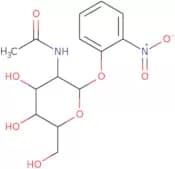
CAS:<p>2-Nitrophenyl 2-acetamido-2-deoxy-a-D-galactopyranoside is a fluorogenic substrate that is used in enzyme assays. It can be used as a chromogenic substrate or conjugate with an enzyme to detect the presence of glucose.</p>Pureza:Min. 95%Peso molecular:342.3 g/mol2-Nitrophenyl 2-acetamido-2-deoxy-b-D-galactopyranoside
CAS:<p>2-Nitrophenyl 2-acetamido-2-deoxy-b-D-galactopyranoside is a carboxymethyl derivative of the natural substrate of β-galactosidase, which is used as a substrate for the production of recombinant proteins in the corynebacterium glutamicum. The enzyme β-galactosidase hydrolyzes this substrate to produce an acid molecule and a sugar molecule. This product can be used in biotechnological processes for the production of recombinant proteins or other bioactive molecules. It can also be used in the isolation of nucleic acid from bacteria or fungi, or to study bacterial membrane transport systems. 2NPGAG can be expressed as a recombinant protein with expression vectors such as pET21a and pET24a. It has been shown that this product inhibits transport through membranes by binding to cellulose, which may be useful for studies on cellulose biosynthesis</p>Pureza:Min. 95%Peso molecular:342.3 g/mol3-Indolyl b-D-cellotetraoside
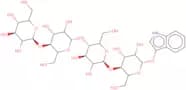
3-Indolyl b-D-cellotetraoside is a chemiluminescent substrate that is used as an indicator in the detection of aminoglycosides. The ligand is a cell wall component that has been shown to bind specifically to the active site of bacterial β-lactamases, which are enzymes that catalyze the hydrolysis of β-lactam antibiotics. 3-Indolyl b-D-cellotetraoside can be used for bacterial identification and enumeration, food testing, and enzyme substrate for diagnostics. It fluoresces in response to electron excitation with a wavelength of about 590 nm.Pureza:Min. 95%Peso molecular:781.71 g/mol4-Nitrophenyl phosphate bis(tris) salt
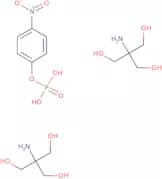
CAS:<p>Substrate for alkaline phosphatase</p>Fórmula:C6H6NO6P•(C4H11NO3)2Pureza:(%) Min. 99%Forma y color:PowderPeso molecular:461.36 g/mol4-Nitrophenyl 2-O-(a-D-glucopyranosyl)-a-D-glucopyranoside
CAS:<p>4-Nitrophenyl 2-O-(α-D-glucopyranosyl)-α-D-glucopyranoside is a specialized chromogenic pNP substrate featuring dual glucose-linked moieties, designed for accurate detection and quantification of specific glycosidase enzymes. Upon cleavage by target enzymes, this substrate releases 4-Nitrophenol, which can be easily monitored spectrophotometrically as a yellow color change. This advanced substrate offers enhanced specificity and sensitivity in enzyme assays, facilitating cutting-edge research in biochemistry, enzymology, and other related fields.</p>Pureza:Min. 95%Peso molecular:463.39 g/mol2-Nitrophenyl 2,3,4-tri-O-acetyl-b-D-glucuronide methyl ester
CAS:<p>2-Nitrophenyl-2,3,4-tri-O-acetyl-b-D-glucuronide methyl ester is a tri-O-acetylated glucuronide substrate commonly used in chromogenic assays to detect the activity of beta-glucuronidase. Upon hydrolysis by the enzyme, the substrate releases 2-nitrophenol, which can be spectrophotometrically. The substrate is widely used in diagnostic tests to assess bacterial and fungal infections, as well as in drug metabolism studies.</p>Pureza:Min. 95%Peso molecular:455.37 g/mol