Sustratos de enzimas
Los sustratos enzimáticos son moléculas sobre las cuales actúan las enzimas para catalizar reacciones químicas. El sustrato se une al sitio activo de la enzima, donde sufre una transformación específica para formar el producto de la reacción. Los sustratos enzimáticos son herramientas esenciales en la investigación para estudiar la cinética enzimática, la especificidad y el mecanismo de acción. También se utilizan en ensayos diagnósticos y estudios bioquímicos. En CymitQuimica, ofrecemos una selección diversa de sustratos enzimáticos de alta calidad para apoyar su investigación en enzimología y bioquímica.
Subcategorías de "Sustratos de enzimas"
Se han encontrado 1527 productos de "Sustratos de enzimas"
Ordenar por
Pureza (%)
0
100
|
0
|
50
|
90
|
95
|
100
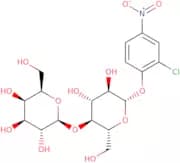
2-Chloro-4-nitrophenyl b-D-lactoside
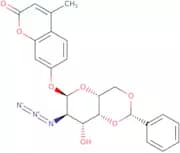
CAS:<p>2-Chloro-4-nitrophenyl b-D-galactopyranoside is a chromogenic enzyme substrate used to study the activity of beta-lactoside. It produces a yellow color when cleaved by the enzyme, making it a useful tool in enzyme assays and screening experiments.</p>Pureza:Min. 95%Forma y color:PowderPeso molecular:497.83 g/mol4-Methylumbelliferyl 2-azido-2-deoxy-4,6-O-phenylmethylene-a-D-galactopyranoside
CAS:<p>4-Methylumbelliferyl 2-azido-2-deoxy-4,6-O-phenylmethylene-a-D-galactopyranoside is a fluorogenic substrate that reacts with beta D galactosidase to produce light. This product is useful for diagnostics, conjugate production, and other applications. 4MUF 2 -Gal provides a convenient means of detecting beta D galactosidase activity in cell culture media and can be used as a chromogenic substrate for the detection of enzymes involved in glycosylation reactions. It is also used to detect staining by bioluminescence. The compound can be used in food testing and environmental testing to measure the presence of beta D galactosidase.</p>Fórmula:C23H21N3O7Pureza:Min. 95%Peso molecular:451.43 g/mol2,4-Dinitrophenyl b-D-cellobioside
CAS:<p>2,4-Dinitrophenyl b-D-cellobioside is a chemiluminescent substrate that is used to detect the activity of enzymes and other proteins. It can be conjugated with an antibody or other ligand for use in diagnostic purposes. 2,4-DNPBC is a pure compound with a high quality that does not contain any other impurities. Its CAS number is 157956-96-2.</p>Pureza:Min. 95%2-Chloro-4-nitrophenyl 2-acetamido-2-deoxy-a-D-glucopyranoside
<p>L-2-Chloro-4-nitrophenyl 2-acetamido-2-deoxy-a-D-glucopyranoside is a chemiluminescent substrate for the detection of aminoglycoside antibiotics. It can be used to determine the concentration of aminoglycosides in blood, urine, and serum. The chemiluminescence reaction is dependent on the presence of oxygen. This product has been shown to have a high quality and purity with environmental testing and staining properties. L-2-Chloro-4-nitrophenyl 2-acetamido-2-deoxy--a--D--glucopyranoside has also been shown to bind ligands such as porphyrins, bilirubin, or hemin with bioluminescence or chromogenic substrates in diagnostics or culture media for food testing. L--2--Chloro--4--</p>Pureza:Min. 95%4-Nitrophenyl 3,4,6-tri-O-acetyl-b-D-galactopyranoside
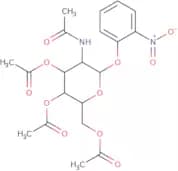
CAS:4-Nitrophenyl 3,4,6-tri-O-acetyl-b-D-galactopyranoside is a nucleic acid molecule that has been synthesized by recombinant expression in Corynebacterium glutamicum. It is a photosynthetic molecule and can be used to study the molecular basis of photosynthesis. The 4-nitrophenyl group on the sugar moiety confers resistance to degradation by nucleases. 4NP3,4,6GalAc has been shown to be capable of binding to proteins and polypeptides that are important for photosynthesis. This compound also has marginalizing effects on C. glutamicum strains that are used as expression vectors for recombinant protein production.Pureza:Min. 95%Peso molecular:427.36 g/mol2-Nitrophenyl 2-acetamido-3,4,6-tri-O-acetyl-2-deoxy-b-D-galactopyranoside
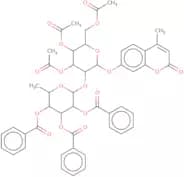
CAS:<p>2-Nitrophenyl 2-acetamido-3,4,6-tri-O-acetyl-2-deoxy-b-D-galactopyranoside is a chemiluminescent substrate for the detection of beta galactosidase. It is a white to light yellow powder with a molecular weight of 564.87 and an assay of ≥ 98% by HPLC. This product has been shown to be stable when stored at 4°C for up to three months.</p>Pureza:Min. 95%Peso molecular:468.41 g/mol4-Methylumbelliferyl 3,4,6-tri-O-acetyl-2-O-(2,3,4-tri-O-benzoyl-a-L-fucopyranosyl)-b-D-galactopyranoside
<p>4-Methylumbelliferyl 3,4,6-tri-O-acetyl-2-O-(2,3,4-tri-O-benzoyl-a-L-fucopyranosyl)-b-D-galactopyranoside is a fluorogenic substrate that is used for the detection of β D -galactosidase. β D -Galactosidase is an enzyme that breaks down lactose in milk and is used as a diagnostic tool for identifying lactose intolerance. This substrate can be used as a conjugate in immunoassays to detect antibodies against the enzyme or it can be used to measure the activity of the enzyme in food samples. It also can be used to measure α1,3 galactosyltransferase activity in colorectal cancer cells or bacteria.</p>Pureza:Min. 95%Peso molecular:922.9 g/mol4-Nitrophenyl 2-acetamido-4-O-(2-acetamido-3,4,6-tri-O-acetyl-2-deoxy-b-D-glucopyranosyl)-3,6-di-O-acetyl-2-deoxy-b-D-glucopyranosid e
CAS:<p>4-Nitrophenyl 2-acetamido-4-O-(2-acetamido-3,4,6-tri-O-acetyl-2-deoxy-b-D-glucopyranosyl)-3,6-di-O -acetyl2 deoxy b D glucopyranosid e is a chemiluminescence substrate that reacts with hydrogen peroxide to produce light. It is used in diagnostics for the detection of bacterial and fungal cultures. The reaction between 4NPAA and hydrogen peroxide generates light at 540 nm. This product has been tested for purity and quality using various methods including culture media, environmental testing, bioluminescence, staining, fluorogenic substrate, enzyme substrate, food testing and conjugate.</p>Pureza:Min. 95%Peso molecular:755.68 g/molPhenylethyl 2-acetamido-2-deoxy-b-D-glucopyranoside
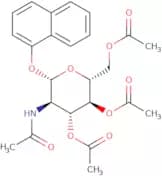
CAS:<p>Phenylethyl 2-acetamido-2-deoxy-b-D-glucopyranoside can be used to inhibit the growth of bacteria, yeast, and fungi. It is a yellow powder that has been shown to cause regression in tumor xenografts in mice. Phenylethyl 2-acetamido-2-deoxy-b-D-glucopyranoside inhibits cellular proliferation by blocking the synthesis of proteins and nucleic acids. This compound also has been shown to have an effect on the environment because it inhibits the growth of phytoplankton. Phenylethyl 2-acetamido-2-deoxy-b-D-glucopyranoside was found to disrupt bacterial gene expression profiles, which may be due to its ability to inhibit protein synthesis at the ribosome level.</p>Pureza:Min. 95%Peso molecular:325.36 g/mol1-Naphthyl 2-acetamido-3,4,6-tri-O-acetyl-2-deoxy-b-D-glucopyranoside
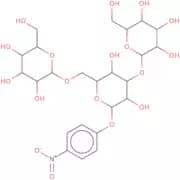
CAS:<p>1-Naphthyl 2-acetamido-3,4,6-tri-O-acetyl-2-deoxy-b-D-glucopyranoside is a fluorogenic substrate for bacterial beta D glucosidase. It is used for measuring the enzyme activity in different types of culture media and in the detection of bacterial contamination in food and environmental samples. This product can be used to detect the presence of beta D glucosidase by measuring luminescence with a luminometer. 1NAAG can also be used as a chromogenic substrate or to conjugate with antibodies for use in immunoassays.br></p>Pureza:Min. 95%Peso molecular:473.47 g/mol4-Nitrophenyl 3,6-di-O-(a-D-mannopyranosyl)-b-D-mannopyranoside
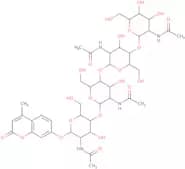
<p>4-Nitrophenyl 3,6-di-O-(a-D-mannopyranosyl)-b-D-mannopyranoside is a chemiluminescent substrate that is used in the detection of enzymes. It is also used to measure the activity of beta-glucosidase, alpha-galactosidase, and alkaline phosphatase. The product has been tested for environmental sensitivity and has not shown any effects on bacterial growth. 4-Nitrophenyl 3,6-di-O-(a-D-mannopyranosyl)-b-D-mannopyranoside can be used as a high quality stain for histological sections and immunohistochemical studies. This product has been tested for staining properties with different dyes and has shown no interference with the staining process.</p>Pureza:Min. 95%Peso molecular:625.53 g/mol4-Methylumbelliferyl N,N',N'',N'''-tetraacetyl-b-D-chitotetraoside
CAS:<p>4-Methylumbelliferyl N,N',N'',N'''-tetraacetyl-beta-D-chitotetraoside is a fluorogenic substrate for chitinase. After enzymatic cleaveage, free 4-methylumbelliferone (also known as hymecromone) is released, exhibiting blue fluorescence upon excitation with UV light. The strongest fluorescence of 4-methylumbelliferone requires deprotonation of the hydroxyl group (thus requires alkaline pH), with a maximal fluorescence intensity obtained with excitation at 350 to 370 nm and emission at 440 to 470 nm. The use of 4-methylumbelliferyl N,N',N'',N'''-tetraacetyl-beta-D-chitotetraosideas a substrate for measuring the chitinase activity is used for fungal infection detection and Gaucher disease screening.</p>Fórmula:C42H60N4O23Pureza:Min. 95%Forma y color:PowderPeso molecular:988.94 g/molLuciferin-caprylate
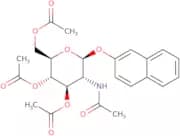
<p>Luciferin-caprylate is a substrate for chemiluminescence, which is the light produced by a chemical reaction. It has been shown to have high quality and environmental testing as well as being a ligand for bioluminescence. Luciferin-caprylate can be used for diagnostics in the areas of culture media, food testing, and enzyme substrate. This compound can also be used as a fluorogenic substrate or conjugate.</p>Pureza:Min. 95%2-Naphthyl 2-acetamido-3,4,6-tri-O-acetyl-2-deoxy-b-D-glucopyranoside
CAS:<p>2-Naphthyl 2-acetamido-3,4,6-tri-O-acetyl-2-deoxy-b-D-glucopyranoside is a fluorogenic substrate that is used in food testing as well as environmental testing. It has been shown to be a ligand for the enzyme beta-galactosidase. This product is also a chemiluminescent and bioluminescent substrate that can be used in diagnostics and culture media.</p>Pureza:Min. 95%Peso molecular:473.47 g/mol5-Bromo-4-chloro-3-indoxyl phosphate, p-toluidine salt - micronized
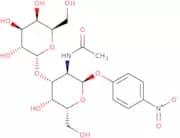
CAS:<p>5-Bromo-4-chloro-3-indoxyl phosphate, p-toluidine salt - micronized is a chemiluminescent substrate used in diagnostic assays. It is an enzyme substrate that is commonly used to detect peroxidase activity and has been shown to be effective in detecting various types of bacteria. This product is a high quality chemical with a purity of at least 98% and has been tested for environmental safety. 5-Bromo-4-chloro-3-indoxyl phosphate, p-toluidine salt - micronized can be used as a fluorogenic substrate for the detection of proteases and aminopeptidases.</p>Pureza:Min. 95%4-Nitrophenyl 2-acetamido-2-deoxy-3-O-(a-D-galactopyranosyl)-a-D-galactopyranoside
CAS:<p>4-Nitrophenyl 2-acetamido-2-deoxy-3-O-(a-D-galactopyranosyl)-a-D-galactopyranoside is a fluorescent substrate that can be used in chemiluminescent assays. It is a high purity, high quality chemical that has been tested for culture media, environmental testing and bioluminescence. This product is an excellent choice for use in diagnostics, chromogenic substrates, enzyme substrates and food testing.</p>Pureza:Min. 95%Peso molecular:504.44 g/mol4-Nitrophenyl b-D-thiomannopyranoside
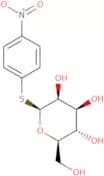
CAS:<p>4-Nitrophenyl b-D-thiomannopyranoside acts as a substrate for β-mannosidase and thioglycoligase. Upon enzymatic cleavage, these substrates release 4-nitrophenol, a yellow chromophore that can be detected spectrophotometrically at 405 nm, facilitating quantitative measurements of enzymatic activity. Consequently, these substrates are widely used in biochemical research, clinical diagnostics, and drug discovery for evaluating the function of specific enzymes in various biological processes.</p>Pureza:Min. 95%Peso molecular:317.32 g/mol2-Nitrophenyl 2,3-di-O-acetyl-4-O-triethylsilyl-b-D-xylopyranoside
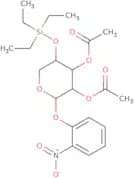
CAS:<p>2-Nitrophenyl 2,3-di-O-acetyl-4-O-triethylsilyl-b-D-xylopyranoside is a chromogenic substrate for enzmatic assays to measure xylosidase activity. It is a derivative of xylose that can be hydrolyzed by xylosidase to release the yellow-colored 2-nitrophenyl group, which can be detected spectrophotometrically. By modifying the xylose molecule with acetyl and triethylsilyl groups, the enzyme substrate becomes more stable and resistant to degradation. This substrate is commonly used in the study of plant biomass degradation and in the detection of xylosidase activity in microorganisms.</p>Pureza:Min. 95%Peso molecular:469.56 g/molBCIP disodium salt sesquihydrate
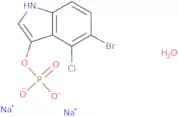
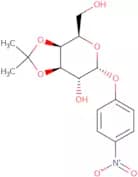
CAS:<p>BCIP is a dye that can be used as a substrate in a fluorometric assay to detect the presence of effector proteins. It is also used in analytical chemistry to detect phosphate, and as a reagent in diagnostic tests for mucin gene expression. BCIP has been shown to have transcriptional regulatory effects on genes encoding for proteins involved in antibody production. BCIP has been shown to act as an effector protein, which influences the amount of mRNA produced by the gene encoding for tissue culture cells. BCIP can also be used as a model system to study the regulation of transcription in vitro.<br>A hybridization technique using BCIP with DNA-dependent RNA polymerase II has been demonstrated and applied to analyze the mechanism of transcriptional control at the level of individual genes. The use of this technique allows for analysis at a single gene level and may allow for better understanding of transcriptional regulation.</p>Pureza:Min. 95%Peso molecular:388.45 g/mol4-Nitrophenyl 3,4-O-isopropylidene-a-D-galactopyranoside
CAS:<p>4-Nitrophenyl 3,4-O-isopropylidene-a-D-galactopyranoside is a chemiluminescent substrate for detecting beta-galactosidase activity in bacteria. This product is a high purity, high quality compound that can be used as a culture media and environmental testing agent. It has been shown to be effective in diagnostics, chromogenic substrate, and enzyme substrate reactions. 4NPPG has been shown to be a fluorogenic substrate for beta-galactosidase assay and can be used as food testing agent with conjugate.</p>Pureza:Min. 95%Peso molecular:341.31 g/mol