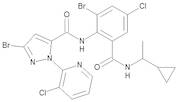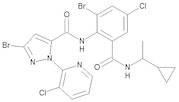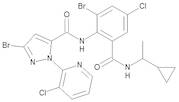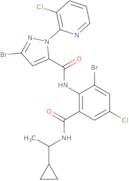
CAS 1031756-98-5
:Formule :C21H17Br2Cl2N5O2
InChI :InChI=1S/C21H17Br2Cl2N5O2/c1-10(11-4-5-11)27-20(31)13-7-12(24)8-14(22)18(13)28-21(32)16-9-17(23)29-30(16)19-15(25)3-2-6-26-19/h2-3,6-11H,4-5H2,1H3,(H,27,31)(H,28,32)
Code InChI :RAMUASXTSSXCMB-UHFFFAOYSA-N
SMILES :CC(C1CC1)NC(=O)C2=C(C(=CC(=C2)Cl)Br)NC(=O)C3=CC(=NN3C4=C(C=CC=N4)Cl)Br
Filtrer par
Pourcentage de pureté
0
100
|
0
|
50
|
90
|
95
|
100
7 produits trouvés.
- Tri par prix ascendant
- Tri par prix descendant
- Puretés inférieures
- Puretés supérieures
- Livraison estimée la plus rapide
Cyclaniliprole 100 µg/mL in Acetonitrile
CAS :Formule :C21H17Br2Cl2N5O2Couleur et forme :Single SolutionMasse moléculaire :602.11LC PestiMix 9 10 µg/mL in Acetonitrile
CAS :Produit contrôlé- 1003318-67-9
- 1031756-98-5
- 104273-71-4
- 105779-78-0
- 1072957-71-1
- 1101132-67-5
- 1207727-04-5
- 121451-02-3
- 1220411-29-9
- 1228284-64-7
- 1229654-66-3
- 123572-88-3
- 1255734-28-1
- 1263133-33-0
- 130561-48-7
- 135186-78-6
- 1352994-67-2
- 1383809-87-7
- 1390661-72-9
- 140163-89-9
- 1417782-03-6
- 1472649-01-6
- 147411-69-6
- 1486617-22-4
- 156963-66-5
- 158237-07-1
- 162320-67-4
- 168088-61-7
- 173662-97-0
- 188489-07-8
- 200509-41-7
- 221205-90-9
- 224049-04-1
- 238410-11-2
- 256412-89-2
- 283159-90-0
- 330459-31-9
- 337458-27-2
- 352010-68-5
- 366815-39-6
- 42835-25-6
- 447399-55-5
- 473278-76-1
- 473798-59-3
- 494793-67-8
- 500207-04-5
- 517875-34-2
- 56073-07-5
- 5836-29-3
- 68049-83-2
- 688046-61-9
- 704886-18-0
- 799247-52-2
- 81-81-2
- 81-82-3
- 81334-34-1
- 81777-95-9
- 82692-44-2
- 847749-37-5
- 850881-70-8
- 862588-11-2
- 874195-61-6
- 874967-67-6
- 875915-78-9
- 881685-58-1
- 882182-49-2
- 902760-40-1
- 907204-31-3
- 911499-62-2
- 915972-17-7
- 926914-55-8
- 943831-98-9
Couleur et forme :MixtureCyclaniliprole
CAS :Produit contrôléFormule :C21H17Br2Cl2N5O2Couleur et forme :NeatMasse moléculaire :602.11Cyclaniliprole
CAS :Cyclaniliprole is a novel insecticide that belongs to the group of neonicotinoids. It has shown high toxicity to insects, as well as synergistic effects with chlorantraniliprole. Cyclaniliprole has been found to be toxic for mammals in acute toxicity studies and is classified as moderately hazardous. The compound is not expected to have any adverse effects on plants or soil organisms, but may have some negative effects on aquatic organisms. Cyclaniliprole can be used against a broad spectrum of pests, such as aphids, leafhoppers, thrips, whiteflies, and mites.Formule :C21H17Br2Cl2N5O2Degré de pureté :Min. 95%Masse moléculaire :602.11 g/molCyclaniliprole
CAS :Cyclaniliprole is an insecticide and ryanodine receptor modulator, demonstrating higher selectivity for insect ryanodine receptors than for those in mammals. It is lethal to both larvae and adult stages of various agricultural pests. Cyclaniliprole exhibits broad-spectrum insecticidal activity against pests from the orders Lepidoptera, Thysanoptera, Diptera, Hemiptera, and Coleoptera.Formule :C21H17Br2Cl2N5O2Masse moléculaire :602.11